Jim van Os is a psychiatrist who knows understands the devastating consequences of the widespread stereotype of schizo diagnoses. He has been actively researching into relations between environment and diagnoses, especially early adverse experiences and how they relate to becoming diagnosed in later years, and involved in research leading to proposals that psychosis is not a discrete illness but a complex that arises on a continuum.
In this TEDx talk Jim van Os paints a picture of a typical scenario in which, typically a young person can get sucked into having slightly strange yet very common experiences of the type that most of us will have at some point, can become all important once they become interpreted as symptoms of a mystifying, debilitating and devastating brain disease.
He points out how this powerful consensus belief is the opposite of what is needed to support a person in recovering.
Instead Jim van Os suggests for us a different understanding – one built upon two or three decades of science and research into the relationship between adverse experiences in early years and coming to struggle and becoming diagnosed later in life.
Now, you don’t have to accept the idea set out here as some universal truth – nothing is – and I certainly don’t, there’s too much of an implication that all unusual experiences are “wrong” and “psychotic”, as he says”:
“Seeing signals in random noise is actually quite human so experiences of hyper meaning are quite common.”
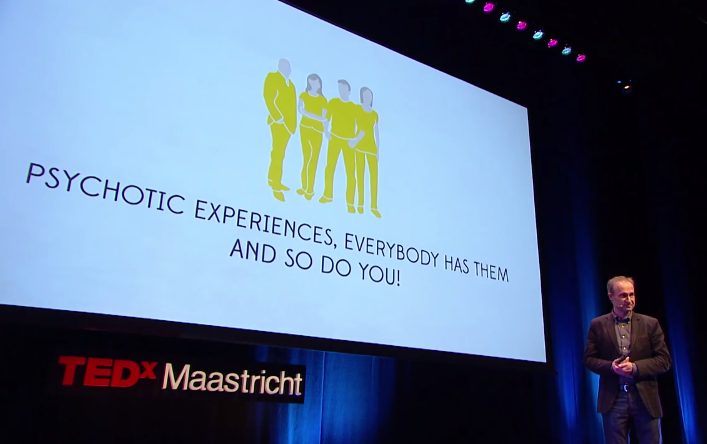
“Psychotic experiences, everybody has then and so do you”
That said what he offers us is both easy to understand and useful.
What is offered here is a way of understanding that is both much more compassionate and useful as a way to interpret what a person might be experiencing.
From there its not too hard for even the dumbest amongst us to understand and imagine that we need offer much broader approach than casting out and throwing meds at people who are already struggling.
It is a classic case of the hyper-meaning of which Jim van Os speaks that such commonplace experiences tend to get diagnosed as first episode psychosis for people going through life-changing and transformational years teens to late twenties.
Jim van Os introduces us to one approach his team is working on that aims to use technology to put information and power into the hands of young people, placing them at the beginning and the centre of taking charge of their own their experience when the world takes a strange turn for them .
After an intro that gives rise to puzzlement and more than a few in the audience wondering where he’s going and squirming in their seats…
“So, maybe some of you start to worry a little bit about my mental health, maybe afterwards you want to take me to the local hospital for a psychiatric assessment.
Now, lets imagine that I tell the psychiatrist that apart from these thoughts I am also hearing voices and that I haven’t been functioning very well for the last six months.
By this I will meet, likely criteria for one of these, so called, schizo diagnoses

Lets say I meet criteria for schizophrenia which is the prototypical diagnostic formulation for madness.
Now, my family will be notified of this diagnosis, and since they don’t know what it is they will start looking on the internet. And they look in the most prestigious scientific journals and they find that I have a devastating genetic brain disease or a debilitating neurological disorder.
So now they start being really worried…
…and they start looking for information about my likely prognosis and they find that my prognosis is bad:
I am totally disabled for the remainder of my lifetime.
Wow!
That’s scary isn’t it?
But you will note that that there is nothing in this terminology that actually allows them to understand what is the matter with me.
The information presented is disconnected from anything that we can understand as a mental function.
What is offered is a stereotype consisting of three things…
1. A mystifying greek name
2. An unproven hypothesis of a genetic brain disease and
3. A hopeless view of outcome.
Next Jim introduces us to his cousin who completed two university studies and who is “witty and compassionate, quite unlike me”, they both ended up in psychiatry, he as Psychiatrist, she as patient.
She worked very hard at her recovery for fifteen years, numerous hospitalisations various treatments and various diagnoses, when she was offered a job, when her employer tried to fire her because of the diagnosis but found they couldn’t, she was forced to disclose her diagnosis and many people refused to work with her.
Five years later she has an exemplary employment record, yet because of the extremely negative expectations associated with psychosis, diagnosed persons continue to face difficult time.
So why to I tell you this?
These are conditions that typically start in adolescence .
There is widespread consensus that in order to recover from psychosis you need a perspective of hope and possibility to change.
And I think it is clear that the concept or the stereotype of psychosis is devoid of exactly that- of possibility for hope and change.
Jim van Os then goes on to outline a different way of understanding what we call psychosis- one actually based in research and that, based in understanding that for many people such experiences can be traced back to adverse experiences in early years, and that opens up options for treatment that are more hopeful and that put the individual in the centre of learning to master and change their own experience.
Psychotic experiences, everybody has them and so do you.
Psychosis as experiencing
hypermeaning

Throughout the day we are exposed to stimulii that we hear, see, taste, feel,
and smell.
Our brain helps us to translate these data into an image of the surrounding world.
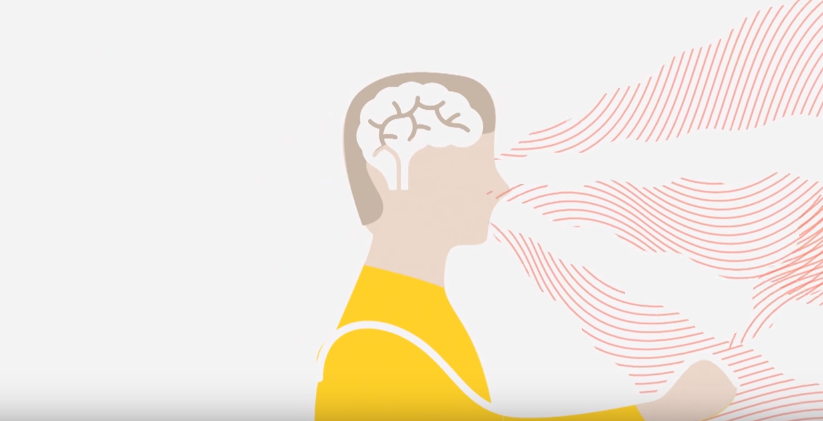
In other words we translate external sensory information from our environment into an internal mental experience.
Sensory translations are highly personal .

For example, two people are walking through the woods…
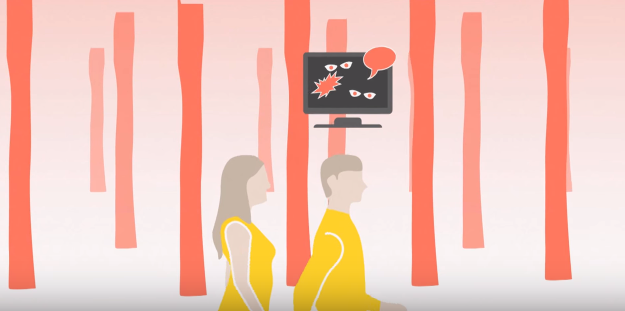
one has been watching a violent horror film earlier

whereas the other did not.
As a result, the one hears rather different things compared with the other.

This is because powerful negative emotions occasioned by the film distort the person’s interpretation of sensory perception.
One could say therefore that this person is experiencing a mild psychotic episode.
Childhood adversities, cannabis use, genetic factors can influence negative interpretation.
This may cause you to feel that the world is full of threats, for example you may start thinking that you are being stalked or that people on TV are talking about you. Such ways of thinking are called “delusions”.
You may also interpret your inner mental processes, for example your thoughts may become so overpowering that you interpret them as external voices or visions. These experiences are called “hallucinations”.
If perceptions of inner thoughts or external environments become psychotic it’s possible to learn, with help, how to modify these. This is a learning process that many people with psychotic symptoms find profitable.
So do you notice the difference from the presentation of the schizophrenia stereotype?
Yet this is what science suggests psychosis is really about.
There are four important points of difference here.
1. what is psychosis?
2. what is the role of the brain?
3. what is the role of genes?
4.. what IS the prognosis of psychosis?
Psychosis is about what you could call “hyper-meaning”. Sometimes we attach too much meaning to the external environment.
Seeing signals in random noise is actually quite human so experiences of hyper meaning are quite common – think about being madly in love or madly worried that the one you love is being unfaithful…
or seeing a face in the dark.
Actually thirty percent of the general population will admit to having had one or more psychotic experiences, things like hearing voices or seeing things, mind reading, thought broadcasting, having special powers, low level, mild but still the same all the things that are hallmark of psychosis.

So I want you to look at the person n your left, and then look at the person on your right.
If its not them, its you.
This is not to say that the brain is not important. The brain is very important. But it is like learning language. The brain provides us with the biological capacity to acquire speech but it is the early environment that programs this capacity so that we speak Chinese, English, French, Dutch.
And it’s the same with psychosis, the brain provides us with the biological capacity to have mental experiences in the first place but it is the environment that can program this capacity towards psychotic modes of thinking.
People growing up in circumstances of childhood trauma or un-safety or extreme exclusion have a higher risk of developing psychotic symptoms.
This because these environments can program our thinking towards the formation of psychotic symptoms.
Genes do play a role – genetic factors are important but their role is not nearly as dominant or as specific as is portrayed. And importantly, genes may act in ways that are complimentary to the environment by making people more or less sensitive to the environments that cause psychosis.
And with regard to outcome…this is a minority.
Some people indeed with psychotic symptoms have a very severe illness and very poor prognosis but this the is is a minority.
There’s also people with diagnosis of schizophrenia who find complete recovery . between these two extremes is a wide spectrum of variation.
In fact extreme variation is the rule.
The notion of extremely uniform poor outcome is a myth.
Psychosis is something that varies from day to day
even from moment to moment within a day .
…and it is capturing this dynamic pattern of variation in response to environment and emotions that is key to treatment.

So, if psychosis is all about variation – varying from day to day, even varying during the day – in response to the environment and emotions a remarkable opportunity presents itself..to diagnose psychosis at the level of experience itself in such a way that it becomes the first step towards treatment without a need to invoke the scary schizo labels.
and since young people are well versed in technology, why not use technology to empower them to track and monitor their experiences themselves so that they can gain insights
To this end our group developed a simple mobile app., that allows people to use their phone to monitor their mental states in daily life, feeding that info back to them so that they can learn and cope.
At random moments during the day app asks user to input information: emotions, thoughts, context, activities.
With this information, patterns of vulnerability and resilience can be made visible . people then have access to their patterns of experiences of hyper meaning as they evolve in the flow of daily life in response to emotions and environment, allowing them to understand what is going on and allowing them to develop better ways of coping.
In clinical practice we find this works very well, particularly with people in the early stages of psychosis.
So where does this leave us ?
Well today [the event] is about reaching the impossible. I think it is in fact much simpler.
I think that nothing stands in our way to make today the first day that we can all feel connected to psychosis because it is all a question of perception.
When we see a person with psychosis we can, with a little effort, and information and in particularly education, we can not see the stereotype of a devastating brain disease
but instead see a person who is struggling with the way we attach meaning to the external and the external environments.
And this is sometimes a difficult and a painful process
but we are all experts.
http://tedxtalks.ted.com/video/Connecting-to-Madness-|-Jim-van/player?layout=&read_more=1