
Note:
If you’re looking for training on “how to deescalate anyone in three easy steps”
then you’ll not find it here.
However, if you are looking for opportunity to both examine the orthodoxy and trenchant mental models that underpin and restrict our thinking and acting, and how we design and operate services in way that all to often are experienced by those who rely on them as dehumanizing, oppressive, and traumatizing; and that lead us to believe that is our only option; and if you believe that “we can do better – and we must,” then this may a good place to start.
UN_ESCALATE: Aim
The overall aim of this workshop is that participants are better able to reduce the number and impact of situations in which those seeking support from services experience that in ways they find dehumanizing, degrading and oppressive.
Why “UN_ESCALATE” ?
Recent times have made yet more visible the extent to which those who have been pushed out to the margins of society are stressed, beyond their “zone of tolerance” for the way they find themselves treated: the way services deem is the best they can expect.
Workers in services equally feel stressed, and struggle to reconcile best supporting those who come to them and the demands of the organization they work in.
When most stressed we tend to default mode: we download language of “escalation”, “de-escalation”; we heap expectation on staff to be experts in “deescalating” those we deem to be “escalating” and in-need-of “de-escalation”. Behaviour interpreted as aggressive is responded to with yet more aggression and authoritarianism: sometimes overt, more often pernicious yet equally injurious.
“The system” is not failing: it produces the results it was designed to produce. Services are all too often experienced by those who find they need to access for support in meeting needs as injurious, traumatizing and oppressive. Meanwhile service organizations espouse values of “anti-oppression” and “trauma informed”.
Models of “de-escalation” are typically used in trainings are typically rooted in war studies.
So, are we waging (yet another) war ?
Or are we seeking to the needs of those who have been most marginalized- cast out – from society in ways that can support (re)connecting, learning, and healing ?
Q. How can we begin to question current practices and habits – and the underlying assumptions they are both built upon and limited by ?
Q How might we begin to build approaches and practices at individual, team, and organization levels that are rooted not in fear, authoritarianism, containment, compliance and control but in connecting, and learning, and healing?
Q. How might we build a different approach to working through difficult situations that rely less on more authoritarianism, control, coercion, and compliance and instead focus on building relationships that can enable and support healing ?
REGISTRATION
Q. So, why is it not called “de-escalate“?
UN_ESCALATE | the workshop…
And why its not just another “de-escalation training” ?
UN_ESCALATE is about much more than what to do in a situation where a person seeking services behaves in a way that gets interpreted as “escalating”, and as someone deemed to be “in-need-of-‘de-escalating’; and tools and techniques “techniques” workers can use to “de-escalate them”.
Those seeking support from services and those who work in them, especially in front line services are stressed too.
These situations are on the rise and in each instance, it comes down to two individuals both of whom are enmeshed in complex systems.

Escalation as a dynamic
None of us can escalate all by ourselves.
the only person we can “de-escalate” is ourselves.
“Escalation” is not a thing that one person does all by themselves, and “de-escalation” is not what them.
Both are caught up in a complex dynamic situation we can understand as “escalation”.
We are each shaped by our experiences in life, and as we move forward we are shaped differently by our different experiences of life.
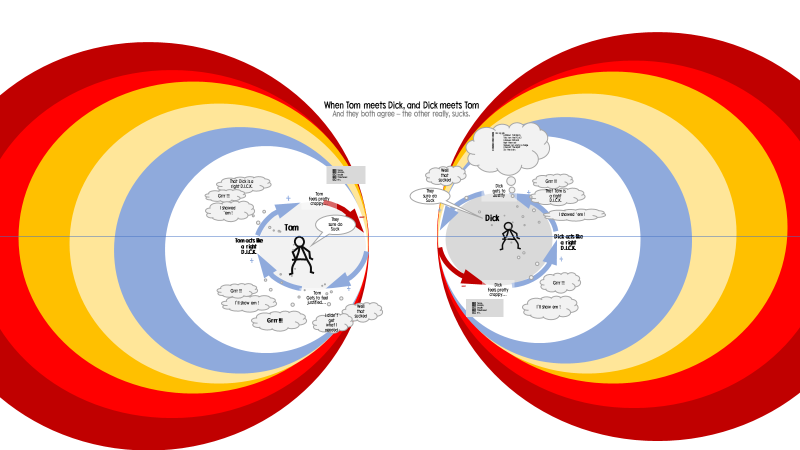
We are enmeshed in complex systems that shape our experiences, condition how we respond, shape our experience in the world and shape our behaviour in any moment, especially those where we feel stressed, and overwhelmed.
Trauma-Organized Systems
First, if we’re using the T-word, it is important to set out that UN_ESCALATE is rooted in an understanding that trauma is not what we’ve come to think it is.
Trauma is not an event – nor a whole series of ongoing, unending events.
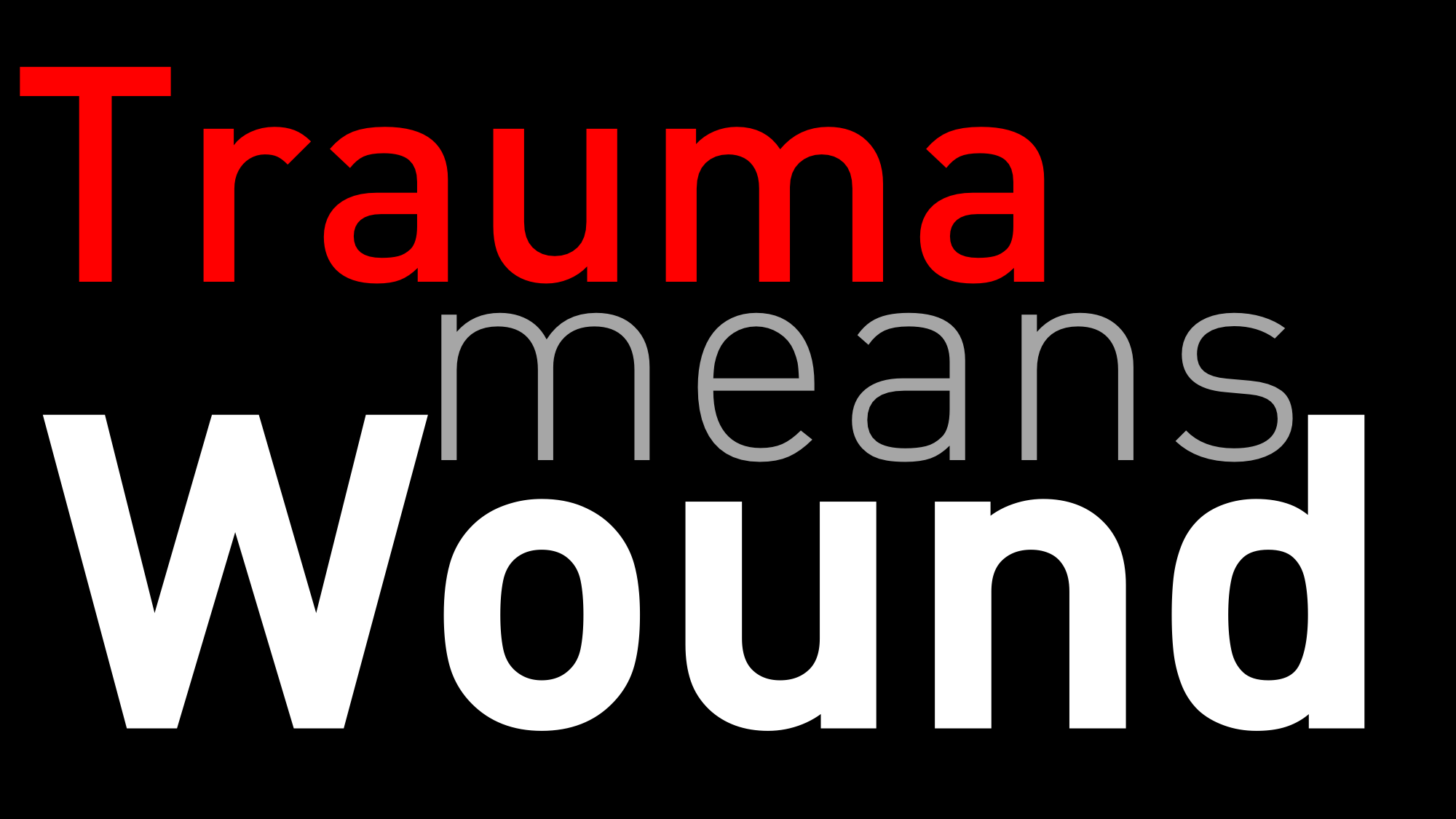
Trauma means wound. And life can be very wounding, indeed. Trauma is not at all hard to understand.
Trauma is not in the past: trauma is now – the wounds we live with now, today. and that resulting from the way we experience what we experience and the way we did not get the support we needed in order to not be left wounded.
Trauma can affect any and all aspect our lives – in all kinds of ways : indeed, there is no aspect of life that cannot be affected.
Trauma is an experience – fundamentally, the experience of having been wounded being left feeling disconnected from ourselves, disconnected our whole being, from our [whole] body, and left feeling disconnected from ourselves disconnected from others, and dis-empowered.
We feel left alone to survive and stuck in patterns that seem to rule our lives, make life difficult, painful. Patterns of feeling, thinking, and behaving that kept us alive also start to wreak havoc with our relationships, health and entire lives. We are separating us further from
So too, our society, institutions, service organizations and workplaces are also similarly shaped. And we can – if we allow ourselves to see it – understand how many of our institutions are rooted in unhealed trauma that is centuries – at least – old.
Just as an individual can hold onto patterns they can recognize, deep-down, as ultimately damaging and yet also feel powerless to change, the same also is true for the organizations we build and uphold.
The vast majority of those who come to services have experienced very difficult lives, and often since even before they emerged from their mother’s womb.
Then on, living a life of having been marginalised, even expelled from society compounds that and makes lie harder than can be imagined by those of us who have been fortunate enough to escape that.
The pain of living life in such a way means living with immeasurable inestimable pain.
Then being expected to contain that pain, and to put up with the many ways we can be treated leads to yet more pain.
And pain shapes us: like nothing else can shape us.
Yet, also, many of those working in services have also experienced difficulties, often of the same kind of adverse life circumstances as clients, have or do live with pain and are also shaped by that pain.
It also is true though, and important to acknowledge, that if we have been able to find ourselves working in services then we have had some good fortune, some support, some advantage or advantages that went at least some way in enabling us to get to that place, and that those who find themselves having to rely on services to meet their basic needs did not, and have yet to.
“People are punished or being in pain and for expressing their pain.
No matter how hard we might find our own lives to be less than rosy, we may not have experienced the kind of difficulties that others, and especially those needing support from services people find themselves in
life circumstances in which people seeking support find themselves are hard to endure, and then on top of that they must also endure being treated the way they can be treated and then expected to endure that too: daily, often many times a day.
Such life experiences also offer limited opportunities to learn different ways we can respond in such difficult situations, instead we learn to survive in a world of pervasive, insidious and sometimes even overt, unadulterated, and unvarnished ultraviolence.
We can easily be, or become blinded to the advantages we have had, to learn, or the support from family members, friends, or community, the advantages we have had in learning how to navigate such situations.
When we are thrust to the margins of society such opportunities are rare and also we need to adapt to the violence we will face many times each day, and we will need to learn other ways.
US and THEM-ism

We can lapse into what in the language of UN_ESCALATE we call US-and-THEM-ism: unconscious, unaware patterns of separation and fragmentation, where we divide the whole of humanity US and THEM.
We are good at this, we could even say it is what we do best. We have created, and create more all the time, endless variations, categories we use to separate others from us.
We come to see an individual, -or whole groups – as “not us”, not-like-us”, we categorize them thus, and then treat them differently: as less than us, as ‘less worthy’, ‘less human’, even ‘not worthy’, ‘not human’.
And then we blame them, and we blame them for leaving us feeling uncomfortable around them.
And then we blame them for behaving in ways that “act out” how they don’t like being treated the way they get treated.
Now, we could view this as feedback, information that something ain’t right, something is amiss, wrong even, with the system in which we are all enmeshed.
We tend not to though: a huge, collective societal, blind spot means we tend default to a collective, defensive, trauma-conditioned response.
We are shaped to interpret things as being their fault, a non compliance [on their part that needs to be judged, and corrected [by us].
When a person then behaves in a way that leaves us feeling uncomfortable we might then interpret that as “aggressiveness”, even intentionally so, and requiring correction of some sort.
And we might respond with “counter-aggressiveness”.
Then we might say that they need to be “de-escalated” – by “us”.
Yet, in truth, any “escalation”, such as it is, actually started way, way, way before that, even centuries ago.

…and is deeply embedded in unquestioned beliefs, attitudes, ways-of-doing, orthodoxies, and power relations. And of which is unconscious, unquestioned and un-interrogated.
We might call this “systemic escalation” as [usually] no one actor sets out to escalate but every actors in the system plays some part in creating the effect.
Unaware participation in systems of oppression

Q. How could we..
participate in systems of oppression?
Well, we tend to assume participation is always by some conscious choice, but is this always so? This assumption tends to make it difficult to see when we do, for doing so casts us as a “bad” person: and we don’t like to cast ourselves as that, so develop a blind spot.
More often than not, it tends to be that we have yet to become aware that we have become so enmeshed within complex systems, and shaped by the domains that shaped us especially and including the society, culture, institutions and life experiences, and how they shape our lives, and shape us.
The answer to this question is more often because we are unaware of how our role plays a part, how we have yet to become aware of the choices we can make to stop taking part, minimize or negate that effect, dismantle and create new ways and then to play a different role to shape a different world -in the part of the world we do have influence have .
Q. How could we not have known ?
Downloading – automatic, reflex, unthinking thinking and acting – demands for yet more “more de-escalation” only gets us more of eth same, we create a “spiraling” vicious cycle. This too can be viewed as rooted in trauma, and unhealed trauma at that. Recourse to authoritarianism, us of power is a symptom of a fear-based, and trauma-organized-system. We could also say, that it reveals roots of how we organize services in long ingrained patterns of colonialist thinking and behaving.
Typical models of “de-escalation” are rooted in war studies, or of compliance [e.g., in education systems where models emphasize bringing student behaviour to compliance in a behavioural health framework”.
They typically take no cognizance or understanding of complexity of dynamics and multiple factors at play, like, for example.
- what the person seeking services is being expected to put up with in their life,
- power dynamics, and multiple varieties of systemic oppressions playing out
- the roots of how our institutions, organizations default to authoritarianism- and increasingly so in recent years,
- the roots of all the above and how that can be seen as rooted in colonialist thinking and behaviour – and organized around response to unhealed trauma.
- who pays, who decides, who benefits (with regards to what & how services are designed and operated.
- Us & Them: how we divide ourselves- those with power to do so identify another group and regard them as “not us”.
No amount of more, or better “de-escalation” will ever be enough
De-escalate
“De-escalation trainings” tend to focus on in-the-moment situations that arise when an individual is said to behave in a way that service deems unacceptable and requires the individual’s behaviour to be corrected, non compliance results in the person
being “service restricted” : even further ostracized, excluded, or even punished for their behaviour.
This results in an individual who has already been excluded from and pushed to the margins of society or community being further excluded, pushed further our beyond the margins.
This is itself an escalatory approach, is designed as such: it is literally an escalation in the use of power by the organization [acting on behalf of society] against the individual.
De-escalation as a “band-aid solution”, and an “addiction”
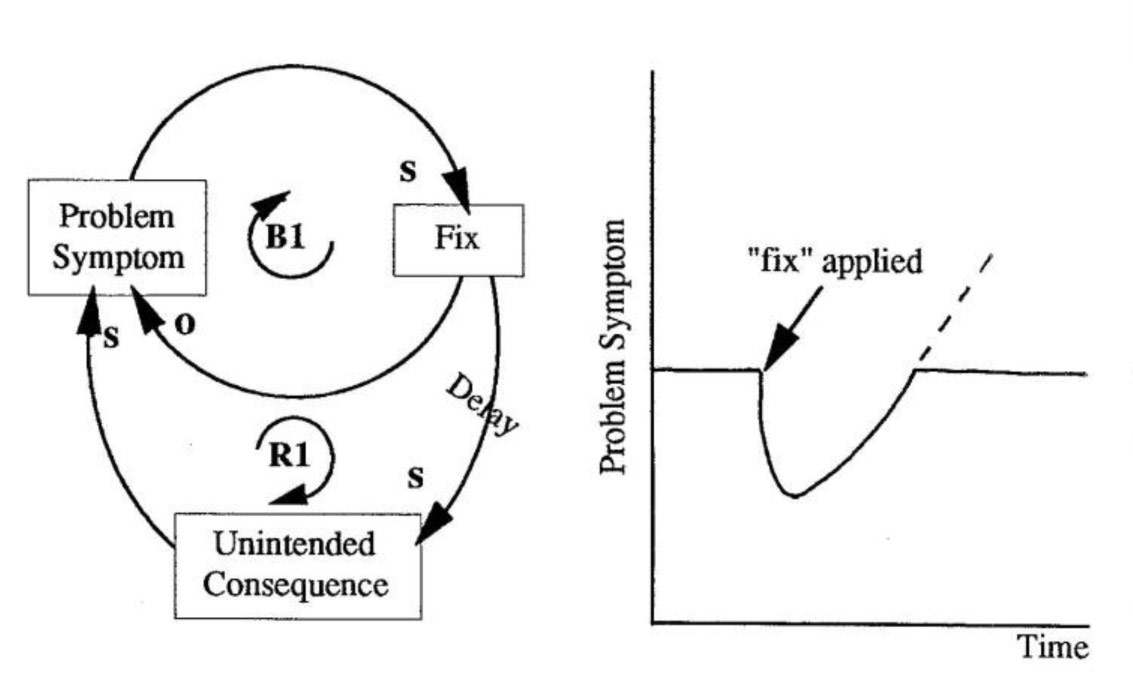
In systems thinking, particularly systems dynamics this is known as a fix-that fails.
This offers a short term value in individual situations but does nothing to examine the root causes othat give rise to the pattern of increase in these type of events.
Eventually, fixes that fail approach tends to give rise to another familiar pattern: known in systems thinking as “shifting the burden”
but more commonly known as “addiction”,
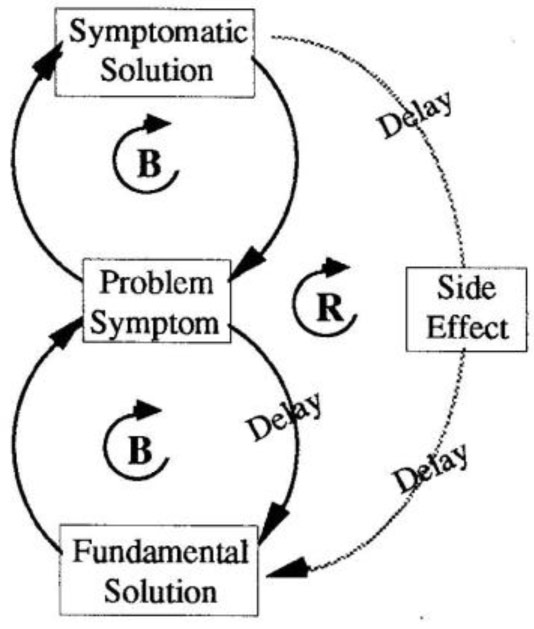
…in which focus on short term solution – “fix” – diverts attention, focus and energy eventually disabling ability to execute, or even imagine a different, long term solution that might reduce, or even do away with, the need for the short term action.
Current focus on, and the calls for “more de-escalation!” is a response to an incident, and event, events that keep arising and keep arising more and more.
What does it do to reduce the number of events ? and the number of times we hear reactive cries for “more de-escalation!”
We will need to have difficult conversations. We will need to go beyond events, automatic thinking, reactivity, increased aggressivity and accepting the inevitability that the only possible response is more of the same.
If we truly want things to change we need to change how we go about this.
We will need to learn to observing the patterns behind the incidents, the events; we will need to examine the structures that create these events – and the rising tide of such events; and we will need to be open to changing our mental models – the deep-seated, and unquestioningly held beliefs upon which these structures – and services, and the way services are designed and run, are founded.
UN_ESCALATE is an opportunity to begin doing that.
So that’s why we called it something else.
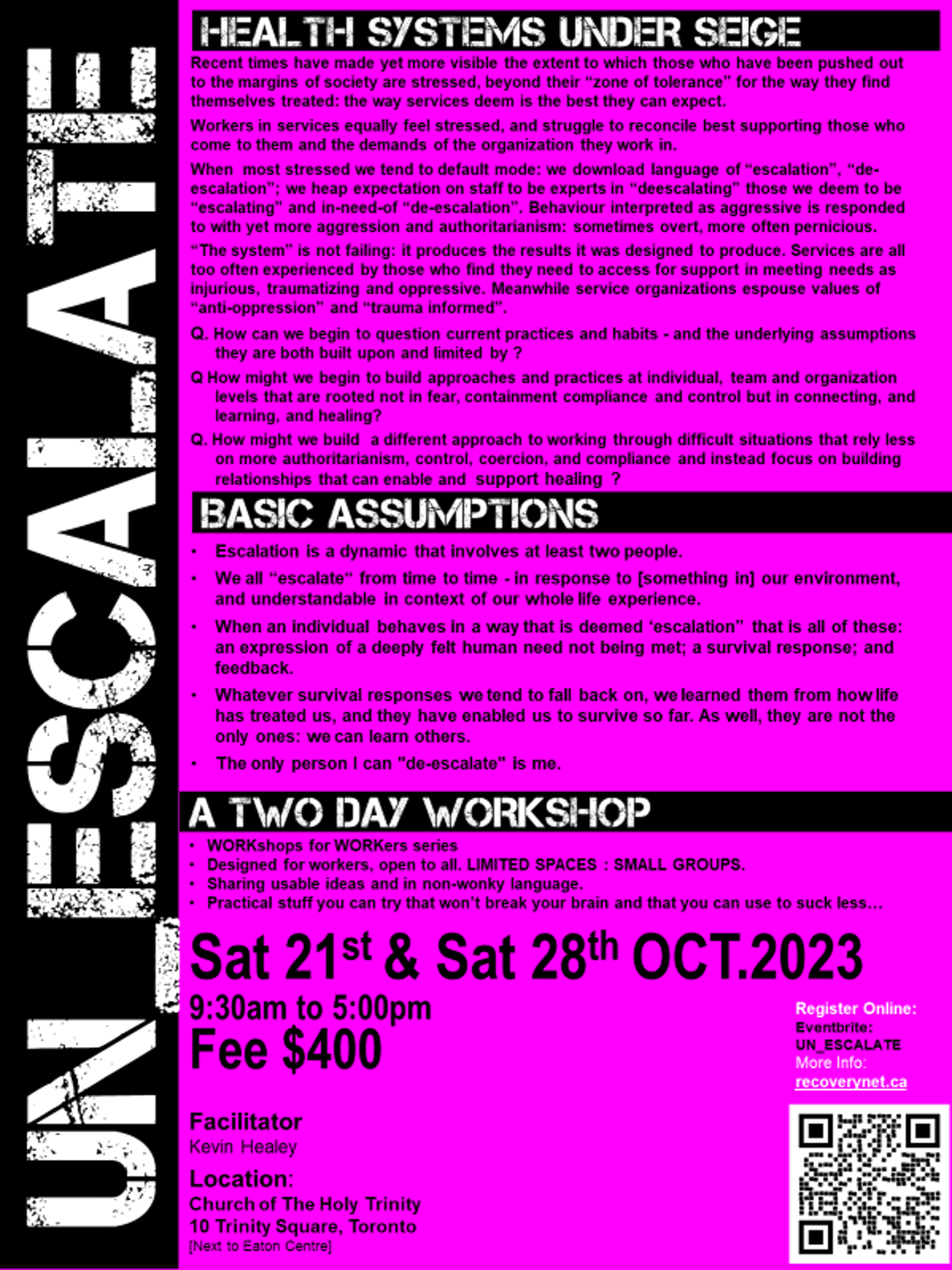
Two Day Workshop:
UN_ESCALATE
Sat 21st Oct: 9am – 5pm
Sat 28th Oct: 9am – 5pm
FEE: $400
Location:
Church of The Holy Trinity
Trinity Square
Toronto
Part of: “Learning Saturdays“
Note – This workshop is in person only.
Note – This workshop takes place on 1st Floor, there are two flights of stairs.
REGISTER ONLINE NOW
Want more Info ?
UN_ESCALATE is…
- Different, and intentionally so.
- Starts in a different place and carves a different path.
- Shares ideas, tools from many sources including: systems thinking and relational dynamics, peace building, peer support, health promotion.
- Focused on ways we can critically examine how services are designed and operated , to not do – or to undo – some of the many things that get done to people who access services that lead them to react in ways that get called “escalating” and results in them being deemed a “person in need of de-escalation”.
If we do this then, maybe, we’ll find ourselves thinking that we need to “de-escalate” another person less often.
“Yeah, we do things round here all the time that ‘escalate’ people.”
UN_ESCALATE : Some basic assumptions.
- No individual escalates all by themself. We each “escalate“: in response to [something in] our environment, and in context of our whole life experience.
- Whatever a person is doing is both an expression of a deeply felt need, and a survival response.
- Whatever survival response we tend to fall back on is likely one that we’ve learned from how life has treated us and one that’s worked so far… but is also not the only one and may not the best one for this moment.
- The only person I can “de-escalate” is me. None of us can “de-escalate another”.
- We can though, de-escalate the situation in which we both find ourselves.
Questions
- Q. How might we draw upon experiences of being in the role of worker required to “de-escalate” a person said to be “in need of de-escalation”?
- Q. How might we draw upon experiences of having been that person said to be “in need of de-escalation”?
- Q. How might we go beyond the operationalization, steps, and rules-based approach of “de-escalation” and instead UN_ESCALATE?
This is a TWO DAY workshop.
Two full days
IN PERSON [How we gonna change the world by hiding behind screens and sitting in our pyjamas?]
Learning Aims and Objectives
Aim
The overall aim of this workshop is that participants are better able to reduce the number and impact of situations in which those seeking support from services experience that in ways they find dehumanizing, degrading and oppressive.
And, especially ..
When working with individuals who have been pushed out to the margins of society:discarded and stigmatized…
In those encounters that that lead a person seeking support to react in ways that services then deem that individual to be “escalating” and “in need of de-escalating”.
Also, that staff in services feel better equipped, more competent, and better able to work in ways that they can bring forth their full humanity and enjoy their work.
The goal? :
Number of encounters experienced by clients as as oppressive: zero.
UN_ESCALATE: Learning Objectives
Participants in this workshop will be better enabled to:
- Recognize for many of those who seek support from health and other services that their experience of doing so can often be degrading, dehumanizing and oppressive.
- Inquire into our current practices, habits, and the underlying assumptions informing them; and how they can contribute to clients often experiencing services as degrading, dehumanizing and oppressive.
- Understand the complexity of dynamics at work in a situation we might call “escalating”.
- Explore new models of understanding and working with situations we call “escalation” that are less violent, coercive, oppressive and more focused on building relations that promote connecting, healing,
- Recognize the part we might play in generating or contributing to a situation that might be regarded as “escalation” – when in the roles from designing and directing to daily running of services that many people experience as oppressive.
- Identify ways we can act differently to reduce the likelihood of “escalation” arising, and to reduce the damaging impact whenever it does.
- Reduce defensiveness in-after-action reviews and debriefings following encounters that go all “Pete Tong”
- Work in ways that can reduce both the number and severity of instances in which individuals who seek support from services experience that as oppressive.
- Offer support to those seeking services who find it difficult and who wish to enhance their ability to self-advocate: Express their needs for support – in ways that make it more likely they will receive it.
- Offer support to those seeking services who find it difficult and who wish to enhance their ability to Communicate any dissatisfaction they may experience with service in ways that makes it more likely that they will be heard and be addressed.
- Initiate and maintain relations and relationships between those we call “worker” and those we call “client” that are rooted in mutual dignity and respect and, which generate connection, learning and healing.
WORKshop for WORKers…
Sharing ideas, thinking tools and practical stuff you can use so you can suck less.
This workshop is designed to share some ideas , tools and approaches we can use to examine how we can change the way we approach situations in which it is usually said that an individual is “in need of de-escalation”.
- Shares and examines some ideas on how we might look upon and understand how escalation works and how power plays out in that.
- Creates opportunity – to use some of these ideas, individually and or in combination, to examine how we work in services in ways that lead people to “escalate” and generate practical ideas for changing how we work in these situations, including systemic changes and also personal choices we make in how we go about the work.
- Including generating ideas for change in our workplace individual, team and organisation level – or different choices we can make starting from our next shift.
- Skills Practice. Working in small groups, you’ll create real scenarios you come across in your work and want time to practice: thinking, doing differently, using the ideas and tools shared in parts 1 & 2, feeling how it feels in your body, reflecting and building confidence.
- Designed as small, interactive, participatory workshop .
- Spaces are Limited [20 spaces].
- IN PERSON
- NO ZOOM!
Facilitator:
Kevin Healey
Location:
Church of The Holy Trinity
10 Trinity Square
[next to Eaton Centre]
REGISTER NOW
Register online now via Eventbrite using the checkout box below.
If you prefer to go to the full event page at Eventbrite use this link:
COMING SOON !!!!







































 agnotarte
 dave umbongo
 drkenplacebo
 highfellow
 recoverynetwork:Toronto


 recovery network: Toronto
You must be logged in to post a comment.