How do people experiencing homelessness experience healthcare settings? How does that affect their health, and their ability to heal?
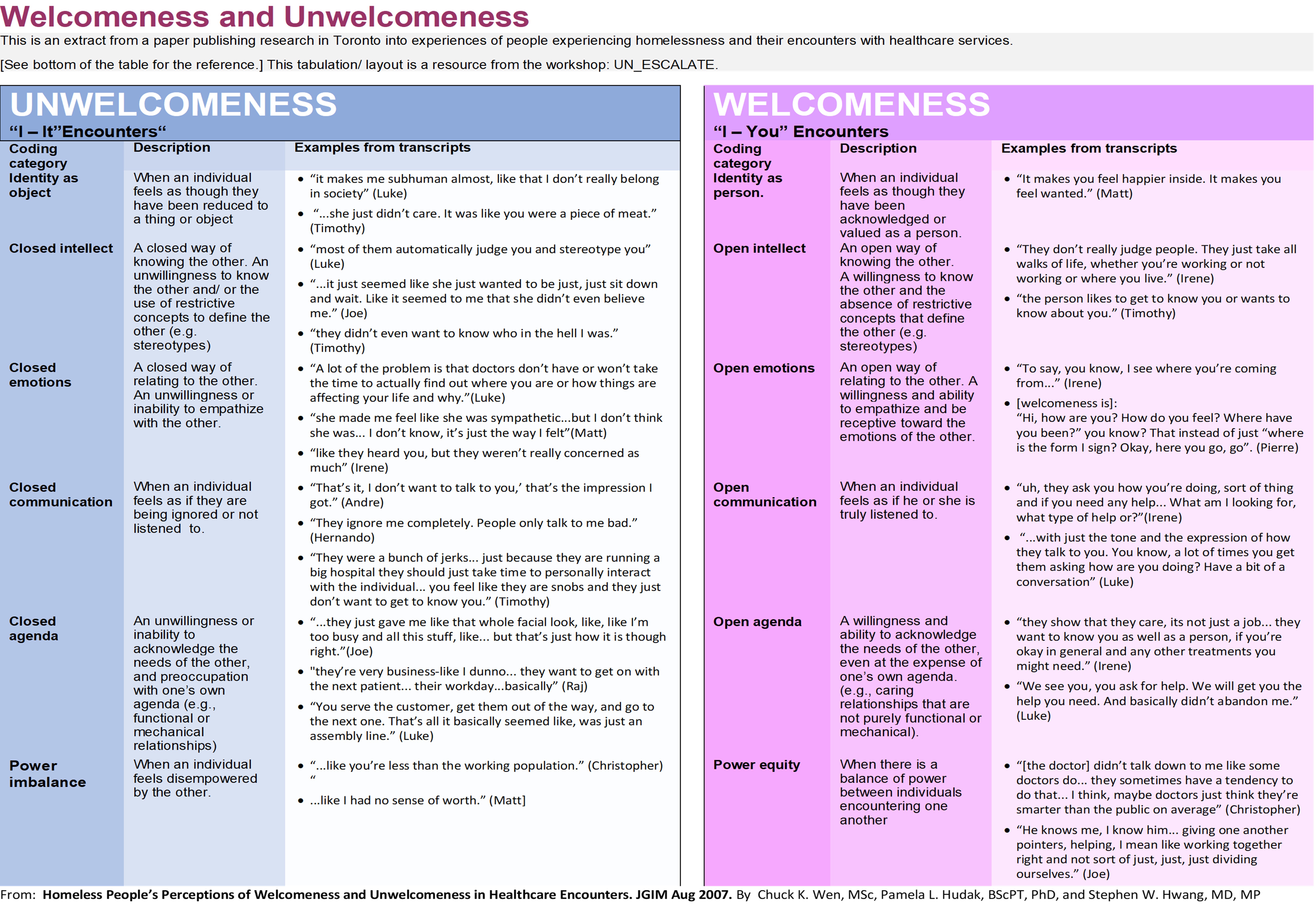
Sharing an article here reporting research conducted interviewing people about their experiences accessing Healthcare services in downtown Toronto.
Researchers coded and sorted the responses into categories and set them out under two broad headings – behaviours by healthcare professionals experienced as leaving them feel UNWELCOME, and behaviours by healthcare professionals they encountered that left them feeling welcome.
The table is my own compilation of that – a one page summary designed and intended to offer you a handy-dandy resource / tool you can print and stick on your workplace fridge or office wall.
It is worth reminding ourselves that the word hospital means “place where hospitality is offered”.
To many, especially those we refer to as “marginalized”.
Those we refer to abstractly as “marginalized” didn’t get there all by themselves: as a friend says says…”
“If we are marginalized, Kevin, it’s is because YOU marginalized us.”
People become marginalized by the actions of others (typically the majority but always those with the power to do so) that render them as marginalized.
The kinds of behaviours illustrated here happen hundreds of times a day – sometimes intentionally, mostly, I suspect, inadvertently, and an individual seeking access to services can experience this dozens of times a day.
This resource illustrates the effect that the sometimes small, subtle behaviours of healthcare professionals shape the way that an individual experiences encounters with services.
Then, when they behave in a way that expresses dissatisfaction with being so treated they get further marginalized by being called “uncooperative”, “difficult patient” and deemed that hey are “escalating” – and in need of de-escalating”.
All this in an industry that has the word “care” in its name.
Health is much more than doing “healthcare” – and when the care is missing then doing “health” can be experienced by those treated as mere objects of tokens as dehumanizing, traumatizing and oppressive.
And for those working in this kind of environment the effect is similarly withering and detrimental to their humanity and their health: this is a big part of what leads to so much talk of “burnout” amongst workers and only leads to more of the same: a vicious cycle of crapitudiness, and a chronically sick health system that serves none of us well.
Without caring human relationships there simply is no care; and without care there can be no health in healthcare too.
So what we are left with is a giant machine concerned only with compliance and efficiency in delivering “health care interventions”.
And whist that is important part of it, healing is about so, so much more than the efficient delivery of “healthcare interventions”.
Handy-dandy POSTER for your fridge or office wall…
Living in Fucktopia: The fucktopic fucktogenesis of fucktosis.
#PandemicAlert:
There’s a name for how you’ve been feeling… there’s one word for all those “comorbid” “conditions”, all those “diagnoses” that you’ve been collecting from one-eyed-seeing “medical professionals”…
You don’t need a diagnosis, there is no vaccine, and there are no magic pills.
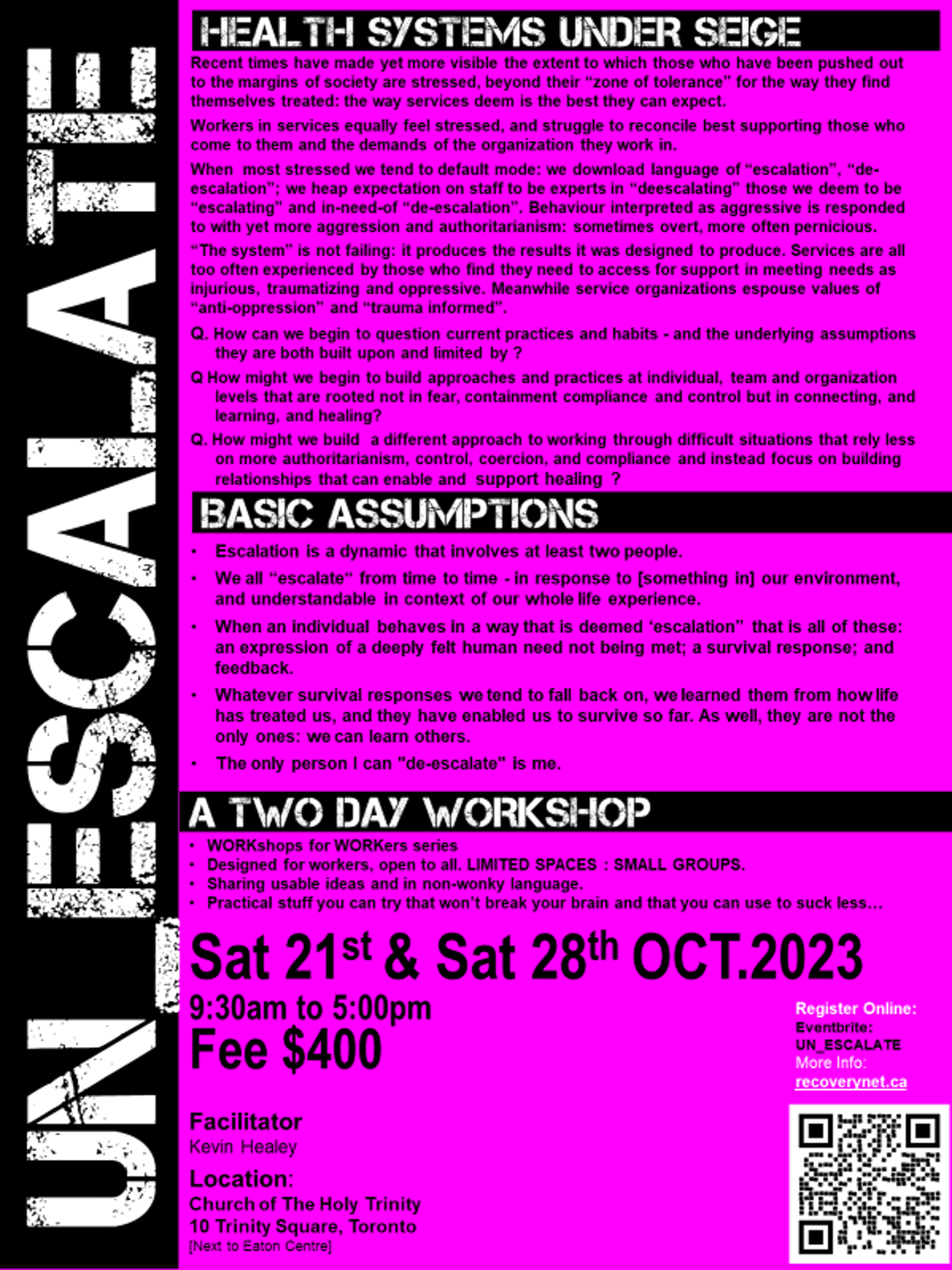
Note: If you’re looking for training on “how to deescalate anyone in three easy steps” then you’ll not find it here.
However, if you are looking for opportunity to both examine the orthodoxy and trenchant mental models that underpin and restrict our thinking and acting, and how we design and operate services in way that all to often are experienced by those who rely on them as dehumanizing, oppressive, and traumatizing; and that lead us to believe that is our only option; and if you believe that “we can do better – and we must,” then this may a good place to start.
UN_ESCALATE: Aim
The overall aim of this workshop is that participants are better able to reduce the number and impact of situations in which those seeking support from services experience that in ways they find dehumanizing, degrading and oppressive.
Why “UN_ESCALATE” ?
Recent times have made yet more visible the extent to which those who have been pushed out to the margins of society are stressed, beyond their “zone of tolerance” for the way they find themselves treated: the way services deem is the best they can expect.
Workers in services equally feel stressed, and struggle to reconcile best supporting those who come to them and the demands of the organization they work in.
When most stressed we tend to default mode: we download language of “escalation”, “de-escalation”; we heap expectation on staff to be experts in “deescalating” those we deem to be “escalating” and in-need-of “de-escalation”. Behaviour interpreted as aggressive is responded to with yet more aggression and authoritarianism: sometimes overt, more often pernicious yet equally injurious.
“The system” is not failing: it produces the results it was designed to produce. Services are all too often experienced by those who find they need to access for support in meeting needs as injurious, traumatizing and oppressive. Meanwhile service organizations espouse values of “anti-oppression” and “trauma informed”.
Models of “de-escalation” are typically used in trainings are typically rooted in war studies.
So, are we waging (yet another) war ?
Or are we seeking to the needs of those who have been most marginalized- cast out – from society in ways that can support (re)connecting, learning, and healing ?
Q. How can we begin to question current practices and habits – and the underlying assumptions they are both built upon and limited by ?
Q How might we begin to build approaches and practices at individual, team, and organization levels that are rooted not in fear, authoritarianism, containment, compliance and control but in connecting, and learning, and healing?
Q. How might we build a different approach to working through difficult situations that rely less on more authoritarianism, control, coercion, and compliance and instead focus on building relationships that can enable and support healing ?
And why its not just another “de-escalation training” ?
UN_ESCALATE is about much more than what to do in a situation where a person seeking services behaves in a way that gets interpreted as “escalating”, and as someone deemed to be “in-need-of-‘de-escalating’; and tools and techniques “techniques” workers can use to “de-escalate them”.
Those seeking support from services and those who work in them, especially in front line services are stressed too.
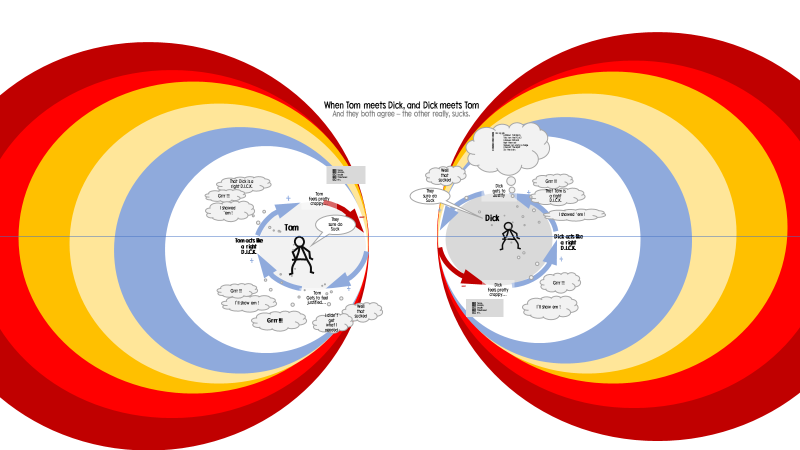
These situations are on the rise and in each instance, it comes down to two individuals both of whom are enmeshed in complex systems.
Escalation as a dynamic
None of us can escalate all by ourselves. the only person we can “de-escalate” is ourselves.
“Escalation” is not a thing that one person does all by themselves, and “de-escalation” is not what them.
Both are caught up in a complex dynamic situation we can understand as “escalation”.
We are each shaped by our experiences in life, and as we move forward we are shaped differently by our different experiences of life.
We are enmeshed in complex systems that shape our experiences, condition how we respond, shape our experience in the world and shape our behaviour in any moment, especially those where we feel stressed, and overwhelmed.
Trauma-Organized Systems
First, if we’re using the T-word, it is important to set out that UN_ESCALATE is rooted in an understanding that trauma is not what we’ve come to think it is.
Trauma is not an event – nor a whole series of ongoing, unending events.
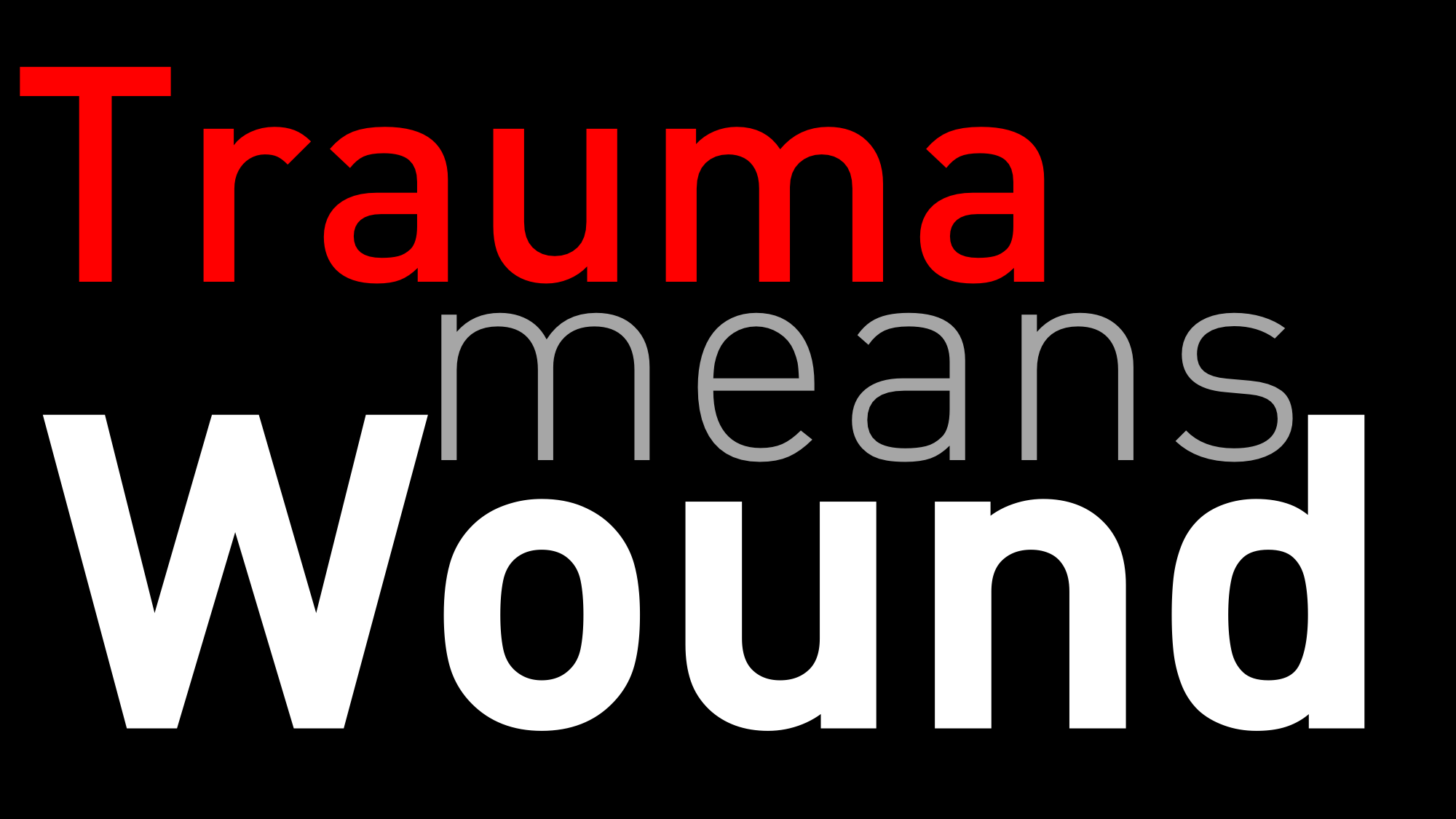
Trauma means wound. And life can be very wounding, indeed. Trauma is not at all hard to understand.
Trauma is not in the past: trauma is now – the wounds we live with now, today. and that resulting from the way we experience what we experience and the way we did not get the support we needed in order to not be left wounded.
Trauma can affect any and all aspect our lives – in all kinds of ways : indeed, there is no aspect of life that cannot be affected.
Trauma is an experience – fundamentally, the experience of having been wounded being left feeling disconnected from ourselves, disconnected our whole being, from our [whole] body, and left feeling disconnected from ourselves disconnected from others, and dis-empowered.
We feel left alone to survive and stuck in patterns that seem to rule our lives, make life difficult, painful. Patterns of feeling, thinking, and behaving that kept us alive also start to wreak havoc with our relationships, health and entire lives. We are separating us further from
So too, our society, institutions, service organizations and workplaces are also similarly shaped. And we can – if we allow ourselves to see it – understand how many of our institutions are rooted in unhealed trauma that is centuries – at least – old.
Just as an individual can hold onto patterns they can recognize, deep-down, as ultimately damaging and yet also feel powerless to change, the same also is true for the organizations we build and uphold.
The vast majority of those who come to services have experienced very difficult lives, and often since even before they emerged from their mother’s womb.
Then on, living a life of having been marginalised, even expelled from society compounds that and makes lie harder than can be imagined by those of us who have been fortunate enough to escape that.
The pain of living life in such a way means living with immeasurable inestimable pain.
Then being expected to contain that pain, and to put up with the many ways we can be treated leads to yet more pain.
And pain shapes us: like nothing else can shape us.
Yet, also, many of those working in services have also experienced difficulties, often of the same kind of adverse life circumstances as clients, have or do live with pain and are also shaped by that pain.
It also is true though, and important to acknowledge, that if we have been able to find ourselves working in services then we have had some good fortune, some support, some advantage or advantages that went at least some way in enabling us to get to that place, and that those who find themselves having to rely on services to meet their basic needs did not, and have yet to.
“People are punished or being in pain and for expressing their pain.
No matter how hard we might find our own lives to be less than rosy, we may not have experienced the kind of difficulties that others, and especially those needing support from services people find themselves in
life circumstances in which people seeking support find themselves are hard to endure, and then on top of that they must also endure being treated the way they can be treated and then expected to endure that too: daily, often many times a day.
Such life experiences also offer limited opportunities to learn different ways we can respond in such difficult situations, instead we learn to survive in a world of pervasive, insidious and sometimes even overt, unadulterated, and unvarnished ultraviolence.
We can easily be, or become blinded to the advantages we have had, to learn, or the support from family members, friends, or community, the advantages we have had in learning how to navigate such situations.
When we are thrust to the margins of society such opportunities are rare and also we need to adapt to the violence we will face many times each day, and we will need to learn other ways.
US and THEM-ism
We can lapse into what in the language of UN_ESCALATE we call US-and-THEM-ism: unconscious, unaware patterns of separation and fragmentation, where we divide the whole of humanity US and THEM.
We are good at this, we could even say it is what we do best. We have created, and create more all the time, endless variations, categories we use to separate others from us.
We come to see an individual, -or whole groups – as “not us”, not-like-us”, we categorize them thus, and then treat them differently: as less than us, as ‘less worthy’, ‘less human’, even ‘not worthy’, ‘not human’.
And then we blame them, and we blame them for leaving us feeling uncomfortable around them.
And then we blame them for behaving in ways that “act out” how they don’t like being treated the way they get treated.
Now, we could view this as feedback, information that something ain’t right, something is amiss, wrong even, with the system in which we are all enmeshed.
We tend not to though: a huge, collective societal, blind spot means we tend default to a collective, defensive, trauma-conditioned response.
We are shaped to interpret things as being their fault, a non compliance [on their part that needs to be judged, and corrected [by us].
When a person then behaves in a way that leaves us feeling uncomfortable we might then interpret that as “aggressiveness”, even intentionally so, and requiring correction of some sort.
And we might respond with “counter-aggressiveness”.
Then we might say that they need to be “de-escalated” – by “us”.
Yet, in truth, any “escalation”, such as it is, actually started way, way, way before that, even centuries ago.
…and is deeply embedded in unquestioned beliefs, attitudes, ways-of-doing, orthodoxies, and power relations. And of which is unconscious, unquestioned and un-interrogated.
We might call this “systemic escalation” as [usually] no one actor sets out to escalate but every actors in the system plays some part in creating the effect.
Unaware participation in systems of oppression
Q. How could we.. participate in systems of oppression?
Well, we tend to assume participation is always by some conscious choice, but is this always so? This assumption tends to make it difficult to see when we do, for doing so casts us as a “bad” person: and we don’t like to cast ourselves as that, so develop a blind spot.
More often than not, it tends to be that we have yet to become aware that we have become so enmeshed within complex systems, and shaped by the domains that shaped us especially and including the society, culture, institutions and life experiences, and how they shape our lives, and shape us.
The answer to this question is more often because we are unaware of how our role plays a part, how we have yet to become aware of the choices we can make to stop taking part, minimize or negate that effect, dismantle and create new ways and then to play a different role to shape a different world -in the part of the world we do have influence have .
Q. How could we not have known ?
Downloading – automatic, reflex, unthinking thinking and acting – demands for yet more “more de-escalation” only gets us more of eth same, we create a “spiraling” vicious cycle. This too can be viewed as rooted in trauma, and unhealed trauma at that. Recourse to authoritarianism, us of power is a symptom of a fear-based, and trauma-organized-system. We could also say, that it reveals roots of how we organize services in long ingrained patterns of colonialist thinking and behaving.
Typical models of “de-escalation” are rooted in war studies, or of compliance [e.g., in education systems where models emphasize bringing student behaviour to compliance in a behavioural health framework”.
They typically take no cognizance or understanding of complexity of dynamics and multiple factors at play, like, for example.
what the person seeking services is being expected to put up with in their life,
power dynamics, and multiple varieties of systemic oppressions playing out
the roots of how our institutions, organizations default to authoritarianism- and increasingly so in recent years,
the roots of all the above and how that can be seen as rooted in colonialist thinking and behaviour – and organized around response to unhealed trauma.
who pays, who decides, who benefits (with regards to what & how services are designed and operated.
Us & Them: how we divide ourselves- those with power to do so identify another group and regard them as “not us”.
No amount of more, or better “de-escalation” will ever be enough
De-escalate
“De-escalation trainings” tend to focus on in-the-moment situations that arise when an individual is said to behave in a way that service deems unacceptable and requires the individual’s behaviour to be corrected, non compliance results in the person
being “service restricted” : even further ostracized, excluded, or even punished for their behaviour.
This results in an individual who has already been excluded from and pushed to the margins of society or community being further excluded, pushed further our beyond the margins.
This is itself an escalatory approach, is designed as such: it is literally an escalation in the use of power by the organization [acting on behalf of society] against the individual.
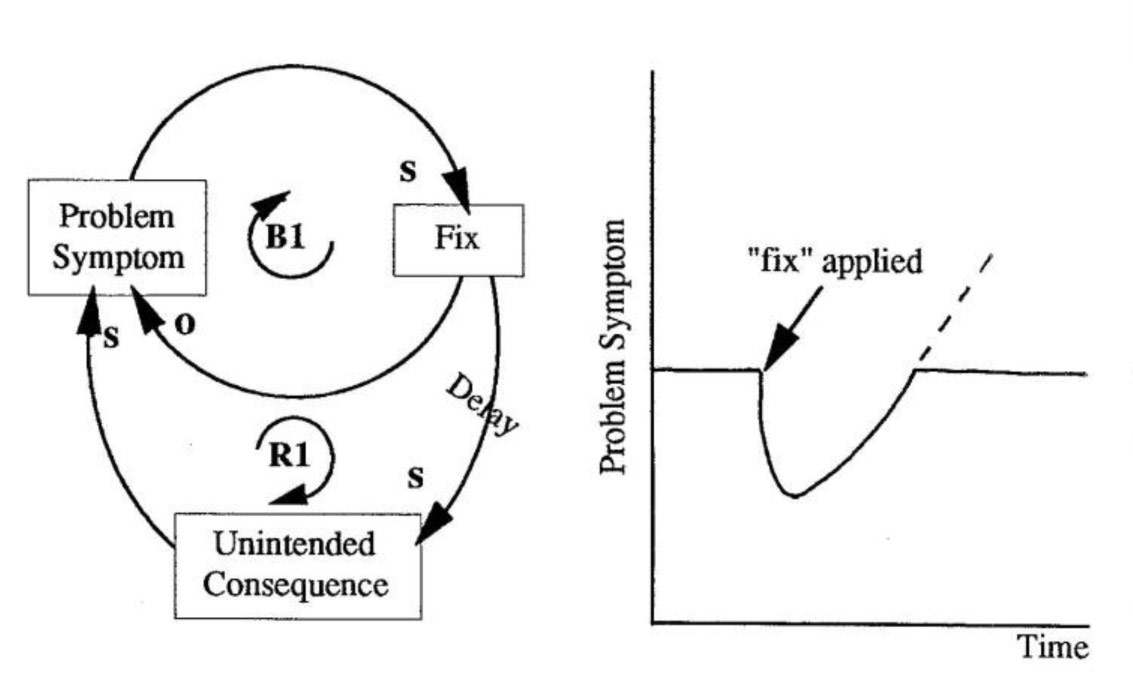
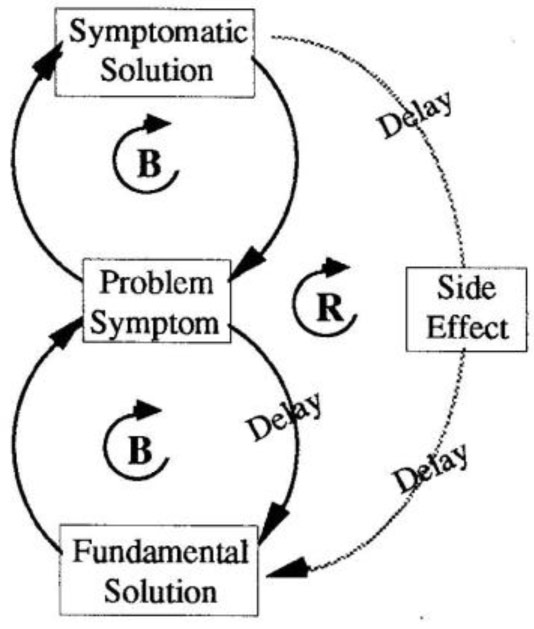
De-escalation as a “band-aid solution”, and an “addiction”
In systems thinking, particularly systems dynamics this is known as a fix-that fails. This offers a short term value in individual situations but does nothing to examine the root causes othat give rise to the pattern of increase in these type of events.
Eventually, fixes that fail approach tends to give rise to another familiar pattern: known in systems thinking as “shifting the burden” but more commonly known as “addiction”,
…in which focus on short term solution – “fix” – diverts attention, focus and energy eventually disabling ability to execute, or even imagine a different, long term solution that might reduce, or even do away with, the need for the short term action.
Current focus on, and the calls for “more de-escalation!” is a response to an incident, and event, events that keep arising and keep arising more and more. What does it do to reduce the number of events ? and the number of times we hear reactive cries for “more de-escalation!”
We will need to have difficult conversations. We will need to go beyond events, automatic thinking, reactivity, increased aggressivity and accepting the inevitability that the only possible response is more of the same.
If we truly want things to change we need to change how we go about this.
We will need to learn to observing the patterns behind the incidents, the events; we will need to examine the structures that create these events – and the rising tide of such events; and we will need to be open to changing our mental models – the deep-seated, and unquestioningly held beliefs upon which these structures – and services, and the way services are designed and run, are founded.
UN_ESCALATE is an opportunity to begin doing that. So that’s why we called it something else.
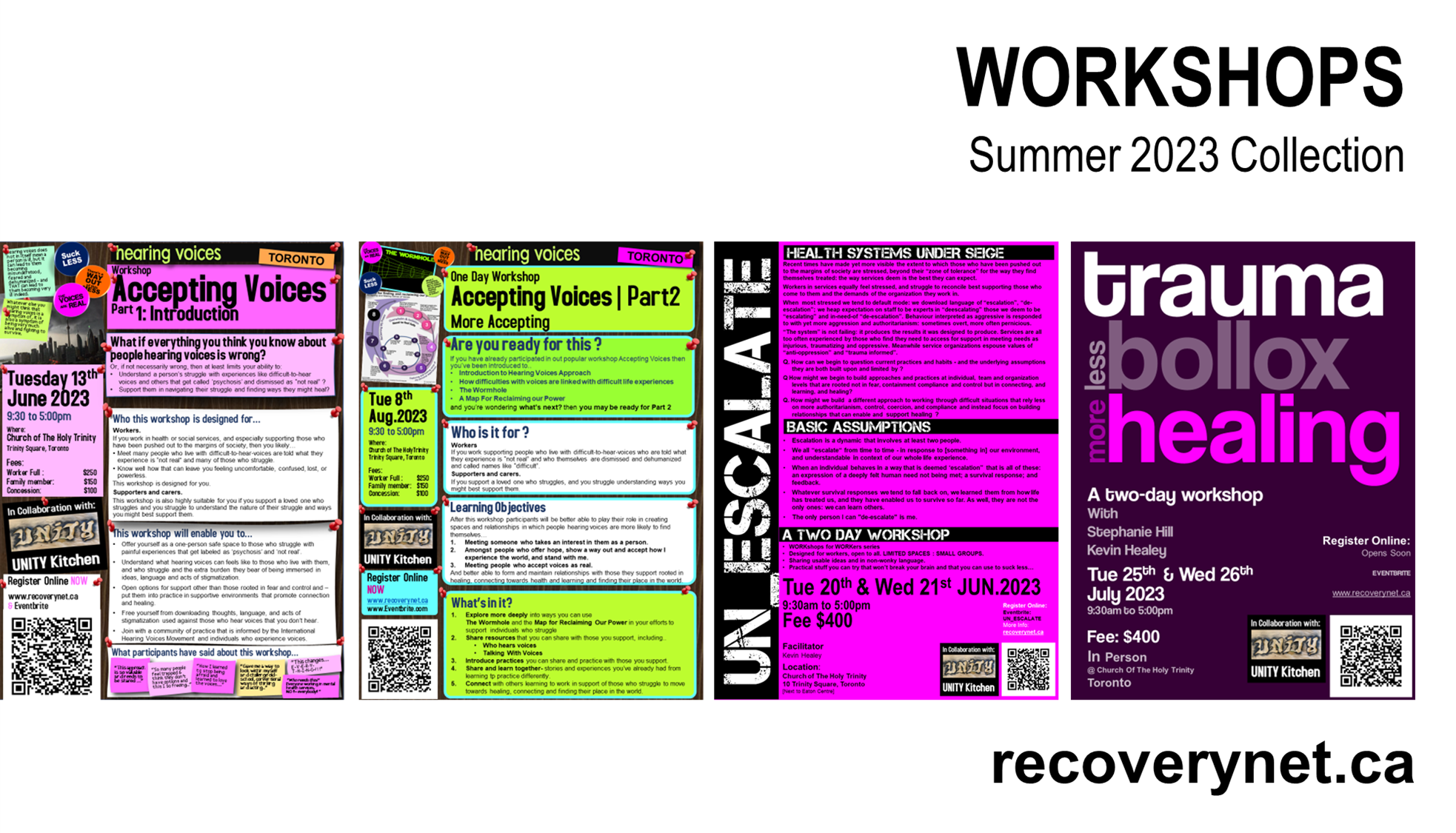
Two Day Workshop:
UN_ESCALATE Sat 21st Oct: 9am – 5pm Sat 28th Oct: 9am – 5pm
FEE: $400
Location: Church of The Holy Trinity Trinity Square Toronto
Part of: “Learning Saturdays“
Note – This workshop is in person only.
Note – This workshop takes place on 1st Floor, there are two flights of stairs.
Starts in a different place and carves a different path.
Shares ideas, tools from many sources including: systems thinking and relational dynamics, peace building, peer support, health promotion.
Focused on ways we can critically examine how services are designed and operated , to not do – or to undo – some of the many things that get done to people who access services that lead them to react in ways that get called “escalating” and results in them being deemed a “person in need of de-escalation”.
If we do this then, maybe, we’ll find ourselves thinking that we need to “de-escalate” another person less often.
“Yeah, we do things round here all the time that ‘escalate’ people.”
UN_ESCALATE : Some basic assumptions.
No individual escalates all by themself. We each “escalate“: in response to [something in] our environment, and in context of our whole life experience.
Whatever a person is doing is both an expression of a deeply felt need, and a survival response.
Whatever survival response we tend to fall back on is likely one that we’ve learned from how life has treated us and one that’s worked so far… but is also not the only one and may not the best one for this moment.
The only person I can “de-escalate” is me. None of us can “de-escalate another”.
We can though, de-escalate the situation in which we both find ourselves.
Questions
Q. How might we draw upon experiences of being in the role of worker required to “de-escalate” a person said to be “in need of de-escalation”?
Q. How might we draw upon experiences of having been that person said to be “in need of de-escalation”?
Q. How might we go beyond the operationalization, steps, and rules-based approach of “de-escalation” and instead UN_ESCALATE?
This is a TWO DAY workshop.
Two full days
IN PERSON [How we gonna change the world by hiding behind screens and sitting in our pyjamas?]
Learning Aims and Objectives
Aim
The overall aim of this workshop is that participants are better able to reduce the number and impact of situations in which those seeking support from services experience that in ways they find dehumanizing, degrading and oppressive.
And, especially ..
When working with individuals who have been pushed out to the margins of society:discarded and stigmatized…
In those encounters that that lead a person seeking support to react in ways that services then deem that individual to be “escalating” and “in need of de-escalating”.
Also, that staff in services feel better equipped, more competent, and better able to work in ways that they can bring forth their full humanity and enjoy their work.
The goal? : Number of encounters experienced by clients as as oppressive: zero.
UN_ESCALATE: Learning Objectives
Participants in this workshop will be better enabled to:
Recognize for many of those who seek support from health and other services that their experience of doing so can often be degrading, dehumanizing and oppressive.
Inquire into our current practices, habits, and the underlying assumptions informing them; and how they can contribute to clients often experiencing services as degrading, dehumanizing and oppressive.
Understand the complexity of dynamics at work in a situation we might call “escalating”.
Explore new models of understanding and working with situations we call “escalation” that are less violent, coercive, oppressive and more focused on building relations that promote connecting, healing,
Recognize the part we might play in generating or contributing to a situation that might be regarded as “escalation” – when in the roles from designing and directing to daily running of services that many people experience as oppressive.
Identify ways we can act differently to reduce the likelihood of “escalation” arising, and to reduce the damaging impact whenever it does.
Reduce defensiveness in-after-action reviews and debriefings following encounters that go all “Pete Tong”
Work in ways that can reduce both the number and severity of instances in which individuals who seek support from services experience that as oppressive.
Offer support to those seeking services who find it difficult and who wish to enhance their ability to self-advocate: Express their needs for support – in ways that make it more likely they will receive it.
Offer support to those seeking services who find it difficult and who wish to enhance their ability to Communicate any dissatisfaction they may experience with service in ways that makes it more likely that they will be heard and be addressed.
Initiate and maintain relations and relationships between those we call “worker” and those we call “client” that are rooted in mutual dignity and respect and, which generate connection, learning and healing.
WORKshop for WORKers…
Sharing ideas, thinking tools and practical stuff you can use so you can suck less.
This workshop is designed to share some ideas , tools and approaches we can use to examine how we can change the way we approach situations in which it is usually said that an individual is “in need of de-escalation”.
Shares and examines some ideas on how we might look upon and understand how escalation works and how power plays out in that.
Creates opportunity – to use some of these ideas, individually and or in combination, to examine how we work in services in ways that lead people to “escalate” and generate practical ideas for changing how we work in these situations, including systemic changes and also personal choices we make in how we go about the work.
Including generating ideas for change in our workplace individual, team and organisation level – or different choices we can make starting from our next shift.
Skills Practice. Working in small groups, you’ll create real scenarios you come across in your work and want time to practice: thinking, doing differently, using the ideas and tools shared in parts 1 & 2, feeling how it feels in your body, reflecting and building confidence.
Designed as small, interactive, participatory workshop .
Spaces are Limited [20 spaces].
IN PERSON
NO ZOOM!
Facilitator:
Kevin Healey
Location:
Church of The Holy Trinity
10 Trinity Square
[next to Eaton Centre]
REGISTER NOW
Register online now via Eventbrite using the checkout box below.
If you prefer to go to the full event page at Eventbrite use this link:
What if Trauma is not what you’ve been led to believe it is ?
Trauma is not an event – or even a whole bunch of events;trauma is not in the past; trauma is not the horrible thing or things that happened to us, near us, around us; and Trauma is not something that affects only a few individuals who’ve also been given a diagnosis.
Trauma is not only an individual issue, trauma is also a collective issue, a social issue, and a political issue.
Trauma is not hard to understand.
Trauma means wound. And life can be very wounding indeed. Especially if we don’t have access to the kind of supports we need so that
we don’t become traumatized by our experience of events
and so we can heal.
Trauma is not only an individual experience.
Trauma is experienced in families, in social networks, in communities, in groups, in entire populations. And, it can do so for generations, even hundreds of years.
Trauma – and the effects of unhealed, mass trauma – is also evident in our culture, and social institutions, and in services intended to support those who struggle., and which often claim to be “trauma informed”.
There, is these days, plenty of “bollox” spoken and written about many a subject.
It is quite possible that trauma is the topic more than any other, about which the most “bollox” has been wrought on the world.
Current understanding of trauma is stuck, trapped in the way it was framed so that it could be included in the whizzy, sciencey-looking diagnostic system cobbled together by the American Psychiatric Association in the 1980s: as PTSD.
Our understanding of trauma is changing fast, and is no longer the domain of anointed “experts”. Some of the most important work is being done by those who have found ways of healing and sharing what they’ve learned.
Even many of the most highly trained health professionals and others working in helping professions, their training is probably 20 years out of date. our understanding of trauma is moving fast.f you think you can learn what you need to know about trauma from a college course, you’ll need to wait , maybe another ten years or more for them to catch up with even where we are today.
Or you could start here…
Understanding trauma is not at all complicated.
“Trauma” means “wound”.
And, life can be very wounding indeed.
Trauma is not what happened but the effect our experienced of what happened that can live within us – today.
Why is this important? We cant change what happened. We can learn to heal the wounds we bear, we can learn to lessen the effects our experiences have on us.
We can though, learn ways we can heal: heal the heal the wounds left within us, we can learn to heal our own wounds and we can learn to support others – each other in healing our wounds.
Aim of this workshop
The overall aim of this workshop is to begin building an understanding of the many and various ways that life can leave us wounded large enough, wide enough, and deep enough that it enables us to generate the kind of capacity for healing supporting individual, family, community and cultural healing that we will need as we face the future.
And,
To bring people together, learning with and from each other, and in an ongoing community of learning and practice, to generate capacity or healing in the community.
Learning Objectives
Those who participate in this workshop bill be better able to
Express a meaningful understanding of trauma in simple language that is compassionate, pragmatic, and that need not break our brain, yet enable us to generate maximum capacity for learning, connecting and healing.
Appreciate the limitless ways that life can leave us wounded, and the infinite variety of how that very unhealed woundedness manifests in uniquely personal ways.
Begin to identify our own need for healing.
Appreciate and identify how unhealed trauma-woundedness manifests in the ways we tend to shape our world, especially in our relationships, in our teams, workplaces and institutions and in our culture.
Turn our attention away from categorizing to ways we can support healing individuals, families, groups, communities, cultures, peoples and at societal level.
Play our part in building a world that leaves us less wounded and less often.
Work in ways that support growing our collective capability to heal ourselves, and each other at individual, family, group, communities, cultures, peoples, and societal levels.
Workshop Description
Please Note: This workshop will not seek to offer a definition of “trauma”: what trauma is and what trauma isn’t.
We believe that attempting to do so is futile and restricting, and more often than not results in more people being left traumatized by how they experience life; experience support from services; and also hinders and even prevents healing.
It also prevents us finding and treating ways we can support individuals, groups, families and whole communities in healing.
This excludes and silences so many of us; and especially those who need support most.
It denies us support and it disables our whole society society from moving toward collective healing.
We can make a different choice.
No amount of the kind of conversation we are having about trauma to date will heal us.
It will, and can only, result in more of what we have already: only those privileged few who have been deemed to be “just traumatized enough” are offered any kind of support at all.a
Two Day Workshop:
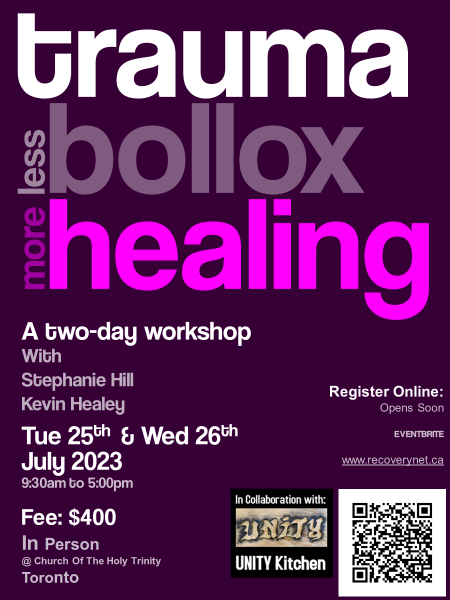
Trauma: less bollox, more healing
Sat 4th & Sat 11th NOV 2023
9:30am to 5:00pm
Fee: $400
Location:
Church of The Holy Trinity Trinity Square Toronto
Note: This workshop is in-person only. Note: This workshop takes place on first floor- there are two flights of stairs.
Full description follows below: after the registration box.
The conversation around trauma is expanding faster that any of us can keep up with. Many are fighting to have their own pain and struggle included a trauma context.
Conversely, many others fight to resist that, claiming only they have knowledge, expertise, power, and authority to define what trauma is and what trauma is not. Some even going so far as dismissing the very real, living pain that others live with others as #nottrauma, or #notrealtrrauma.
This results in many – even the vast majority – of us being excluded from consideration that their own struggle-in-life is related to their experiences in life; and especially how they have been treated since whatever happened did happen; and more especially how they are treated when they seek support from services.
We only need be willing to open our eyes to see that it is plain as day that many of our institutions and services fail wholesale, the many who live with the woundedness of living as a human in this world that seems, daily, to be made by humans to be one that is less and less suited for humans to flourish.
And, much of the talk to date about “trauma informed is just some huge bunch of gold plated, gilt edged, utter, utter bollox.
And, more tragically, even many of those health services, and even more so, some of those claiming to be “trauma-informed” also fail us miserably, some even shamelessly.
No amount of more of the same will never be enough
No amount of more of the same will enable us to find a way out of this mess.
No amount of more of the same power struggles between those institutions and individuals who claim sole right to define our pain will help us move towards finding and creating ways to heal our own pain, nor to find and create ways support each other in healing.
No amount of more of the same treating trauma as something that only a highly trained professional can possibly understand or can possibly have anything to offer to help us find our way to healing.
No amount of more of the same thinking that trauma as a very narrowly controlled-by-experts list of very specific life experiences that can happen to an individual will help us understand, help us heal, or support each other in healing.
No amount of more of the same defining trauma as a solely individual experience , will help us truly understand when trauma is also a collective and cultural experience.
No amount of more of the same defining trauma as a deficit, deficiency or disorder, and cf categorizing those individuals, groups families, communities and cultures as being deficient, disordered or just plain not up to living in a cruel, unjust and often uncaring world will lead us to find and create pathways of healing.
No amount of more of the same regarding trauma as something that only a highly trained professional can possibly understand will get us anywhere other than where we are now.
And, no amount of more of the same old bollox will help use create a world that leaves us wounded less or less often.
What if…
What if we took just some of the energy, attention, and resources that are consumed by seeking to win unwinnable arguments, seeking to define what trauma is and what trauma is not, and used it instead to inquire curiously how we could build new ways of understanding that promote learning, connecting and healing?
We will need to have a different conversation about trauma, and the first step to doing that is to resist the temptation to continue having the same conversation that we keep having about trauma.
This workshop offers an opportunity to participate in and to experience a different kind of conversation about trauma, woundedness, learning connecting and healing.
Trauma means wound – and life can be wounding.
The woundedness we can be left living with lives in our body, mind, spirit, relations, and spirit and
manifests in an infinite variety of ways. Each of us is wounded in our own unique way, and each of us can find our own unique pathways to healing.
Wounds can heal – if we have the supports that we need to be able to heal. There are no prescriptions, templates or cookie cutter recipes.
We will need to learn to have a different kind of conversation
If we are to get ourselves out of this mess we made – the mess that we made- then we will need to learn to have different kind of conversation.
The workshop: Trauma: less bollox, more healing offers an opportunity to participate in and experience the beginning of a different conversation.
A conversation intended to find and build a different kind of understanding that can enable us to co create co generate new ways, and re-energize some older ways to, that we can shift focus to ways we can support individuals, families, groups, communities and cultures in healing and supporting healing.
And, the workshop is designed as a first step.
Over the two days we will engage in learning with and from each other, dialogue and curious inquiry
Day One will focus on sharing multiple understandings and hearing multiple perspectives and understanding how our understanding of trauma can itself lead to those seeking services being more traumatized, and how they may be more conducive to healing.
The aim is to allow us to build deeper, more full understanding trauma, how it affects our lives , and implications for how we design, fund, manage and operate services , especially those intended to support healing, and that enables us to generate new ways, and to re-energize some older ways, that support learning, connecting, and healing.
Day Two will shift focus to making more concrete – we will use an open space technology format in which participants design their own projects, and focus on area of interest to them, e.g. a deeper inquiry into some ideas or some aspect or aspects already touched upon, or co creating and prototyping new ways of bringing to bear an understanding of trauma that better healing and that address concerns in work, team or organization.
What Participants have said about this workshop…
What I’m taking away from this workshop
I expected to unpack my biases about others, I unpacked biases about myself.
Participant
A really excellent workbook of tools and resources !! This is a keeper!
Participant
I’m taking away the idea and knowledge that we can choose our language, from: “Victim” & “Aggressor” to: “One who has been hurt” & “One who has hurt others”. I love this recognition that we’ve all hurt another + been hurt by another. this was such a learning for me.
Participant
I will be taking away the body and grounding practices that were implemented throughout the session as I felt these were helpful and important in developing awareness and being present with the self & what’s surrounding us.
Participant
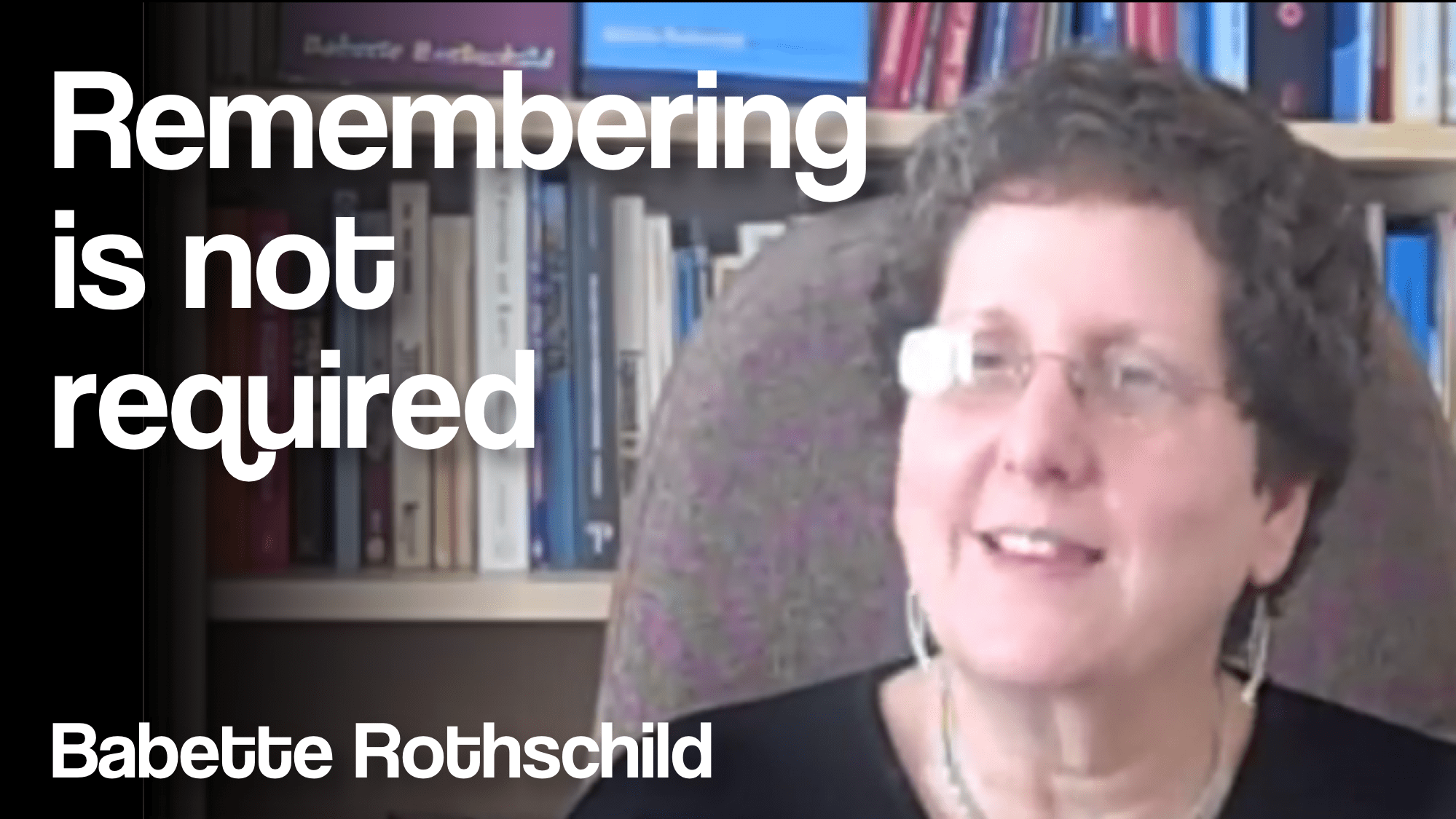
There is no one way to heal and healing doesn’t mean I have to relive / remember / remind myself of my trauma (more how I felt as total description).
Participant
I really enjoyed the exercise of identifying what is bollox vs [healing ] with the sticky notes and being able to reflect on what I learned from others and what they were able to take from my contributions.
Participant
I also am taking away the value of how I share my story: What is necessary to share? Why am I sharing? Who is served from my sharing ? (Do I feel pressured to share ? Am I sharing to make myself feel better at the expense of others’ well-being ?) What are the valuable pieces of this ? Do I need details or is the focus the feelings, thoughts, etc. “Shitty Shit” is often enough.
Participant
I think the main take away has been realizing that trauma isn’t necessarily the shit that happens to you or to others, but what comes after. This feels to be like transformative justice in some ways. In other words, practicing and embodying the kinds of environments, relations and world I want to live in.
Participant
Raised a lot of questions for me about how I think about trauma. I need to learn / explore more. -And I’m going away with an abundance of ideas where I can do that.
Participant
Everyone experiences trauma differently.
Participant
The exercises helped to apply what we learned and further share our narratives and feelings.
Participant
I’m still learning how to understand what the heck trauma really even is; learning about my own, but not alone, rather, with others. I’m doing my best and trying to show up.
Participant
How would I describe this workshop to others…?
A holistic workshop that speaks to the wisdom of your body and how trauma presents itself so uniquely in each of us, as individuals.
Participant
It allows us to transform “US& THEM” language into language we can learn from, shifting accountability and recognizing we’ve all both hurt another and been hurt by another.
Participant
I would describe this workshop as a welcome space to begin opening up a dialogue on trauma. What I mean by this is that there is no pressure to talk about trauma: that is your own trauma. Sometimes we just need spaces like this to exist to even get to a point where we can share respond, and listen. Thank you.
Participant
A way to develop an understanding of what trauma means, and how unhealed wounds affect how we lead our lives and can have a more open understanding & compassion for people (and myself)
Participant
A space to process how “trauma healing” can be helpful & harmful – what works and what hurts.
Participant
A space that uses theory, processing, and sharing circles to better understand what trauma, healing and bollox can look like, and empowers participants to be their own experts in their healing. Its not what we do but why we do it.
Participant
This workshop explores the concept of trauma from non-conventional perspective, allowing for the sharing of lived experience combined with theory. – You will walk away with more questions than answers
Participant
Expect to experience an “unlearning” of what you thought you know about how trauma is conceptualized, as well as its treatment.
Participant
It was an open space to be vulnerable and looks at trauma differently while considering other understandings of these topics.
Participant
There was a feeling of mutual respect and interest in each others’ ideas that was fostered by the facilitators.
Participant
I really liked the safe space that was cultivated during the workshop, I liked the interactive style of [presenting] and as previously mentioned, I liked the breaks. I really learned a lot.
Participant
It was an open space to be vulnerable and looks at trauma differently while considering other understandings of these topics.
The exercises helped to apply what we learned and further share our narratives and feelings.
Well, the first thing I want to say is: Mandate my ass!
Because it seems as though we’ve been convinced that 26% of the registered voters, not even 26% of the American people, but 26% of the registered voters form a mandate or a landslide. 21% voted for Skippy and 3, 4% voted for somebody else who might have been running.
But, oh yeah, I remember. In this year that we have now declared the year from Shogun to Reagan, I remember what I said about Reagan, I meant it.
Acted like an actor. Hollyweird. Acted like a liberal. Acted like General Franco when he acted like governor of California, then he acted like a Republican. Then he acted like somebody was going to vote for him for president.
And now we act like 26% of the registered voters is actually a mandate.
We’re all actors in this I suppose.
What has happened is that in the last 20 years,
America has changed from a producer to a consumer.
And all consumers know that when the producer names the tune, the consumer has got to dance. That’s the way it is.
We used to be a producer – very inflexible at that, and now we are consumers and, finding it difficult to understand.
Natural resources and minerals will change your world.
The Arabs used to be in the 3rd World. They have bought the 2nd World and put a firm down payment on the 1st one.
Controlling your resources we’ll control your world.
This country has been surprised by the way the world looks now. They don’t know if they want to be Matt Dillon or Bob Dylan. They don’t know if they want to be diplomats or continue the same policy – of nuclear nightmare diplomacy. John Foster Dulles ain’t nothing but the name of an airport now. The idea concerns the fact that this country wants nostalgia.
They want to go back as far as they can – even if it’s only as far as last week. Not to face now or tomorrow, but to face backwards.
And yesterday was the day of our cinema heroes riding to the rescue at the last possible moment. The day of the man in the white hat or the man on the white horse – or the man who always came to save America at the last moment – someone always came to save America at the last moment – especially in “B” movies.
And when America found itself having a hard time facing the future, they looked for people like John Wayne.
But since John Wayne was no longer available, they settled for Ronald Reagan and it has placed us in a situation that we can only look at – like a “B” movie.
Come with us back to those inglorious days when heroes weren’t zeros. Before fair was square. When the cavalry came straight away and all-American men were like Hemingway to the days of the wondrous “B” movie.
The producer, underwritten by all the millionaires necessary, will be Casper “The Defensive” Weinberger – no more animated choice is available.
The director will be Attila the Haig, running around frantically declaring himself in control and in charge. The ultimate realization of the inmates taking over at the asylum.
The screenplay will be adapted from the book called “Voodoo Economics” by George “Papa Doc” Bush.
Village People “the very military “Macho Man.”Company!!!” “Macho, macho man!” “Two-three-four.” He likes to be well, you get the point.” Huuut!
A theme song for saber-rallying and selling wars door-to-door. Remember, we’re looking for the closest thing we can find to John Wayne. Clichés abound like kangaroos – courtesy of some spaced out Marlin Perkins, a Reagan contemporary. Clichés like, “itchy trigger finger” and “tall in the saddle” and “riding off or on into the sunset.” Clichés like, “ Get off of my planet by sundown!” More so than clichés like, “he died with his boots on.” Marine tough the man is. Bogart tough the man is. Cagney tough the man is. Hollywood tough the man is. Cheap steak tough. And Bonzo’s substantial. The ultimate in synthetic selling: A Madison Avenue masterpiece – a miracle – a cotton-candy politician… Presto! Macho!
Macho, macho man!”
Put your orders in America. And quick as Kodak your leaders duplicate with the accent being on the dupes – cause all of a sudden we have fallen prey to selective amnesia – remembering what we want to remember and forgetting what we choose to forget. All of a sudden, the man who called for a blood bath on our college campuses is supposed to be Dudley “ God-damn” Do-Right?
You go give them liberals hell Ronnie.” That was the mandate to the new Captain Bligh on the new ship of fools. It was doubtlessly based on his chameleon performance of the past: as a Liberal Democrat. As the head of the Studio Actor’s Guild, when other celluloid saviors were cringing in terror from Mc Carthy, Ron stood tall. It goes all the way back from Hollywood to hillbilly. From Liberal to libelous, from “ Bonzo” to Birch idol, born again. Civil rights, women’s rights, gay rights: … It’s all wrong. Call in the cavalry to disrupt this perception of freedom gone wild. God damn it, first one wants freedom, then the whole damn world wants freedom. Nostalgia, that’s what we want…: the good ol’ days, when we gave’em hell. When the buck stopped somewhere and you could still buy something with it. To a time when movies were in black and white, and so was everything else. Even if we go back to the campaign trail, before six-gun Ron shot off his face and developed hoof-in-mouth. Before the free press went down before full-court press, and were reluctant to review the menu because they knew the only thing available was… Crow. Lon Chaney, our man of a thousand faces: no match for Ron. Doug Henning does the make-up; special effects from Grecian Formula 16 and Crazy Glue; transportation furnished by the David Rockefeller of Remote Control Company. Their slogan is, “ Why wait for 1984? You can panic now… And avoid the rush.”
So much for the good news… As Wall Street goes, so goes the nation. And here’s a look at the closing numbers: racism’s up, human rights are down, peace is shaky, war items are hot. The House claims all ties. Jobs are down, money is scarce, and common sense is at an all-time low on heavy trading. Movies were looking better than ever, and now no one is looking, because we’re starring in a “ B” movie. And we would rather had… John Wayne. We would rather had… John Wayne.
You don’t need to be in no hurry. You ain’t never really got to worry. And you don’t need to check on how you feel. Just keep repeating that none of this is real. And if you’re sensing, that something’s wrong, Well just remember, that it won’t be too long Before the director cuts the scene. Yea.”
This ain’t really your life, Ain’t really your life, Ain’t really ain’t nothing but a movie.”
This ain’t really your life, Ain’t really your life, Ain’t really ain’t nothing but a movie.”
Dr. Judith Herman, who helped launch the field of trauma studies, has returned to publishing after a long, mysterious ordeal
At the age of 81, psychiatrist Dr. Judith Herman has rejoined the conversation, publishing “Truth and Repair,” a follow-up to her 1992 book “Trauma and Recovery: The Aftermath of Violence — From Domestic Abuse to Political Terror.”
By Ellen Barry
Published: Thu 27 Apr 2023, 6:07 PM
In the fall of 1994, the psychiatrist Dr. Judith Herman was at the height of her influence. Her book “Trauma and Recovery,” published two years earlier, had been hailed in The New York Times as “one of the most important psychiatric works to be published since Freud.”
Her research on sexual abuse in the white, working class city of Somerville, Massachusetts, laid out a thesis that was, at the time, radical: that trauma can occur not only in the blind terror of combat, but quietly, within the four walls of a house, at the hands of a trusted person.
More than most areas of science, psychology has been driven by individual thinkers and communicators. So what happened to Herman — as arbitrary as it was — had consequences for the field. She was in a hotel ballroom, preparing to present her latest findings, when she tripped on the edge of a rug and smashed her kneecap.
“Just, wham,” she said. “Smack.”
On and off for more than two decades, Herman groped her way through a fog of chronic pain, undergoing repeated surgeries and, finally, falling back on painkillers. The trauma researchers who surrounded her in the Boston area moved on with their work, and the field of trauma studies swung toward neurobiology.
“She is a brilliant woman who lost 25 years of her career,” said her friend and colleague Dr. Bessel van der Kolk, whose 2014 book, “The Body Keeps the Score,” helped propel the field toward brain science. “If you talk about tragedy, that is a tragedy.”
At the age of 81, Herman has rejoined the conversation, publishing “Truth and Repair,” a follow-up to her 1992 book “Trauma and Recovery: The Aftermath of Violence — From Domestic Abuse to Political Terror.” During that period, trauma has gained broad acceptance in popular culture as a way to understand mental health.
But the dominant idea now comes from van der Kolk, who argues that traumatic experiences are stored in the body and can best be addressed through the unconscious mind. “The Body Keeps the Score” has appeared on the bestseller list for an astonishing 232 weeks. TikTok bulges with testimonials from members of Gen Z, identifying all manner of habits and health conditions as trauma responses.
Herman does not want to use this flush of attention to debate her old friend. But in “Truth and Repair,” she picks up where she left off in 1992, arguing that trauma is, at its heart, a social problem rather than an individual one.Drawing on interviews with survivors, she lays out a theory of justice designed to help them heal, centering on collective acknowledgment of what they have suffered. Her approach is frankly political, rooted in the feminist movement and unlikely to go viral on TikTok.
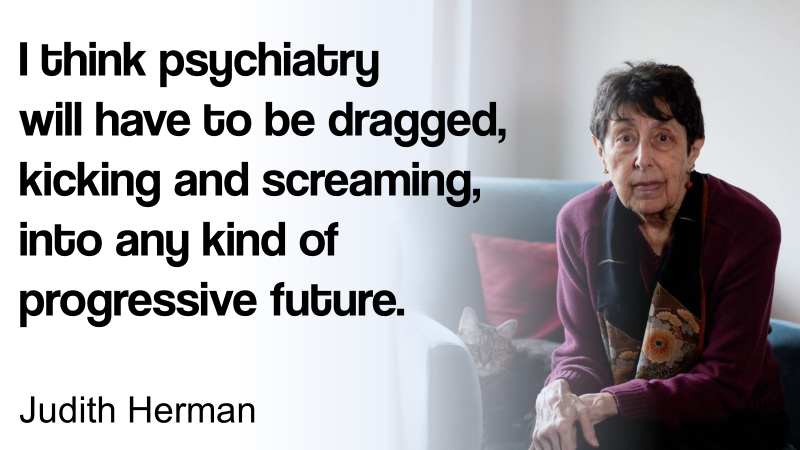
This does not seem to trouble her at all. “In my own life, I feel like I’m in a good place,” she said. “On the other hand, I think psychiatry will have to be dragged, kicking and screaming, into any kind of progressive future.”
A pledge
When Herman and van der Kolk met in the 1980s,she was treating the daughters of working-class Irish and Italian families, who were coming forward with stories of sexual abuse. He had been treating veterans who seemed trapped in the past, exploding with extreme rage at minor frustrations.
She was reserved; he was expansive. Herman likes to call herself “plain vanilla,” doggedly faithful to psychodynamic psychotherapy; van der Kolk is “flavour of the month,” always exploring new treatments, first Prozac, then body work and eye movement desensitisation and reprocessing.
They had this in common: The patients they treated had been routinely dismissed by the psychiatric establishment as malingerers or hysterics. “We were in explicit agreement,” van der Kolk said. “We noted that people in academia were often very cruel to each other, and we made a pledge to have each other’s back.”
The diagnosis of PTSD was brand-new, having first appeared in the Diagnostic and Statistical Manual of Mental Disorders, or DSM, in 1980, and the Boston area, van der Kolk said, “was to trauma what Vienna was to music.” A trauma study group convened monthly in the elegant stretch of Cambridge mansions known as Professors’ Row.
They argued, Herman said, about “what counted” as trauma. “The guys who worked with the vets, we had some back and forth, shall we say,” she said. “We had some knockdown drag-outs, calling out the sexism of the men who thought combat trauma was trauma and everything else was just whining.”
Herman is widely credited with putting this question to rest. “Trauma and Recovery” addressed a general audience in “measured, gripping, almost surgically precise” language, as the Times review put it, and with the authority of a Harvard psychiatrist.
Her ideas also radiated into the communities where she practised, said Rosie McMahan, whose family worked with Herman and her colleague Emily Schatzow to confront sexual abuse by her father.
“She did this remarkable thing — ‘Wait a minute, the same things that were happening to those soldiers, in a sense, happened in families,’” said McMahan, whose book, “Fortunate Daughter,” describes her family’s reconciliation. “They recognised that it was trauma and called it such. They behaved as if it was.”
Their ideas were gaining ground. In 1994, the editors of the DSM expanded the definition of PTSD, dropping the requirement that the traumatic event be “outside the range of usual human experience.” Herman and van der Kolk began lobbyig for the inclusion of complex PTSD, the result of recurring or long-term traumatic events.
Then came what’s known as the “memory wars” — a pushback from leading psychiatrists against therapy that encouraged patients to unearth memories of sexual abuse. The criticism often zeroed in on van der Kolk, who served as an expert witness in high-profile cases, and Herman, whose work on dissociation was regularly cited by defenders of repressed-memory therapy.
Herman shrugged off this critique as “predictable,” the same resistance that Vietnam War veterans and rape victims had encountered when they came forward. “You know, history is a dialectical process,” she said. “When you have a movement that challenges the power structure, you’re going to have a backlash.”
Since the mid-1990s, the editors of the DSM have consistently opposed further expanding the definition of PTSD. The original definition was “intentionally strict, meant to avoid the possibility that all mental disorders are simply caused by trauma,” said Dr. Allen Frances, who chaired the task force for the DSM’s fourth edition.
While stress contributes to most psychiatric problems, he said, PTSD diagnoses can be made quickly and carelessly, without pursuing underlying mental disorders, such as anxiety and depression. Taking that leap, he added, means “all the rest of the knowledge ever accumulated about mental disorders goes out the window.”
Pain of unexplained origin
On the day she broke her kneecap, Herman was preparing to deliver a workshop on her latest findings, and was carrying a carousel of slides to a projector. She was distracted and did not see that a binding had come loose from the rug.
Herman has offered vague explanations for the 30-year gap between her books. “Life intervened, in the form of illnesses and a move to an assisted-living community,” she writes in a forward to “Truth and Repair.” In an interview, she flicked away the question, calling it “a very long, sad tale which I won’t bore you with.”
But there is a story. Her kneecap healed, but nerve tumours had formed in her leg, and the pain grew steadily worse. For long stretches, daily life became a challenge. There were remissions, but there were also times she could not get out of bed, where even changing positions was “extremely, extremely painful.” At one point, she was so desperate that she asked a doctor if he could amputate her leg.
“All you could think about was pain,” she said. “It wasn’t even thinking about pain. It was being pain. One’s existence was just pain. It’s like being in a tunnel.” Like “your whole existence is pain, and nothing exists outside of it,” she added.
There was a subtext in her doctors’ response, early on, which she, as a fellow physician, was uniquely qualified to identify: They did not quite believe her. “I was a middle-aged woman with pain of unexplained origin,” she said. In the jargon of medical residents, she said, she was a “crock,” or a female hypochondriac.
Eleven years and three surgeries later, her doctors said there was nothing more they could do. This was the worst of it, when there was no hope of reprieve. “It made me not want to live,” she said. “That is literally what happened.”
A remedy appeared in 2019, almost by chance. She had gone to see a surgeon about arthritis in her hand, and instead, he peered at her knee. After she left, he emailed her an article about a surgery that had been developed at Walter Reed National Military Medical Center to treat amputees, war veterans from Iraq and Afghanistan.
Later that year, surgeons removed the damaged nerves, sutured them to a motor nerve harvested from her quadriceps and then implanted them into her muscle. She weaned herself off fentanyl, set aside the brace and the crutches. She compared the relief she felt to the sensation women have when childbirth ends.
“I mean, it’s really heavenly,” she said. “I’m in a permanent state of gratitude.”
And that, she said, was why she had the energy to finish another book.
“It’s a totally crazy story,” she said. “I owe it all to the forever wars.”
This article originally appeared in The New York Times.
The overall aim of this workshop is to begin building an understanding of the many and various ways that life can leave us wounded that is large enough, wide enough, and deep enough it enables us to generate the kind of capacity for supporting individual, family, community and cultural healing that we will need as we face the future.
Learning Objectives
Those who participate in this workshop bill be better able to
Express a meaningful understanding of trauma in simple language that is compassionate, pragmatic, and that need not break our brain, yet enable us to generate maximum capacity for learning, connecting and healing.
Appreciate the limitless ways that life can leave us wounded, and the infinite variety of how that very unhealed woundedness manifests in uniquely personal ways.
Begin to identify our own need for healing.
Appreciate and identify how unhealed trauma-woundedness manifests in the ways we tend to shape our world, especially in our relationships, in our teams, workplaces and institutions and in our culture.
Turn our attention away from categorizing to ways we can support healing individuals, families, groups, communities, cultures, peoples and at societal level.
Play our part in building a world that leaves us less wounded and less often.
Work in ways that support growing our collective capability to heal ourselves, and each other at individual, family, group, communities, cultures, peoples, and societal levels.
Workshop Description
Please Note: This workshop will not seek to offer a definition of “trauma”: what trauma is and what trauma isn’t.
We believe that attempting to do so is futile and restricting, and more often than not results in more people being left traumatized by how they experience life; experience support from services; and also hinders and even prevents healing.
It also prevents us finding and treating ways we can support individuals, groups, families and whole communities in healing.
This excludes and silences so many of us; and especially those who need support most.
It denies us support and it disables our whole society society from moving toward collective healing.
We can make a different choice.
No amount of the kind of conversation we are having about trauma to date will heal us.
It will, and can only, result in more of what we have already: only those privileged few who have been deemed to be “just traumatized enough” are offered any kind of support at all.a
Two Day Workshop:
Trauma: less bollox, more healing
Tue 25th & Wed 26th July 2023 9:30am to 5:00pm
Fee: $400
Location:
Church of The Holy Trinity Trinity Square Toronto
Note: This workshop is in-person only. Note: This workshop takes place on first floor- there are two flights of stairs.
Full description follows below: after the registration box.
The conversation around trauma is expanding faster that any of us can keep up with. Many are fighting to have their own pain and struggle included a trauma context.
Conversely, many others fight to resist that, claiming only they have knowledge, expertise, power, and authority to define what trauma is and what trauma is not. Some even going so far as dismissing the very real, living pain that others live with others as #nottrauma, or #notrealtrrauma.
This results in many – even the vast majority – of us being excluded from consideration that their own struggle-in-life is related to their experiences in life; and especially how they have been treated since whatever happened did happen; and more especially how they are treated when they seek support from services.
We only need be willing to open our eyes to see that it is plain as day that many of our institutions and services fail wholesale, the many who live with the woundedness of living as a human in this world that seems, daily, to be made by humans to be one that is less and less suited for humans to flourish.
And, much of the talk to date about “trauma informed is just some huge bunch of gold plated, gilt edged, utter, utter bollox.
And, more tragically, even many of those health services, and even more so, some of those claiming to be “trauma-informed” also fail us miserably, some even shamelessly.
No amount of more of the same will never be enough
No amount of more of the same will enable us to find a way out of this mess.
No amount of more of the same power struggles between those institutions and individuals who claim sole right to define our pain will help us move towards finding and creating ways to heal our own pain, nor to find and create ways support each other in healing.
No amount of more of the same treating trauma as something that only a highly trained professional can possibly understand or can possibly have anything to offer to help us find our way to healing.
No amount of more of the same thinking that trauma as a very narrowly controlled-by-experts list of very specific life experiences that can happen to an individual will help us understand, help us heal, or support each other in healing.
No amount of more of the same defining trauma as a solely individual experience , will help us truly understand when trauma is also a collective and cultural experience.
No amount of more of the same defining trauma as a deficit, deficiency or disorder, and cf categorizing those individuals, groups families, communities and cultures as being deficient, disordered or just plain not up to living in a cruel, unjust and often uncaring world will lead us to find and create pathways of healing.
No amount of more of the same regarding trauma as something that only a highly trained professional can possibly understand will get us anywhere other than where we are now.
And, no amount of more of the same old bollox will help use create a world that leaves us wounded less or less often.
What if…
What if we took just some of the energy, attention, and resources that are consumed by seeking to win unwinnable arguments, seeking to define what trauma is and what trauma is not, and used it instead to inquire curiously how we could build new ways of understanding that promote learning, connecting and healing?
We will need to have a different conversation about trauma, and the first step to doing that is to resist the temptation to continue having the same conversation that we keep having about trauma.
This workshop offers an opportunity to participate in and to experience a different kind of conversation about trauma, woundedness, learning connecting and healing.
Trauma means wound – and life can be wounding.
The woundedness we can be left living with lives in our body, mind, spirit, relations, and spirit and
manifests in an infinite variety of ways. Each of us is wounded in our own unique way, and each of us can find our own unique pathways to healing.
Wounds can heal – if we have the supports that we need to be able to heal. There are no prescriptions, templates or cookie cutter recipes.
We will need to learn to have a different kind of conversation
If we are to get ourselves out of this mess we made – the mess that we made- then we will need to learn to have different kind of conversation.
The workshop: Trauma: less bollox, more healing offers an opportunity to participate in and experience the beginning of a different conversation.
A conversation intended to find and build a different kind of understanding that can enable us to co create co generate new ways, and re-energize some older ways to, that we can shift focus to ways we can support individuals, families, groups, communities and cultures in healing and supporting healing.
And, the workshop is designed as a first step.
Over the two days we will engage in learning with and from each other, dialogue and curious inquiry
Day One will focus on sharing multiple understandings and hearing multiple perspectives and understanding how our understanding of trauma can itself lead to those seeking services being more traumatized, and how they may be more conducive to healing.
The aim is to allow us to build deeper, more full understanding trauma, how it affects our lives , and implications for how we design, fund, manage and operate services , especially those intended to support healing, and that enables us to generate new ways, and to re-energize some older ways, that support learning, connecting, and healing.
Day Two will shift focus to making more concrete – we will use an open space technology format in which participants design their own projects, and focus on area of interest to them, e.g. a deeper inquiry into some ideas or some aspect or aspects already touched upon, or co creating and prototyping new ways of bringing to bear an understanding of trauma that better healing and that address concerns in work, team or organization.
What Participants have said about this workshop…
What I’m taking away from this workshop
I expected to unpack my biases about others, I unpacked biases about myself.
Participant
A really excellent workbook of tools and resources !! This is a keeper!
Participant
I’m taking away the idea and knowledge that we can choose our language, from: “Victim” & “Aggressor” to: “One who has been hurt” & “One who has hurt others”. I love this recognition that we’ve all hurt another + been hurt by another. this was such a learning for me.
Participant
I will be taking away the body and grounding practices that were implemented throughout the session as I felt these were helpful and important in developing awareness and being present with the self & what’s surrounding us.
Participant
There is no one way to heal and healing doesn’t mean I have to relive / remember / remind myself of my trauma (more how I felt as total description).
Participant
I really enjoyed the exercise of identifying what is bollox vs [healing ] with the sticky notes and being able to reflect on what I learned from others and what they were able to take from my contributions.
Participant
I also am taking away the value of how I share my story: What is necessary to share? Why am I sharing? Who is served from my sharing ? (Do I feel pressured to share ? Am I sharing to make myself feel better at the expense of others’ well-being ?) What are the valuable pieces of this ? Do I need details or is the focus the feelings, thoughts, etc. “Shitty Shit” is often enough.
Participant
I think the main take away has been realizing that trauma isn’t necessarily the shit that happens to you or to others, but what comes after. This feels to be like transformative justice in some ways. In other words, practicing and embodying the kinds of environments, relations and world I want to live in.
Participant
Raised a lot of questions for me about how I think about trauma. I need to learn / explore more. -And I’m going away with an abundance of ideas where I can do that.
Participant
Everyone experiences trauma differently.
Participant
The exercises helped to apply what we learned and further share our narratives and feelings.
Participant
I’m still learning how to understand what the heck trauma really even is; learning about my own, but not alone, rather, with others. I’m doing my best and trying to show up.
Participant
How would I describe this workshop to others…?
A holistic workshop that speaks to the wisdom of your body and how trauma presents itself so uniquely in each of us, as individuals.
Participant
It allows us to transform “US& THEM” language into language we can learn from, shifting accountability and recognizing we’ve all both hurt another and been hurt by another.
Participant
I would describe this workshop as a welcome space to begin opening up a dialogue on trauma. What I mean by this is that there is no pressure to talk about trauma: that is your own trauma. Sometimes we just need spaces like this to exist to even get to a point where we can share respond, and listen. Thank you.
Participant
A way to develop an understanding of what trauma means, and how unhealed wounds affect how we lead our lives and can have a more open understanding & compassion for people (and myself)
Participant
A space to process how “trauma healing” can be helpful & harmful – what works and what hurts.
Participant
A space that uses theory, processing, and sharing circles to better understand what trauma, healing and bollox can look like, and empowers participants to be their own experts in their healing. Its not what we do but why we do it.
Participant
This workshop explores the concept of trauma from non-conventional perspective, allowing for the sharing of lived experience combined with theory. – You will walk away with more questions than answers
Participant
Expect to experience an “unlearning” of what you thought you know about how trauma is conceptualized, as well as its treatment.
Participant
It was an open space to be vulnerable and looks at trauma differently while considering other understandings of these topics.
Participant
There was a feeling of mutual respect and interest in each others’ ideas that was fostered by the facilitators.
Participant
I really liked the safe space that was cultivated during the workshop, I liked the interactive style of [presenting] and as previously mentioned, I liked the breaks. I really learned a lot.
Participant
It was an open space to be vulnerable and looks at trauma differently while considering other understandings of these topics.
The exercises helped to apply what we learned and further share our narratives and feelings.
Participant
unbolloxing
articipants in these workshops:
Participant
• Trauma: less bollox, more healing,
• UN_ESCALATE
will be invited to join our community of leaning and healing, which we have chosen to call: unbolloxing.





































 agnotarte
 dave umbongo
 drkenplacebo
 highfellow
 recoverynetwork:Toronto


 recovery network: Toronto
You must be logged in to post a comment.