
In the Globe and Mail yesterday – Madeleine Meilleur, the Minister of Community Safety and Correctional Services steps forward to take responsibility for reviewing how police respond to calls involving people in mental health distress.
This is very welcome – and about time too – Toronto police officers shot dead three people in the last year when a different approach would likely have led to very different outcomes for everyone.
It is easy to want to blame the officer who pulled the trigger for overeacting in a situation like this but it is likely that in these situations the officer’s training is clicking in exactly the way it is designed to. So we need to redesign the training that police officers receive and we need to give officers on patrol a broader range of skills to deal with these difficult and complex situations than squeezing the trigger .
Of course the majority of these calls does not end this way but many do end in lower levels of violence and likely many could be dealth with without any police involvement at all.
And it is likely merely another symptom of a “mental health system” that is failing chronically.
Bullets and pills
That police officers need different training for these situations – this much is obvious. What may be less obvious is why does it fall to armed police officers to deal with so many situations where someone is experienceing severe emotional distress? Really in a society that boasts to the world of it’s compassion, is that all we’ve got?
With more people finding themselves isolated , distresed, ill, with longer wait times in emergency, lack of any treatment or responbse beyond pushing pills a depot injections, and other services being chipped away at daily, police find themselves more and more often called to situations where someone is experiencing a difficult emotional state. And yet they likely than not have little or no suitable training. Ask a police officer if they think they are the best people to deal with these situations.
For some time now other police services round the world including some a short drive down the road in Ontario have been learning and changing their approach for some time. In Toronto this has not been made a priority. Shame on you Chief. Shame on you Police Commissioners.
Listening works better than escalating violence every time. There really ought to be very few instances when it becomes necessary for police to pull a gun and shoot someone. Three shootings in a year suggest a change ought to be made a high priority – were it any other group in society then it certainly would have been.
Even the best training, by itself is not enough
And we need to do much more than simply put officers through a training course. But it is a start and it’s good that minister has taken the initiative.
But lets have more – we want workable ways for peers who’ve been on the pointy end of current police methods to work alongside and with police teams when they to respond to such incidents : examples already exist and work well – and in Ontario.
So, lets hope it happens quickly rather than the typical years and years of analysing scratching chins. We need change before another bullet enters another chest.
from globe and mail…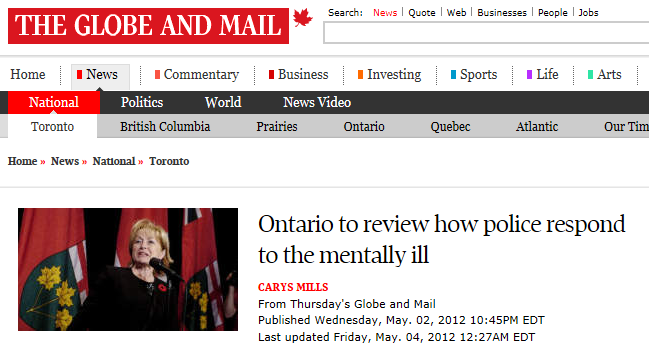
Ontario to review how police respond to the mentally ill
CARYS MILLS
From Thursday’s Globe and Mail
Published Wednesday, May. 02, 2012 10:45PM EDT
Last updated Thursday, May. 03, 2012 5:29AM EDT
Ontario’s minister in charge of policing has ordered her department to review how officers across the province respond to people in the throes of mental illness after a string of fatal shootings by police.
“We need to take a step back and see what are we doing and what is done elsewhere, and to come out with recommendations,” said Madeleine Meilleur, the Minister of Community Safety and Correctional Services, in an interview.
The move comes on the heels of an announcement that Toronto police will review its protocols after three recent deaths.
Standards enforced by the province are minimal and in many cases individual forces have bolstered their training and response methods related to mental illness only after coroner’s inquests have made recommendations following tragic deaths.
A Globe and Mail investigation earlier this year found that the amount of training and how police approach people in psychiatric crises varies widely.
Ontario’s review will attempt to find best practices by consulting experts, including the province’s chief coroner and forensic pathologist, Ms. Meilleur said.
“We read too often in the paper that there’s an unfortunate incident that occurs,” she said. “I’m not attributing blame here because … the police officers arrive on the scene, they don’t know … the individual they face is someone with mental illness.”
The closing of beds and the move away from institutionalized mental-health care in Canada has put the responsibility of responding to people in crisis more and more in the hands of the police, who have limited access to health-care experts in these crucial moments.
“Health issues and health problems are always on my mind,” said Ms. Meilleur, a former nurse, who was appointed to her portfolio last October.
John Pare, the deputy police chief in London, Ont., who sits on the justice committee of the Ontario Association of Chiefs of Police, said he welcomes recommendations from the province. Police are looking to improve their response to people in crisis, he said, but health needs to improve so police aren’t the default responders.
While officers are instructed to use lethal force when someone poses an imminent threat to a person’s life, advocates say officers could be better equipped to de-escalate crisis situations before they reach that point.
Recent fatal shootings in Toronto include that of Sylvia Klibingaitis, who called 911 herself last October and said she was bipolar. The province’s police watchdog, the Special Investigations Unit, cleared police in the case and said she went toward an officer with a knife.
Michael Eligon, 29, was shot in February after he fled a hospital wearing only a hospital gown. The SIU, which cleared officers in that case too, said he was carrying scissors and threatened police. About a dozen officers surrounded him, shouting demands that he ignored, the SIU said.
Ms. Klibingaitis’s sister, Anita Wasowicz, said she welcomes the province’s review but wishes it happened sooner. “My sister’s death can at least be a stepping stone toward preventing other families suffering like we are,” Ms. Wasowicz said. “She shouldn’t have died in vain.”
She said she believes officers escalated her sister’s crisis by approaching in an authoritative way, shouting and pointing their guns. “Individuals in a crisis can’t often listen to orders,” she said.
The decision to launch the review is recent so there’s no deadline yet for the recommendations, said a spokeswoman for the minister.
Mental health lawyer Anita Szigeti has advocated for a public provincial inquiry but so far the ministry has no plans to open the review up for public input. But Ms. Szigeti said the probe is still a good start. “We’re admitting that there’s a problem,” she said.
She said existing response teams that pair mental-health professionals with police need to be changed so that they can respond to 911 calls first. Some police forces have teams now for parts of their jurisdiction but they aren’t available 24/7 and are often unable to respond until front-line officers have deemed a scene safe.
For front-line officers across the province Ms. Szigeti said there should be intensive training like a 40-hour model developed in Memphis, Tenn. The training, which was recently adopted in York Region, includes exposing police to people with mental illnesses when they are not in crisis.
Ms. Szigeti said the review should look at alternatives to lethal force, including tasers, for front-line officers who are first to arrive to scenes. But the minister said the province is not looking to change its policy, which sets out that only supervisors and specialized units can carry tasers.
Dorothy Cotton, a psychologist who has reviewed officer training across the country, said police dispatchers also need better training so they know the right questions to ask and information to relay to officers about someone’s mental state.
All new recruits get brief crisis training at the Ontario Police College but training within forces varies widely. There needs to be more consistency, Ms. Cotton said, although communities will have their own needs. “There is no one-size-fits-all model,” she said.
Public outcry over police awareness of mental-health issues was reignited in Toronto last summer over the case of Charlie McGillivary, a 46-year-old disabled man who was unable to speak. He collapsed and died after he was taken down by police in a case of mistaken identity. The SIU cleared officers in the case.
Related articles
- Families of people shot by police want to aid better understanding of mental illness (theglobeandmail.com)
- Stop killing the mentally ill, citizens plead to police (thestar.com)











































 agnotarte
 dave umbongo
 drkenplacebo
 highfellow
 recoverynetwork:Toronto



 recovery network: Toronto
You must be logged in to post a comment.