
So good we asked her to sing it twice, so we could capture this…
Alex Arena singing self-penned “Ambience” at MADx.
So good we asked her to sing it twice, so we could capture this…
Alex Arena singing self-penned “Ambience” at MADx.
Boxing Kitty says…

Santa baby’s Origins story.
 My dreams are like torments
My every moment
Voices in my brain
of friends that were slain…
..telling me
keep going, dont give up
Episode from Global News’ series Living In Colour.
How a person’s “mental health” can be impacted by cultural expectations, stereotypes and discrimination.
Host Farah Nasser speaks with four people of colour, including Uppala Chandraesekera, Munira Abukar, Asante Haughton and David Lewis-Peart, on how race impacts a person’s mental well-being.
 “The Water Wars continue!
Many think that the movement at Standing Rock has come and gone, not knowing that was only a wake up call to what is happening around the world!
Indigenous people continue to lead the fight against big corporations who only wish to profit at the expense of the people’s well being in the fight for clean water.
In 2017 Taboo of the Black Eyed Peas pulled together some amazing Indigenous artist on a song and video titled “Stand Up” (For Standing Rock) which went on to win an MTV VMA award which veteran Native emcee Supaman was a part of.
The fight continues in this hard hitting visual masterpiece where Supaman teams up with grammy nominated Maimouna Youssef from the Choctaw nation to inspire, educate, motivate, and encourage those still standing in the global fight to clean water.”
Supaman
Youtube: https://www.youtube.com/channel/UCK3FcmL4OXk9Dp2QtAitF
Facebook: https://www.facebook.com/Supamanhiphop/
Website: https://supamanhiphop.com/
Twitter: @Supamanhiphop

 Back by popular demand…
Get on the bus, start your 2019 by tilting your universe blowing your mind and / or gaining a whole new perspective on experiences that we’re taught to fear and to believe that we can’t possibly understand in simple, human terms.
We’ll be joined by some cool folks working at the intersections of trauma, psychosis, homelessness and in a system that many can see is overwhelmed and creaking at the seams.
More of the same will never be enough so how do we do different?
You can start here.
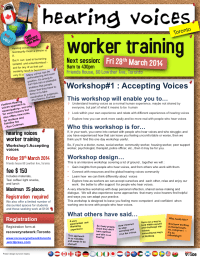
Pleased to announce, in community partnership with Inner City Family Health Team, this special opportunity to participate in our highly valued “liberating” , emancipatory”, even “universe-tilting” Workshop #1: Accepting Voices.
“You gave me a whole new way of thinking about voices”
This workshop offers a beginning, an introduction to a non-diagnostic, non-medical, human experience perspective understanding of the kinds of experiences – like difficult-to-hear voices- that are often categorised as “psychosis”.
A key part is making connections between pain, trauma psychosis powerlessness and disconnectedness we can experience when we find ourselves feared and discarded by society.
 Hearing Voices Workshop#1
Accepting Voice
Thursday 31st Jan 2019
9.30am to 430pm
69 Queen St East
Toronto
Spaces are VERY limited
and registration is required.
Fee
Worker $150
Community $125
Online at Eventbrite:
Full description below. There’s also a [pdf] printer friendly version.

If so, then this workshop might help you tilt your universe and emancipate yourself with very simple and very human ways to understand and begin to act to support a person who struggles with difficult experiences that get called names like “psychosis”.
Our aim is that you can feel more confident in your ability to offer yourself as a one-person safe space to people who hear voices and struggle.
Note: If you’re looking for a workshop on how to diagnose and categorise your friends, family and colleagues and what dehumanizing names to call yourself and them, then know that this is not that workshop.
Our aim is that you can feel more confident in your ability to offer yourself as a one-person safe space to people who live with experiences that get called names like “psychosis” and that can be difficult to live with and more difficult to talk about.
This Workshop is part of a structured and modular approach to learning, and is a first step that is designed to offer a basic grounding but also foundation for further, deeper learning and practice in supporting people who struggle with experiences like difficult to hear voices that get called “psychosis”.
Participation in this workshop is prerequisite to other more advanced and learning opportunities, eg…
Note: If you prefer a print version of this description, try the pdf version:
This unique and innovative workshop offers you a non-diagnostic understanding of the kinds of experience like hearing voices that are that are sometimes called “psychosis”.
We offer you simple, everyday language to show you how you can understand such experiences not as “disconnected from” but intimately connected with reality and in ways that can be overwhelming, painful, frustrating, sometimes terrifying response to the reality we share,
It also offers a framework you can use to connect and draw from your own experiences to help you truly empathize and understand how better to support people who might be undergoing such difficult experiences.
You’ll leave feeling more at ease with both yourself and your ability to offer yourself as a one-person safe-space to people who struggle.
Join us in enacting a society that understands voice hearing, supports individuals who hear voices and views them as full citizens…
What you can expect and connect yourself with a community of people doing just that.
We believe the hearing voices approach is emancipatory for all.
Workers
If, in your work, you work with you come into contact with people who hear voices and who struggle with that; and you have experienced how that can leave you feeling uncomfortable or worse, then we think you’ll find this one day workshop useful.
So, if you’re a doctor, nurse, social worker, community worker, housing worker, peer support worker, psychologist, therapist, police officer, etc. then it may be for you.
Families, carers, everyone.
The workshop is also highly suitable for you if you love, live with, care for people in your life who hear voices and struggle with that – and you have come to realise the limitations of an approach that limits understanding to illness-brain chemicals and you are curious about how else you may understand, and what else you can do…
This is an intensive workshop covering a lot of ground, together we will :
This workshop is designed to leave you feeling more competent and confident in your own ability to offer yourself as a one-person safe space for people who hear voices.
You will not become an expert in one day but you’ll have a good basis for starting and feeling more comfortable – and more human – as you do.
Please feel free to help us let people know about this workshop by printing, posting, distributing, however you can with your networks…
Or, hand to your worker, colleague, or boss, and ask…
“Q. When are you going to do this training?”
Printer-friendly poster [pdf]
HV Wkshp#1-Accepting Voices-Poster-31JAN2013
K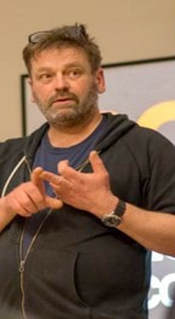 evin Healey hears more voices than you can shake a stick at, so many that even his voices hear voices, and has done so for longer than either he – or they -care to remember.
Founder and coordinator of www.recoverynet.ca, Toronto Hearing Voices group, Anglophone Canada’s longest running, and of the Hearing Voices Café.
Creates and delivers innovative, taboo-busting talks, trainings and workshops that enable people to find new language, and simpler ways to understand surprisingly common human experiences that we’ve made fearful and taboo, so making life even harder both for those who struggle and also for the rest of us to understand.
Shows how we can make simple sense of trauma, pain, psychosis, taboo, and butt-hurt voices, and how they interweave and interconnect our inner-struggle with living in an outer-world that is fast becoming unfit for humans who built it and in which we keep creating results that nobody wants. After you’ve heard him talk you may join those who say they don’t hear voices but now wish they could.
Also Coordinator for the Toronto branch of ISPS-US International Society for Social Psychological Approaches to Psychosis.
 Dave Umbongo
For many years Dave would only say only one word, now he authors articles at http://www.recoverynet.ca and moderates online support groups for voices to talk directly with each other round the world, and he coaches and co-presents in workshops for approaches like voice dialogue.
Enjoys creating memes: out of things voices say, about living in a universe that mostly comprises what he refers to as The Weird, and his own wry observations on the human obsession with calling each other horrible names, categorizing and crushing each other into boxes that don’t fit.
Voices have stories too: His favourite pastime is pretending to be a jelly bean, second is remarking upon how “voices” and “humans” behave in ways that are often very much the-one-is–like-the-other. Dave doesn’t really have a bio – like other superheroes he has an “Origins Story”, and like “The Truth…”, at least some of it, “is Out there…”
 Mark Roininen
Mark has many years experience as “worker” with a major social services agency, and has worked with many who struggle with the kind of experiences that get called “psychosis”.
He shares his personal perspective of how being confronted with his own dark side enabled him to relate more simply and authentically with difficult experiences of the people he works with, in-process, freeing himself from merely following “the script” and playing “invisible worker” so that he can be both more professional and more human.
His ability to share stories of his own experience of learning how to do this work offers others hope that they can too.
When we learn to put aside our fear of both ourselves and each other we generate possibilities, to create new roles, to connect with each other, and to find richer experiences of being human and co-create a world that’s easier to live in for all of us.


Mental Health
We made it all about drugs.
 Sometimes it brings you down
Flawless (Go to the City)
George Michael



































 agnotarte
 drkenplacebo
 recovery network: Toronto
You must be logged in to post a comment.