
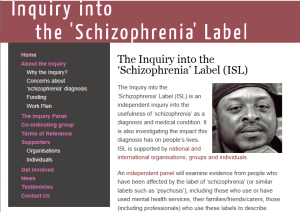
 Inquiry into the ‘Schizophrenia’ Label

An independent Inquiry into the ‘Schizophrenia’ Label has been launched on 16th April 2012 by a group of organisations and individuals concerned about the meaning and usefulness of ‘schizophrenia’ and similar labels such as ‘psychosis’.
The Inquiry aims to investigate the impact this label has on people’s lives and to collect evidence from people, including mental health service users and carers, those (including professionals) who use these labels to describe mental health problems in other people, and those who have concerns about the use of such labels.
Please visit the website www.schizophreniainquiry.org for more information and to submit evidence to the Inquiry.
You can submit evidence via the website by completing a questionnaire or writing to using the testimony form at http://www.schizophreniainquiry.org/get-involved
The evidence collected will be examined by an independent panel made up of service users, academicians and a lawyer.
The panel will produce a report based on this evidence which will be forwarded to a range of organisations including NICE, the Royal College of Psychiatrists, other professional and statutory bodies, private and third sector organisations, and the Department of Health.
This Inquiry has no financial ties to any organisation and is supported initially by around one hundred individuals and over 20 national and international organisations.
You can also use the website to register your support and to spread the word about the Inquiry.
Please email info@schizophreniainquiry.org if you need any further information.
We look forward to your support.
Suman Fernando
Jayasree Kalathil
Phil Thomas
Jan Wallcraft
[Coordinating Group]
______________________________
Press Release
Press release – Embargoed 00:01 16/04/12Inquiry set to question mental health labels
Is the label ‘schizophrenia’ stigmatising people or helping them, a new independent inquiry is set to find out.
With many more poor and black and minority ethnic (BME) people labelled ‘schizophrenics’ than other groups, the diagnosis has been controversial for a long time.
Supported by 23 national and international organisations and 100 individuals, experts and those who have lived with the label are getting together to explore whether the label is useful or counterproductive.
The inquiry will investigate the impact the label ‘schizophrenia’ has on people’s lives and collect evidence from mental health service users, carers and medical professionals among others.
An independent panel consisting of service users, academics and a lawyer will examine the evidence collected and make recommendations to professional, statutory and voluntary sector bodies such as the Department of Health, the Royal College of Psychiatrists, the National Institute for Health and Clinical Excellence and mental health charities.
The inquiry, which has not sourced funding from any organisation, will collect evidence via their website www.schizophreniainquiry.org.
Retired psychiatrist, Dr Suman Fernando, one of the four people co-ordinating the inquiry, said: “We are aware of the increasing unease, even among psychiatrists, about the use of ‘schizophrenia’ or ‘psychosis’ to describe complex problems of living. More importantly, when these are used as labels attached to people, they can cause stigma and undermine the humanity of people given these labels. Indeed, some people seem to suffer from the labels more than they do from other problems of living. Black people in Britain have historically suffered disproportionately in this way.”
Dominic Makuwachuma-Walker, who has experience of being labelled, and is a member of the inquiry panel, said: “The time is right for finding out really what is going on when we label people with a psychiatric diagnosis such as ‘schizophrenia’. Does this label provide the help that some people may actually need or are we just propping up a multi-million dollar research and pharmaceutical industry? And how do we take on board the different cultural meanings that people give to experiences that are being diagnosed as ‘schizophrenia’?”
The evidence-collection phase of the Inquiry will run until June 2012; the report will be published in October 2012.
-ends-
Notes to Editors:
- For more information on the Inquiry, please visit www.schizophreniainquiry.org or contact info@schizophreniainquiry.org.
- For telephone enquiries about the launch of the Inquiry, please contact Dr Suman Fernando at 02074859122 or Dr Jayasree Kalathil at 07906165614.
- 2011 marked the 100th anniversary of the ‘schizophrenia’ diagnosis by the Swiss psychiatrist Eugen Bleuler. Since the term was coined, it has remained a controversial diagnosis, with some people, including psychiatrists and academicians, questioning its validity and usefulness.
- Several studies have shown that, in Britain, people from minority ethnic communities, especially the African Caribbean communities, are five-six times more likely to be given a ‘schizophrenia’ diagnosis than the general population.
In Toronto
Look out for an exent on July 10 at Ryerson as part of Mad Pride
Dr Fernando will be here to speak and Dan Fisher may be skyped in.
Related articles
- Inquiry into the ‘Schizophrenia’ Label (madinamerica.com)
- Schizophrenia: 100 years of bad treatment (recoverynetworktoronto.wordpress.com)
- Black and minority ethnic mental health patients ‘marginalised’ under coalition (guardian.co.uk)
- Symptoms do not Correlate with Quality of Life in Schizophrenia (madinamerica.com)
- Black and Mad (madinamerica.com)







































 agnotarte
 dave umbongo
 drkenplacebo
 highfellow
 recoverynetwork:Toronto



 recovery network: Toronto
You must be logged in to post a comment.