
This Will Change How You Think About Attachment Styles
Forrest Hanson at the Well Being podcast…
“I found the simplest, coolest way of approaching attachment styles recently, and it completely changed how I think about things.
It’s based on a model that was developed by psychologists Kim Bartholomew and Leonard Horowitz, who theorized that the four attachment styles (secure, anxious, avoidant, and fearful) could be defined based on just two questions:
Q. Does the person have a positive or negative view of themselves
and then
Q. Does the person have a positive or negative view of other people ?
There are two answers to each of those two questions which means four possible combinations.
And those four combinations map really nicely to the four attachment Styles:
-
-
- People who have a relatively positive view of both themselves and other people are more securely attached.
- People who have a positive view of other people but a negative view of themselves are relatively anxious: they think that they can’t depend on themselves.
- People who have a positive view of themselves but a negative view of other people tend to be more avoidant:
“I can’t depend on them” might be something that they think. - People who have a negative view of both are fearful:
everything is undependable.
-
I love this model because it both makes everything really simple and straightforward while also having a lot of really interesting insight and nuance to it.
For example
What does a negative view or a positive view really mean ?
… and to me I think it gets to trust …
Can I rely on someone or something to meet my needs?
Can I depend on them ?
and we can go through each of the four attachment styles and think about what that looks like in really practical terms..
People who are securely attached tend to be comfortable with both intimacy and autonomy: being by themselves and being with others because
they feel like they can rely on both themselves or other people to meet their needs they don’t need to be either autonomous or intimate all the time.
and they can comfortably swing back and forth from one to the other.
People who are anxious feel like they can only really get what they need from other people, and they can’t rely on themselves to meet those needs
This tends to lead to a lot of clinging behaviors where they become over invested and overly dependent on their close relationships.
People who are avoidant are confident that they can meet their own needs but not so confident that they can rely on other people.
This this tends to make them compulsively self-reliant
often because being genuinely, emotionally intimate with somebody else is terrifying, and, after all, you can’t get let down if you don’t put yourself out there in the first place.
People who are fearful feel like everything is unreliable
and often they aren’t sure that they can get their needs met at all,
and this can happen because people with a more fearful attachment style tend to come from families – or just have a history in environments – that were chaotic or disorganized, or downright traumatic, maybe.
And this creates a really painful combination of
a low self-esteem on the one hand and high attachment anxiety on the other hand.
This means that they can feel both dependent on other people
while having really intense fears of rejection…
and also a lot of uncertainty that other people are actually going to come through for them.
You might already be thinking about this,
but when I started unpacking this model
one of the best parts about it was that
it felt like it came with a lot of
really clear and ready-made advice for what people can do
in order to work with their unique attachment style,
and move toward more secure forms of attachments:
secure and healthy forms of relating to other people.
For anxiously attached people the key is
improving their view of themselves:
thinking of themselves increasingly as a reliable person
who can meet their own needs without needing to depend on others.
and this isn’t easy
but it could include learning to trust themselves
and getting more comfortable with being
on their own.
and then.
For Avoidantly attached people the key is
improving their view of others:
particularly by learning how to trust
and rely on other people when appropriate
One way that a person might be able to do this
is by running small experiments,
where they gave up just a little bit of control
and see what happens
and then
If something turns out in a way that they don’t like,
Can they have a calm conversation
about their needs with the other person ?
-with the person that they feel like let them down?
For fearfully attached people
they need to feel like it’s possible for their needs to be met at all.
They typically don’t have a lot of experiences with those needs being met.
And they often come from environments where,
when bad things happened they were totally catastrophic.
So many of the people I know with more fearful attachment styles
started working with them just by developing an underlying
feeling of safety.
Particularly, by internalizing the many moments that
we all have in the course of a normal life
where we truly are safe
like, right now:
You can take a breath
and go
“I’m actually okay “
“Maybe things aren’t perfect”
“Maybe my body’s a little uncomfortable”
“but I’m okay”
“I’m going on living”
– and increase some of that underlying feeling of
‘all right, right now…”
This can then make it a lot easier to start learning how to trust
both ourselves
and other people
– a little bit at a time
and this is, in large, part because the risks associated with something bad happening are just annoying
rather than totally devastating
I want to emphasize, here at the end:
There two really key points whenever you talk about attachment theory or attachment styles
and the first one is that
1. Our attachment style isn’t our fault.
Attachment is a combination of nature and nurture
Some people just pop out
a little bit more avoidant
or a little bit more anxious
But one of the key findings in the early research on attachment is
that kids are incredibly responsive
to their environments
and the things that happen to us
early on the circumstances
that we found ourselves in
just aren’t things that we have
a whole lot of influence over
and then second
2. Our attachment Style Isn’t Our DestinyT
The fact that we currently have
certain patterns of behavior is real
but that doesn’t mean that
we have to be a prisoner to them
and, while, in the research the jury’s a bit out on
whether it’s possible for a person to completely change
their attachment style altogether
-that might be a really high bar-
it is definitely possible
for us to be aware of our tendencies
and our blind spots
and actively communicate them
to other people.
Conceptual models like attachment
and even this really simple version of attachment
that I’m talking about here
tend to make clear distinctions between categories:
there are four boxes,
these are the only boxes
and guess what ?
you’re one of them!
you’re one of them! all the time!
and
Sorry you don’t get to pick which box you’re in!
but the truth is that, in reality,
It’s a lot fuzzier than that
and research has shown that it’s possible
for a person to have
different kinds of attachment relationships
with different groups of people.
I was probably really securely attached with my parents as a kid for example.
but I had a much more painful relationship with my peers.
and,
wherever we are right now on the spectrum
from secure, on one side,
to insecure on the other..
It’s really possible for us to move toward
a greater sense of security.
Hear! Hear !
And nice one Forest!
Nice one son!
And, adding to some of that
That thing about “positive” and “negative” view?
That language- that way of dividing the world – is common in psychology and in research.
Its less useful in actual life, which is way more fuzzy, complex and fucked up than that.
Categories are useful, they help us simplify, and understand, and navigate the world, our brains just cant handle all the data it would be required to hold everything in mind.
But we tend forget the categories only exist because we made them up.
– usually made up by someone or someones with the power to make them up and impose on us.
Whether something is “negative” or “positive” is entirely dependent upon where we choose to place the datum – the zero value on an axis.
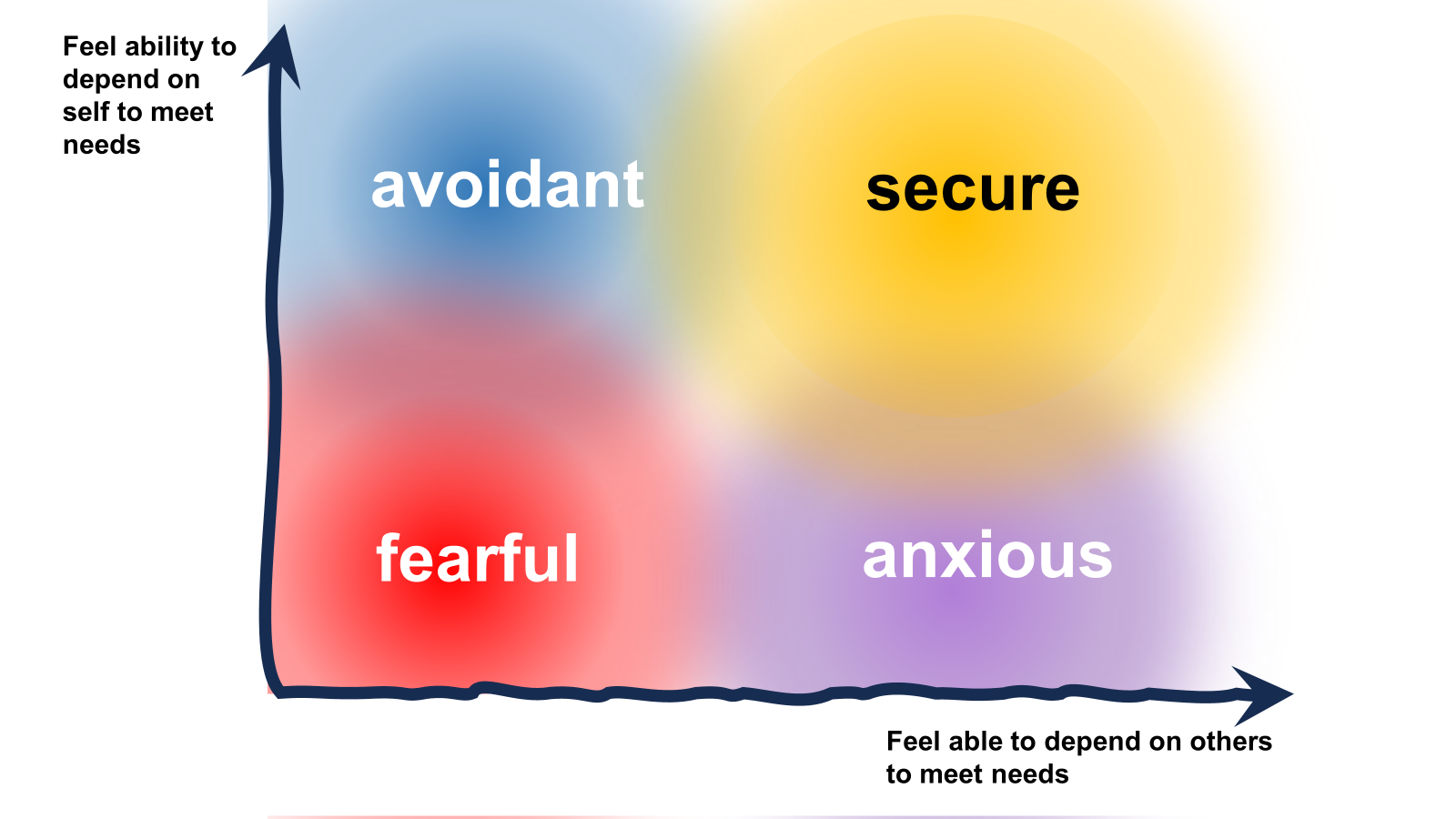
So, for example in the nice little diagram from the research and shared in the video – and shown above – what if we move the datum?
What if we choose a different place to put the datum?
What if we adjust the scale? not to fix whatever style we have in some false fixity: fixed in some made-up category by someone withthe power to do so – decided to bifucate as – “positive / negative” ?
And, lets not forget,
“positive” is a synonym for “good”
and
“negative” is a synonym for “bad”
and that’s part of a long history of crap foisted by humans upon other humans.
Thus the mental models upon which this research is founded reinforce the judgementalism inherent in and intrinsic to the whole field of attachment theory:
“Secure” = “good”
and everything else = “bad”.
And so, anyone who has not been fortunate enough to be born into circumstances that nurtured a perfectly secure attachment style is deficient, broken and , yes “bad”.
Understanding attachment can be hugely useful, not so much if all we do is categorize ourselves and each other into fixed boxes of crapulence.
Whatever attachment style we might have, it is largely a learned response to life circumstances. That it is learned means we can also learn anew.
So, and Forest Hansen doesn’t quite take us there in this short vid , but he does indicate a way we might-
What if we play with the chart?
What if we redraw the lines, what if we position them to indicate fluidity, the constant motion of the universe and the constant flux of life and the ebb and flow of, the relationality of living in the world, or as David Whyte puts it:
“The Conversational Nature of Reality”?
What if we we could adjust the scales – what if we reposition the the X and Y axes – to suggest pathways of how we might nurture, generate and grow awareness, movement, growth, learning, healing?
– in the ways that Forrest suggests and offers examples we might try ?
What if we could?
Well, we can.
I know that because …
I just did it.
And I added some purdy colours to make it more purdy, too.
It might look something like this [below]…
Now, boxes are great,
they’re really useful for keeping crap in.
But a really crappy place to keep people.
Don’t let the boxes made by others box you in.
I broke your box
It didn’t fit me.
Related posts
More on attachment…
- Attachment | Jacob Ham
https://recoverynet.ca/2023/12/03/attachment-jacob-ham/








































 agnotarte
 dave umbongo
 drkenplacebo
 highfellow
 recoverynetwork:Toronto



 recovery network: Toronto
You must be logged in to post a comment.