A Good Use of Heartbeats – Caleb Behn


An excellent profile by Rebecca Carter on Caleb Behn activist and lawyer.

A Good Use of Heartbeats: An Interview With First Nations Activist Caleb Behn

caleb-behnFriday, 01 February 2013 00:00By Rebecca Carter, Truthout | Interview 

Caleb Behn along the proposed Enbridge pipeline route at the Morice River in Houston British Columbia. (Photo: Rebecca Carter)

First Nations activist, attorney and writer Caleb Behn talks about the continuing colonial incursions into his Dene homeland in Northeastern British Columbia, his family and nation’s fight against the extractive industries and bringing Idle No More to a minus-35-degrees-Celsius-environment.

By the age of 31, Caleb Behn had endured 18 facial reconstructive surgeries. He has had 20 screws and 7 plates in his face. At the age of 10, he had his lips sewn shut.

Caleb Behn: I was born with a cleft upper palate and the source of that is unknown, but it is disproportionate amongst indigenous people. It may be a genetic predisposition, but as a result I’ve always had a keen interest in the effect of toxins on children and their development,” he explained. “I’ve spent a lot of time under the knife and having been born humbly, and having to suffer and experience so much pain made me realize that I want to commit myself as a man to trying to relieve that pain in others.”

Caleb is the focal point of a new documentary called Fractured Land by filmmakers Fiona Rayher and Damien Gillis, which explores the ever-deteriorating symbiosis between humanity and the land that we are privileged to inhabit.

Hailing from the Dene homeland in Northeastern British Columbia, Caleb grew up adjacent to the oil and gas industry. He has witnessed from an early age the devastating effects that the industries have had on the environment and the unique and often difficult social climate that arises when cultures clash. With the advent of fracking, an unconventional method of extracting oil and gas, the toll on the land and its people has increased tenfold in the past decade. With degrees in both law and political science, Caleb has been at the forefront of the indigenous movement, representing his people in the centuries-long battle to protect their land and, in turn, the very core of their culture.

Industrial Impact

I grew up in an interesting and beautiful country. We have large amounts of resources of every kind, except uranium – thank God – but we have pretty much everything else.

They’ve been (conventional) drilling here since the ’60s, and Halliburton will say, “Oh, we’ve been fracking since the ’50s,” and I think that’s misleading.

What we saw back in 2007 was the first real rise in unconventional industry development and it happened very quickly. There was water tribute restructuring in Alberta and the oil and gas majors in response didn’t like that, so they pushed out of Alberta and sent their guys east and west to Saskatchewan and British Columbia. The western Canadian basin has the largest hydrocarbon deposit on earth, which just so happens to be contained almost entirely on Treaty 8 land. [Approximately 840,000 square kilometers of land guaranteed to First Nations in the 8th treaty signed between the indigenous of people of North America and the Queen of England in 1899.]

Alberta is very conservative and has always been the bastion of oil and gas and always pushing for the unconventional, so in 2007 we started to see coal bed methane, and then the timber sales, and then we really started to engage the question of fracking.

I always got the history from both my grandpas about how the land had changed in the last 100 years. The land that I grew up in, the land that I thought of as normal by our standards was not. There used to be way more moose and more everything, more beaver, more martins. I always knew that our land was being significantly impacted. There’s a lot of impact because there’s more and more and more development; there’s more forestry, way more petroleum development roads – and with every road comes a parallel increase in every other industry and of course non-indigenous hunters, trappers, campers and I’ll speak quite frankly, a lot of the oil industry guys that I see in our territory aren’t very progressive people; they like big power toys; they like big trucks; they like big guns and they don’t like Indians and they like to mess up the land.

Culture Clash and the “Roughnecks”

The roughneck (oil rig crew worker) culture has come to be a serious and significant culture within the Canadian social mosaic. They use the term roughneck as a term of pride. I don’t mean to judge all of the industry, I know there’s lots of good people, and some of my family works in the industry. I don’t mean to judge them all, but my experience has been there’s a lot of people, a disproportionate amount of rough-and-tumble people, who give conservatives a bad name. There’s a lot of white supremacy, a lot of racism, a lot of biker and biker wannabes. Racism, sexism, and violence against women: These are all big issues and they’ve been identified by public health officials in the territory, but it’s been like that since the beginning. Social dynamics change because cultures change. I suspect there’s violence in most of the resource extraction industries and I suspect that it’s a psychological by-product of the environmentally destructive process, but those are my values speaking. I just have my perspective; I don’t want to stand in judgment. There’s not always violence. There are some great guys who come; there are so many interesting stories of human interaction. There’s something to be said for our territory, we’ve had the missionaries, the settlers, the farmers, the trappers, we’ve had the oil guys and the gas guys and the unconventional gas guys and the dambuilders who come in and they change things – not just on the land, but within the human culture and, speaking frankly, it’s not been good for the indigenous population: That’s the consistent dynamic.

Roots of Activism and Leadership

My grandfather, George Behn was the grand chief of Treaty 8. My mother’s father, John Doty Sr. was the vice grand chief of Treaty 8, so the way that I grew up I was deep in the nation’s politics. I was very aware of the industry; I have family involved in it. We’ve always had this love/hate kind of dual relationship where some family members work in the industry and some family members hate the industry and choose to fight it. I knew that they were impacting our way of life, our land, our family and I can remember from 3, 4, 5 years old … they would have us come and sit in as children and serve tea and just listen to the political discussions our families and our people would have on these issues.

There was a boom in the gas industry in ’83 in our territory and I was born in ’81, so as I came up there were big questions about aboriginal rights in Canada, aboriginal rights generally and what we were going to do as families and as a people – so I was quite engaged and lucky and privileged to be trained traditionally.

My family is very political, but the other side of it is both of my grandfathers try to stay very close to the land; they are very traditional, and my mother’s father was one of the most renowned hunters and trappers and elders in the territory. You can’t describe this man; he’s the epitome of indigenous values. We hunted every summer; we trapped every winter and he was very traditional, very soft-spoken. He’s the one that trained me how to hunt, fish and trap. Hunting with him, I saw my first kill at 4; I got my first gun, a pellet gun, at 4 years old and I was hunting actively from then on.

I killed my first deer when I was 12 and [that] was kind of a big deal. When you kill your first big animal you’re kind of seen as a man within the family and culture. I killed my first moose and my first black bear at 15. When I was 7 years old, me and my grandpa we were out trapping and we caught a seismic exploration team on his trap line and that was the first time I had seen my grandpa get really angry and really upset and we went home and the next day we were calling the family saying they’re exploring up here. So at 7 years old, I was already aware of what happens when the initial exploration happens, the impacts on the indigenous people and the impact on the hunters.

I went to law school because I got tired of paying our indigenous lawyers massive amounts of money to argue what I thought I could argue just as well. I’ve always been attracted to law I think because I come from an oral tradition and trained to be a leader traditionally … and I don’t mean to sound vain: the path of leadership in my community is one of servitude and one of humility. To speak on behalf of your community is a massive responsibility and it’s a hard road. I finished my undergrad in 2007, and when I came home we got wrapped up in this massive fight with oil and gas development and I found this to be a kind of colonial war; and if I’m going to get caught up in a war, I want to fight effectively and lawyers are the only citizens in Canada who are allowed by right to speak to a judge. It’s a very powerful tool, so I decided to get that tool on behalf of my people. My degree has been entirely focused on the nexus between environmental law and indigenous people

Idle No More

I was in Ottawa when Chief Theresa Spence began her hunger strike. I went down and met with her on the third day of her fast and I started hearing about Idle No More, and I started seeing these flash mobs and these videos and I couldn’t wait to get home. I helped arrange our Idle No More here in Fort Nelson, with my chiefs and trustees … who are all women. It’s really heartening to see the women reclaiming their rightful place as leaders in the community and I don’t just mean in my territory, but in Canada and even globally…. I was the only male in the room as we were planning this event.

In a rural place like this, where it’s minus 35 degrees Celsius, you can’t flash mob dance outside because our elders will die, so we’ve had to approach it differently. We had a little flash mob in town. We went to the local school government offices there and had a demonstration, and then we drove around town with all of our trucks with signs, honking our horns and shutting down traffic. It was a very northern thing to do in the spirit of these flash mobs and these round dances and these spontaneous expressions of hope and pride and just the rejection of being idle.

In general, for me, it’s been invigorating and I think it’s interesting when you compare it to Occupy. Some people are saying that Occupy was about the money and Idle No More is about the land. I’m not sure if I fully believe that, but there are some very salient observations there. The way I understand it is, just to stop being idle in the face of constant colonial encroachment. The land is a fundamental issue, but it’s not the land; it’s the environment and not the western-centric idea of land as something that needs to be protected so that you can use it later. The land is what we are obliged to protect; it’s more than us; I fight for the land because it is that which is greater than me and I have to live a life and conduct myself in a way that honors it. The land focus isn’t just about land; it’s also about culture.

Next Steps

In the next six to eight months, I’d like to see legal personhood extended to water bodies. In my own work, I’d like to see indigenous values, concepts and traditions become incorporated into the law of the country, provincial and federal – and my hope is to take that global. I’d like to spend my life on trying to bring indigenous laws made around natural resource development to be as strong, as recognized, as received and as compelling as the western colonial law, because I believe that within indigenous law are very different perspectives on how we as human beings interact with the natural world and I think that there are very pragmatic principles that deal with the destructive potential that we have now as a species that was never in existence before. My goal is to empower that vision through scholarship and through legal activism and through my own personal life.

I read this interesting research paper back when I was younger about how most mammals have the same amount of heartbeats regardless of their size … whales, hummingbirds, tortoises, humans … we have different life spans but we have a relatively consistent heartbeat in our lives and that made me realize that the clock is ticking; you only get so many heartbeats and I wanted to make mine count for as much as possible and I believe that helping to end the suffering and erosion of tradition in the world expanding around us will be a good use of my heartbeats.

Fractured Land is still in production and seeking donations to help complete the film. To view a demo of the documentary, or for more information on how you can donate and get involved please visit here.

Posted in Uncategorized | Tagged , , , | 1 Comment

Spirit of Keith Moon – Peter and The Test Tube Babies


1986-soberphobia (1)Well a voice spoke to me
but it weren’t my own,
someone was coming thru’
on the psychic telephone.
He said
“Hi Arsehole”
I’m coming thru’,

Peter & The Test Tube Babies – Spirit Of Keith Moon

As I stood in the lobby waiting for my key,
I felt something strange happening to me.
I rushed up to my room and shut the door,
the room was empty but I weren’t alone no more.

Well a voice spoke to me but it weren’t my own,
someone was coming thru’ on the psychic telephone.
He said “Hi Arsehole” I’m coming thru’,
let’s have some fun now and smash up this room.

I wanna throw things out the window,
I wanna smash up the room.
‘Cause I’ve been possessed by,
the spirit of Keith Moon.

Well out the window went the TV followed by the phone,
then we covered all the walls with fire extinguisher foam.
We tore the sink from the wall and let the bath overflow,
then watched it hit the pavement, ten floors below.

Posted in hearing voices, manamana, music, spirit | Tagged , | Comments Off on Spirit of Keith Moon – Peter and The Test Tube Babies

Finding Fanon


finding fanon 2

Original here: https://vimeo.com/138951543″

href=”https://vimeo.com/user3083985″>David Blandy</a> on <a


Posted in Ideas | Tagged | 3 Comments

James Joyce, language and stream of consciousness


Iconoclast, rebel, exile, explorer.

Here’s a  great introduction to James Joyce from School of life

Joyce was born in Dublin a city he both loved and loathed and which became “the universal city in my work” – and even the entire universe. He exiled himself to be free from twin oppressions of  Catholic morality and colonization by the British empire to Trieste where he would write, and write, and write and experiment and play with language and literary forms, delving inside the human spirit dissolving boundaries between  everyday life and great mythical adventure, and those between the streets of Dublin and  the cosmos.

The 12minute video shows how Joyce’s work had three great themes:

The Heroism of Ordinary Life
In probably his most renowned work Joyce likened a single ordinary day in the life of an ordinary Dubliner to the that most transformative of journey of legend: The Odyssey in which Homer’s tells of the trail, temptations of Odysseus, or Ulysses .

William Blake wrote of seeing the world in a grain of sand, heaven in a wild flower, Joyce found  all human history and literature, and the universe too in one day in the life of Leopold Bloom in Dublin.

Stream of Consciousness
Polite society had become accustomed to portrayals of people politely speaking in turn those fully formulated and logical sentences, and it was taken as given that this was how people shared what they thought.

Joyce’s approach was different – he was determined to portray the inner workings of what actually goes on inside us; to capture what runs through through our heads moment by moment. He strove for it to come alive from the page the manner that thought arises – not in polite, mannered, neatly formulated sentences but jarred, jagged and jumbled; grubby, profane and taboo; all weirdly and wonderfully juxtaposed with running commentary on what we witness moment by moment.

He was one of a handful writers who attempted to capture and portray what William James had first given the name to: “stream of consciousness” became the term by which this form of writing is known – shocking at the time it has, in the hundred years since, become a commonplace.

Experience of Language
Adept with languages Joyce pushed at its limits by making up his own version of english using as many as forty different languages in the same sentence or even the same word. He wanted to capture on the page how language sounds inside our minds and also the many possible meanings loaded into a single word or phrase. What might seem impenetrable on the page comes alive when we hear it read out loud in the same way Finnegan came alive when when whiskey spilled whiskey on his face.

James Joyce’s writing is a lot like hearing voices, he did what they do- mix-up, mash-up and play games with words, meanings, ideas of what’s happening, what’s  happened, what might happen, and all the muddled mess of what’s inside – leaving we the reader/ listener to make our meaning or even as many meanings as we like – make our choices and make of it all what we will.

“If we could slice off the top of people’s heads and get a view of the diverse thoughts that circulate and cut across one another, contradicting, confusing, we’d have a much more accurate picture of our fellow humans and one completely at odds with the one we typically have: that people are psychological monoliths…”
Joyce


Posted in hearing voices, Ideas | Tagged , | 2 Comments

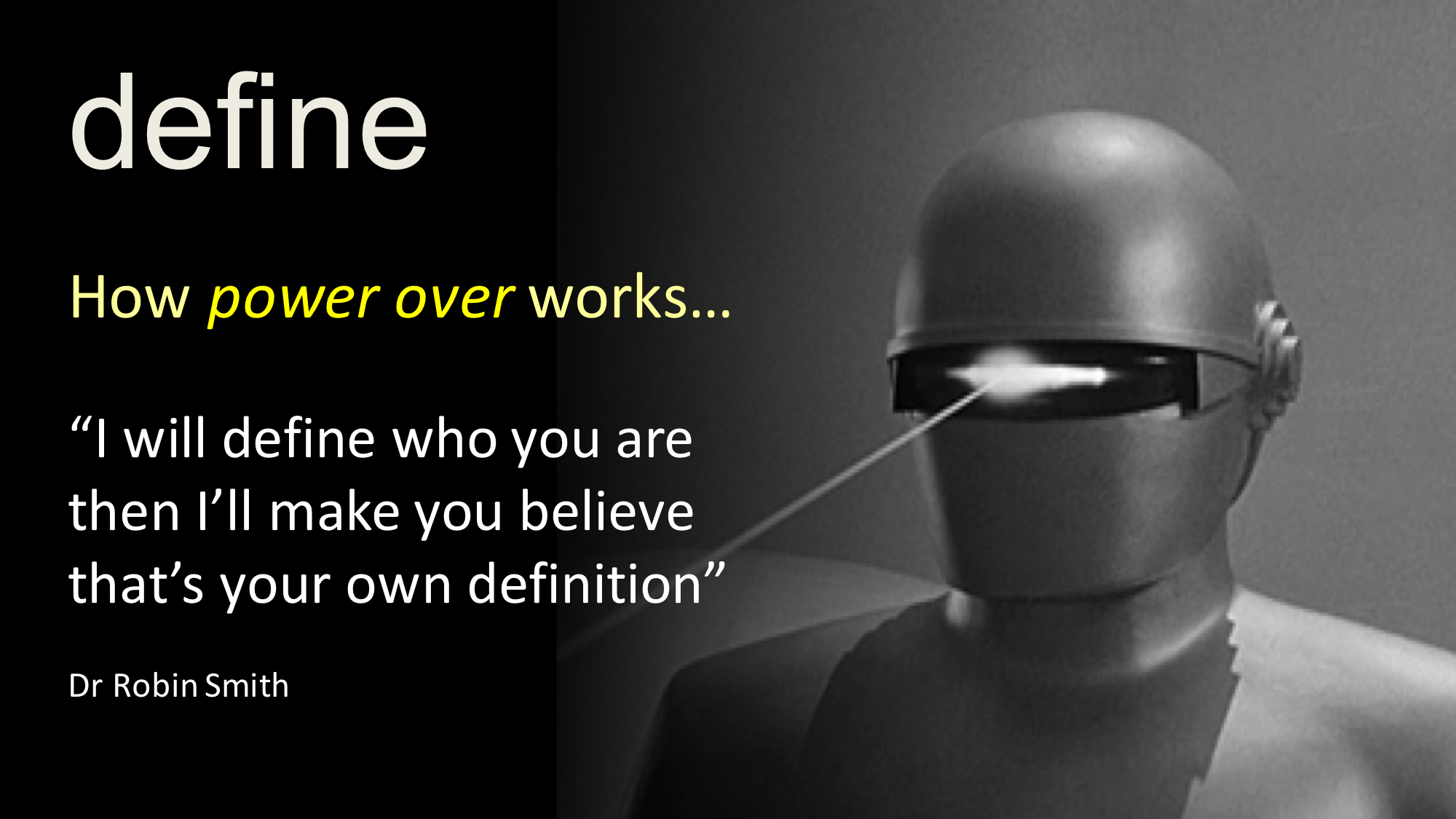
Define: how power-over works…


how power over works


In physics, power is the capacity to do work – like lift a weight or boil water to make steam- work is something that might be exploited in some useful in some way.

Human systems are far messier and understanding power is more complex, notions of power, work, useful, especially exploit are laden with layers of meaning most of which aint good but power can still be understood as that same capacity to do something – to act in the world to affect the world.

Now, one person’s acting in their world impacts the capacity of others to act in theirs. Power-over refers to one person or one group having power over another, using their power in ways that delineate how other can act, delineate who they are.  Sometimes that’s blindingly obvious in its intention and effect -and human history is replete with examples of that.

Often though it’s much less obvious, here’s one example of how power over is exercised subtly yet with great impact. Acting to define another’s experience is, definitively, a definition-in-action of using power as power-over them.

We each have the same right to use our power to describe our own experiences in terms and language of our own choosing. We each have the same basic right to name our world and to name our experiences in the world, name ourselves.

While we have the right to name ourselves in our own words, it pays to be careful when we name the experience of others. The words we use to name others and their experiences says more about us than it can ever say about them.

Whenever we use our power, and the power of the groups, societies and institutions we belong to or work for to define the language others use to describe their experiences then we are using our  power as power-over them.
We are determining that we have more right to name  their experience than they have. Whether we do that consciously or unconsciously that is a choice we make.

We can choose to use our power to make the world smaller for others- defining, on our own the terms, the words they use name their world, the words they use to name their experience in it and the words they use to name them themselves.

We can instead seek to use our power to make the world easier and larger for others – to use our power to aid them finding and using their power and using whatever language best suits them in communicating their experience with the world.

Our role is not to tell others how to name their experience our job is to listen and seek to understand.

When we impose our words or our specific meaning of a word on other we impose our world over theirs, we impose ourselves on their lives, we colonize them they can become accepted only when they learn our jargon, when they adopt our reality as theirs, our definition of them as their own.

There are some who use their power to define use of language in new ways as “symptoms” of illness – dismissing it as meaningless “word salad” and “neologism”.  As neuroscientist V.S. Ramachandran says:

“if someone says something we don’t understand it doesn’t mean they are crazy, it means we’re not smart enough to understand.”

Others might call it poetry.

We can use language to define a dystopian world where only a privileged few get to decide what words the rest of us must use, and how we must use them but our experience of language is as a creative process- one in which we all participate- and we can use language to create a world that’s easier for  to live in for all of us.

Words as gift or words as weapon.
Choose yours.

Klaatu barada nikto.

Posted in Difference and Diversity, Emancipate yourself..., Listening | Tagged , , , , | Comments Off on Define: how power-over works…

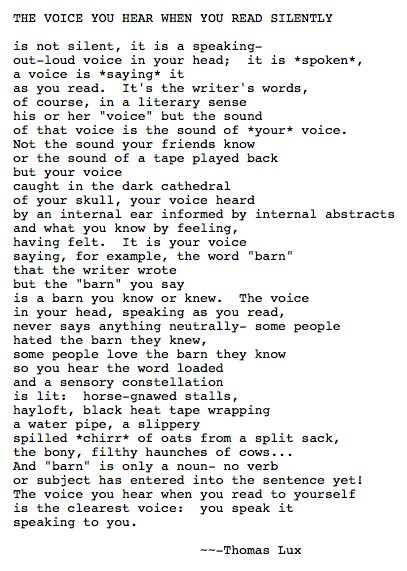
The voice you hear when you read silently – Thomas Lux


The Voice You hear When You Read Silently

is not silent, it is a speaking-
out-loud voice in your head; it is *spoken*,
a voice is *saying* it
as you read.  It’s the writer’s words,
of course, in a literary sense
his or her “voice” but the sound
of that voice is the sound of *your* voice.
Not the sound your friends know
or the sound of a tape played back
but your voice
caught in the dark cathedral
of your skull, your voice heard
by an internal ear informed by internal abstracts
and what you know by feeling,
having felt.  It is your voice
saying, for example, the word “barn”
that the writer wrote
but the “barn” you say
is a barn you know or knew.  The voice
in your head, speaking as you read,
never says anything neutrally- some people
hated the barn they knew,
some people love the barn they know
so you hear the word loaded
and a sensory constellation
is lit:  horse-gnawed stalls,
hayloft, black heat tape wrapping
a water pipe, a slippery
spilled *chirr* of oats from a split sack,
the bony, filthy haunches of cows…
And “barn” is only a noun- no verb
or subject has entered into the sentence yet!
The voice you hear when you read to yourself
is the clearest voice:  you speak it
speaking to you.

Thomas Lux
the voice you hear when you read silently


Posted in Difference and Diversity, Emancipate yourself..., hearing voices, Ideas, Spoken Word | Tagged , , , | Comments Off on The voice you hear when you read silently – Thomas Lux

Depression screening tests for children unreliable – d’oh!


Many people believe that the great myriad of mental disorders we can choose from must be diagnosed by some sciencey-seeming test – involving fabulous technology that peers right into the inner workings of our brain to find faulty circuits – or at least require the drawing of our blood so some lab tech can check for imbalances in those brain chemicals that must get all outta balance an’ wibbly-wobbly like.

If only it were as simple as ticking a few boxes on a checklist, calling it a name and picking a prettily coloured tablet.

We’ll that is the fantasy we’ve built but it was never going to be that easy and researchers are now providing the evidence base of evidence based medicine is pretty thin, and deeply flawed.

Yet the questionnaires get simpler and more likely to lock even more kids into the diagnosis – drugs  pipeline.

A new study published in Canadian Journal of Psychiatry shows what any kid knows – when life is more complicated than adults can handle they just make stuff up, lie through their teeth and tell you to shut up and do what they say.

The testing demonstrates that one handy-dandy, easy-peasy questionnaire – designed by a drug company no less – led to 22 percent of children being given a false positive diagnosis.

That’s not science, that’s guessing -or playing with loaded dice, take your pick – and if you can get away with it, a very lucrative business plan.

If your car mechanic operated on a similar hit-rate: diagnosing one in four cars with a fault they did not have then you’d take your business elsewhere, and they’d have investigative TV journalists all over their lot doing their utmost to reveal their dodgy practices to an unwary public.

In mental health they call it “science”.

It’s not science, it’s just bollocks.

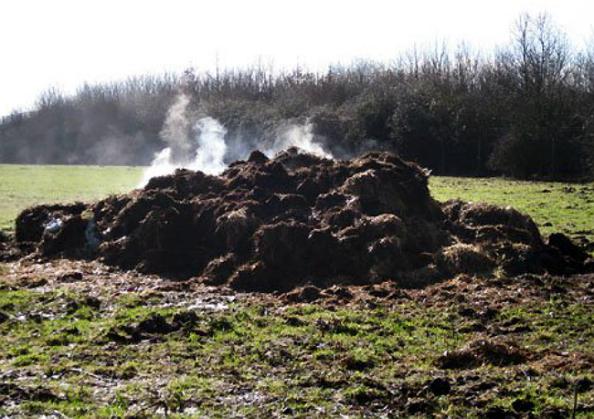
We were going to show an image of one of the ridiculously simplistic questionnaires right here but we believe you you’ll get more useful information from this one…
steaming pile

Toronto Star, 5th Aug, 2016

Depression screening tests for children unreliable, study says

Doctors in Canada and the U.S. are increasingly using short questionnaires to identify depression in pediatric patients.

Common surveys used to screen for depression in children and teenagers are unreliable and may lead to misdiagnoses, a study in the Canadian Journal of Psychiatry says.

Because general practitioners in Canada and the U.S. are increasingly using short questionnaires to identify depression in pediatric patients, Brett Thombs, a clinical epidemiologist and psychologist in Montreal, set out to systematically review 20 screening tests to see how accurately they diagnosed depression in children ages 6 to 18.

“Our study shows that if depression screening were carried out using existing screening tools, many non-depressed children and adolescents would be mistakenly identified as depressed,” said Thombs, who is affiliated with the Jewish General Hospital’s Lady Davis Institute for Medical Research and McGill University’s Faculty of Medicine.

Thombs’ review found that one popular depression-screening questionnaire developed by a major drug company was accurate 78 per cent of the time. In other words, 22 per cent of kids who didn’t have depression screened positive.

“There is no evidence they can come close to giving valid diagnoses,” Thombs told the Star. “When used properly, psychiatric medications can help people. When used on kids who don’t have the diagnosis, they won’t see the benefit but they will face all the side effects.”

Thombs is also concerned about the effect screening would have on a health system that is already strained for resources.

“We have a terrible problem taking care of kids who have really serious mental health needs,” said Thombs. They’re seeing a generalist or family doctor or not getting care at all or they’re on a terribly long waiting list. Or they’re prescribed medications when behavioural treatments would work better but they’re not able to access those treatments because of wait lists or insurance problems. If we’re going to bring in massive numbers of kids whose needs aren’t as recognizable, we have to ask, ‘Who are we going to treat less?’”

Earlier this year, a federal task force in the U.S. recommended routine depression screening for adolescents in primary care settings. In Canada, provincial governments in Alberta, British Columbia and Manitoba have called for widespread depression screening.

Thombs — who conducted the review with colleagues in Quebec, Ontario, Manitoba and Alberta — said he’s spoken with primary care physicians who are using the screening questionnaires not as a stepping stone to a deeper investigation that includes a lengthy diagnostic interview but to confirm a diagnosis of depression and prescribe medication.

“Hopefully, there aren’t many service providers out there who would administer a questionnaire and prescribe medication based on that questionnaire,” said Dr. Joanna Henderson, a clinical psychologist and scientist in the child, youth and family program at the Centre for Addiction and Mental Health in Toronto.

Henderson has worked with communities across the country to implement a screening tool that targets both addiction and mental health issues, opening the door so these conditions can be treated together. The screening tool she used wasn’t evaluated in Thombs’ review.

She sees screening tools not as a path to diagnosis and drugs but as an important way to identify young people in distress and align them with services that can help.

“We know that many young people experiencing difficulties don’t reach out for assistance. Often, by the time young people do receive treatment, they’re far along in their difficulties.”

“I think it’s clear from this review that more work needs to be done,” Henderson said. “We wouldn’t recommend that any service provider, physician or non-physician, use only a screening tool to base their treatment plan on. The intention of a screening tool . . . is to identify which young people need more attention. Which young people should have a further assessment of what’s going on? Based on that assessment, we make treatment recommendations, which may or may not include medication.”

The number of high-school students who reported taking prescription drugs for anxiety and/or depression has doubled to 6 per cent (39,300) since 2001, according to CAMH’s latest annual survey on drug use and health among Ontario students.

Nearly 20 per cent of Ontario students rated their mental health as fair or poor, up from 11 per cent in 2007 .

We couldn’t find the publication online but here’s the announcement from the commencement of the study in 2012.


Posted in Uncategorized | Tagged , , | Comments Off on Depression screening tests for children unreliable – d’oh!

Tenor Madness – Sonny Rollins & John Coltrane


tenor madness2

The only recording of Sonny Rollins and John Coltrane playing together,  May 1956.

Posted in Crazy World, mental illness? or..., music | Tagged , , , | Comments Off on Tenor Madness – Sonny Rollins & John Coltrane

Friends – Suli Breaks


suli breaks freindsLife is too short to live for other people’s ideas.

They say, If you truly want to know yourself,
look at your five closest friends. Because you are a reflection of the people

you spend most of your time with whether you like it or not, like them or not,
friends can do two things either push us forward or pull us back.
‘Cause you see, as a young basketball player
I never really felt the need to learn how to jump, until all of my friends
started to dunk and as a young student I only really started to get in trouble
in class when all of my friends started to flunk.

Think about it, when you got your results who
were the first people you asked so how did you in English, maths and art
and you know that we always assume that our grades were okay as long as we got more
A’s than our mates.

But when it came to getting into college, did
all of you guys get accepted into the same place?

You see, that’s why I say it’s important to
have friends with benefits. Because if they don’t add to life then they
subtract from it and if they don’t do nothing at all that’s just as bad because
breaking even isn’t an exact profit.

Listen, as humans we look at our surroundings
and learn to adapt to it, so if you surround yourself with bums what do you
expect will be the outcome.

You end up full of shit because life is too
short to live for other people’s ideas and that’s the harsh reality and
whenever I use the term friend I add air quotes because apparently I have
30,000 friends on Facebook, 200,000 on YouTube 33,00 on twitter but when things
hit the fan all they ever did was like my picture.

So wait, am I implying, contrary to popular
belief, that you should only be friends with people that can help you.

YES I
AM.

People that respect your identity and decisions
you choose to make indefinitely, people that can help you grow because true
friends are people that benefit you emotionally, spiritually, mentally and
regularly.

Not a friend that calls you no fun just because
you believe to enjoy yourself you don’t always need to get drunk.

Not one that has sex and laughs at your
virginity because you believe in integrity

Not a friend that smokes, that makes you the
butt of the joke when you’re opposed to conforming although they know you’re an
athlete and understand how it affects your performance.

Not a friend that puts you down 9 out of ten
times whenever you’re in a crowd but then becomes your best buddy when no one
else is around. That’s not a true friend.

But at the same time remember one hand washes
the other before they can both wash the face so before you can expect good
friends you have to learn to be one yourself and that involves having morals
that you stand by and stick to, ‘cause as Malcolm x said ” a man that stands
for nothing will fall for everything”.

So there’s nothing wrong with having friends
with benefits so ultimately both of you can find ways to benefit each other.


Posted in Uncategorized | Tagged , | Comments Off on Friends – Suli Breaks

Those fighting to be included…


those fighting to be included

Those fighting to be included in the ideal of equality are not being divisive.
Those fighting to keep those people out
are.

John Stewart


Posted in Emancipate yourself..., Ideas | Tagged , , | Comments Off on Those fighting to be included…