
How do people experiencing homelessness experience healthcare settings?
How does that affect their health, and their ability to heal?
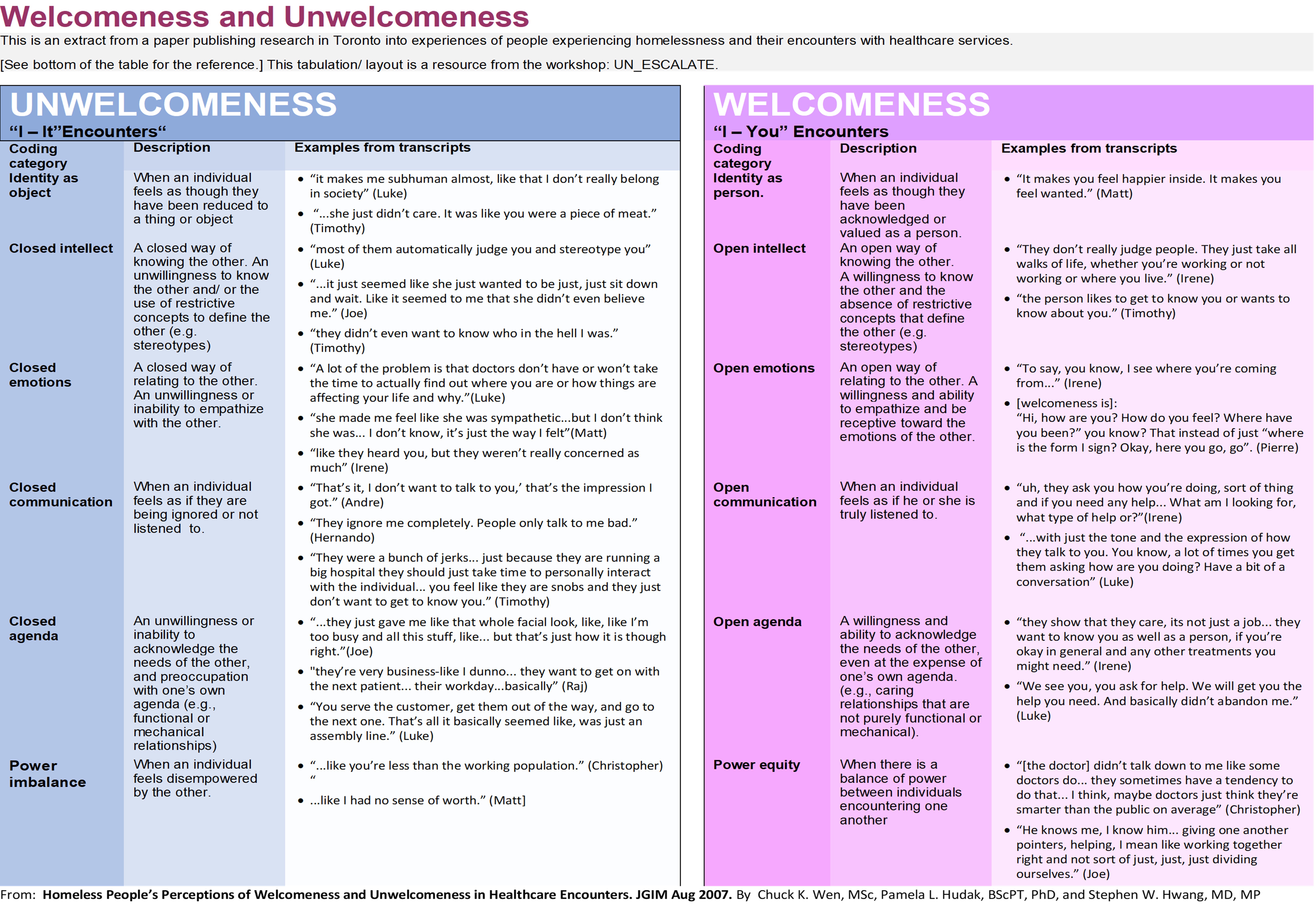
Sharing an article here reporting research conducted interviewing people about their experiences accessing Healthcare services in downtown Toronto.
Researchers coded and sorted the responses into categories and set them out under two broad headings – behaviours by healthcare professionals experienced as leaving them feel UNWELCOME, and behaviours by healthcare professionals they encountered that left them feeling welcome.
The table is my own compilation of that – a one page summary designed and intended to offer you a handy-dandy resource / tool you can print and stick on your workplace fridge or office wall.
It is worth reminding ourselves that the word hospital means
“place where hospitality is offered”.
To many, especially those we refer to as “marginalized”.
Those we refer to abstractly as “marginalized” didn’t get there all by themselves:
as a friend says says…”
“If we are marginalized, Kevin, it’s is because YOU marginalized us.”
People become marginalized by the actions of others (typically the majority but always those with the power to do so) that render them as marginalized.
The kinds of behaviours illustrated here happen hundreds of times a day – sometimes intentionally, mostly, I suspect, inadvertently, and an individual seeking access to services can experience this dozens of times a day.
This resource illustrates the effect that the sometimes small, subtle behaviours of healthcare professionals shape the way that an individual experiences encounters with services.
Then, when they behave in a way that expresses dissatisfaction with being so treated they get further marginalized by being called “uncooperative”, “difficult patient” and deemed that hey are “escalating” – and in need of de-escalating”.
All this in an industry that has the word “care” in its name.
Health is much more than doing “healthcare” – and when the care is missing then doing “health” can be experienced by those treated as mere objects of tokens as dehumanizing, traumatizing and oppressive.
And for those working in this kind of environment the effect is similarly withering and detrimental to their humanity and their health: this is a big part of what leads to so much talk of “burnout” amongst workers and only leads to more of the same: a vicious cycle of crapitudiness, and a chronically sick health system that serves none of us well.
Without caring human relationships there simply is no care; and without care there can be no health in healthcare too.
So what we are left with is a giant machine concerned only with compliance and efficiency in delivering “health care interventions”.
And whist that is important part of it, healing is about so, so much more than the efficient delivery of “healthcare interventions”.
Handy-dandy POSTER for your fridge or office wall…

Source:
PDF: Homeless Peoples Perceptions of Welcomeness and Unwelceomeness in Healthcare Encounters- Wen, Hudak, Hwang
← WELCOMEness and UNWELCOMEness: Experiences in healthcare settings of people living in homelessness
Related:
Alex Jadad: Its not about health, its not very caring, and its not a system.
https://recoverynet.ca/2019/01/13/its-not-about-health-its-not-very-caring-and-its-not-a-system/
Welcome to FUCKTOPIA
https://recoverynet.ca/2023/11/19/welcome-to-fucktopia/









































 agnotarte
 dave umbongo
 drkenplacebo
 highfellow
 recoverynetwork:Toronto



 recovery network: Toronto
You must be logged in to post a comment.