
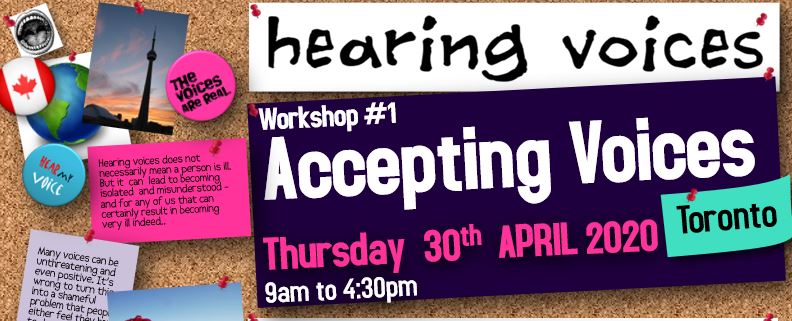
This introductory and foundational workshop will open doors of new understanding, in non-diagnostic non-categorising ways, a range of human experiences like difficult-to-hear voices that get called names like “psychosis”.
This workshop is designed especially for those who work in health and social services but open to all. Indeed it creates a richer experience when we can come together and learn with and from each other.
The world, society, and culture we have created for ourselves and each other is not fit for humans. Join us, be part of creating one that is.
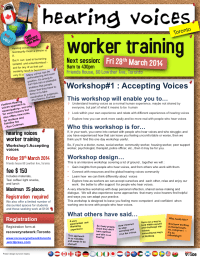
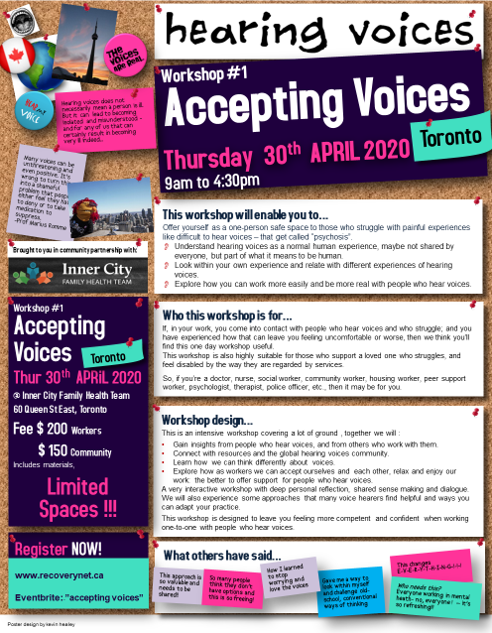 Hearing Voices Workshop #1″
Accepting Voices
Thursday 30th APRIL, 2019
9:30am to 4:30pm
@ Inner City FHT
69 Queen St E
Toronto
These re designed as small group, interactive workshops.
Spaces are limited.
Register Online now at Eventbrite.
Full description below…
Limited Spaces Available.
Tilt your universe blow your mind and / or gain a whole new perspective on experiences that we’re taught to fear and to believe that we can’t possibly understand. This workshop will show you tat you can understand, and in simple, human terms.
We’ll be joined by some cool folks working at the intersections of trauma, psychosis, homelessness and in a system that many can see is overwhelmed and creaking at the seams.
No amount of more of the same will ever be enough
It’s time we started doing things differently.
You can start here
at this Workshop.
“You gave me a whole new way of thinking about voices”
“I’m not quite sure what I learned nut I feel like my whole Universe has been tilted”
“Eye opening, Stunned”
Who needs to attend this workshop?
“Everyone working in mental health. Scatch that: EVERYONE!!!”
This workshop offers a beginning, an introduction to a non-diagnostic, non-medical, human experience perspective understanding of the kinds of experiences – like difficult-to-hear voices- that are often categorised as “psychosis”.
A key part is making connections between pain, trauma psychosis powerlessness and disconnectedness we can experience when we find ourselves feared and discarded by society.
 Hearing Voices Workshop#1
Accepting Voice
Thursday 30thAPRIL 2019
9.30am to 430pm
4th Floor, 69 Queen St East
Toronto
[Queen n Church]
Spaces are limited
and registration is required.
Fee
Worker $200
Community $150
Register Now
Online at Eventbrite:
Click on the BIG RED BUTTON or the link below to go to register now.
https://www.eventbrite.com/e/hearing-voices-workshop-1-accepting-voices-tickets-91351483747
Full description below. There’s also a [pdf] printer friendly version.
Poster Only: HV Workshop#1-Accepting Voices-Poster-APR2020
Full Workshop Description
Do you…?
- Work with people who hear voices and who struggle with their experience of that?
- Have someone in your life who hears voices and struggles with difficult experiences that get called “psychosis
- Feel limited in your ability to understand and support them?
- Feel frustrated at how the story that voices must mean illness limits us – not only the lives of people who hear voices, but all of us?
- Feel weary of the notion that we must fear ourselves and fear each other?
- Want to understand connections between adverse events, trauma , injury woundedness, pain and diffcult-to-hear voices.
- Want to minimise the trauma you deepen or generate in your work with those who face being rendered powerlessness and disconected from society?
- Feel ready to learn more, ask yourself “what else can I do?”.
- Want to know more about how you can be part of the future, join us in enacting a world that understands ?
Are Ready to “tilt your universe”?
If so, then this workshop might help you tilt your universe and emancipate yourself with very simple and very human ways to understand and begin to act to support a person who struggles with difficult experiences that get called names like “psychosis”.
Our aim is that you can feel more confident in your ability to offer yourself as a one-person safe space to people who hear voices and struggle.
Note: If you’re looking for a workshop on how to diagnose and categorise your friends, family and colleagues and what dehumanizing names to call yourself and them, then know that this is not that workshop.
Our aim is that you can feel more confident in your ability to offer yourself as a one-person safe space to people who live with experiences that get called names like “psychosis” and that can be difficult to live with and more difficult to talk about.
Join us in enacting a world that understands voice hearing, supports the needs of people who hear voices and regards them as full citizens.
Note
This Workshop is part of a structured and modular approach to learning, and is a first step that is designed to offer a basic grounding but also foundation for further, deeper learning and practice in supporting people who struggle with experiences like difficult-to-hear voices that get called “psychosis”.
Participation in this workshop is prerequisite to other more advanced and learning opportunities, eg…
- Working With Voices
- Starting and Sustaining Hearing Voices Groups In Your Community
- Carnival des Voix [running your own]
- Working with Maastricht Interview
- Facilitating Voice Dialogue
Full Workshop Description
 Workshop #1 Accepting Voices
This unique and innovative workshop offers you a non-diagnostic understanding of the kinds of experience like hearing voices that are that are sometimes called “psychosis”.
We offer you simple, everyday language to show you how you can understand such experiences not as “disconnected from” but intimately connected with reality and in ways that can be overwhelming, painful, frustrating, sometimes terrifying response to the reality we share,
It also offers a framework you can use to connect and draw from your own experiences to help you truly empathize and understand how better to support people who might be undergoing such difficult experiences.
You’ll leave feeling more at ease with both yourself and your ability to offer yourself as a one-person safe-space to people who struggle.
Join us in enacting a society that understands voice hearing, supports individuals who hear voices and views them as full citizens…
What you can expect and connect yourself with a community of people doing just that.
This workshop will enable you better to …
- Understand hearing voices [and other experiences] as a normal human experience, that can become problematic when a person is left to struggle without support.
- Share simple data and stories about just how common it is to hear voices- how it is not in itself a problem and many people do – some cultures regard it as bringing great benefit.
- Peer through and beyond diagnostic frameworks – resist the urge to catalogue and categorize everything you witness as “symptom”.and instead.
- take an interest in the person struggling with their experience of voices and other experiences called “psychosis” as a human being having a hard time.
- Begin to accept even the most difficult of human experiences as something that can be understood, explored and even valued.
- Look within your own experience and relate with different experiences like hearing voices, visions, unshared beliefs.
- Explore how you can be at ease in your role and be more real with people who have difficult experiences.
- Offer yourself as a one-person safe-space to people who struggle with experiences like hearing voices.
Who this workshop is designed for…
We believe the hearing voices approach is emancipatory for all.
Workers
If, in your work, you work with you come into contact with people who hear voices and who struggle with that; and you have experienced how that can leave you feeling uncomfortable or worse, then we think you’ll find this one day workshop useful.
So, if you’re a doctor, nurse, social worker, community worker, housing worker, peer support worker, psychologist, therapist, police officer, etc. then it may be for you.
Families, carers, everyone.
The workshop is also highly suitable for you if you love, live with, care for people in your life who hear voices and struggle with that – and you have come to realise the limitations of an approach that limits understanding to illness-brain chemicals and you are curious about how else you may understand, and what else you can do…
Workshop design…
This is an intensive workshop covering a lot of ground, together we will :
- Gain insights from people who hear voices, and from others who work with people who hear voices.
- Learn how we can think differently about voices and other experiences that are sometimes called “psychosis”.
- Explore how, as workers, we can accept ourselves and each other, relax and enjoy our work: the better to offer support for people who hear voices.
- Interact – with deep personal reflection, shared sense-making and dialogue.
- We will also share some simple, practical approaches that you can use in your practice on return to work.
- Connect with resources and both local network and the global hearing voices community.
This workshop is designed to leave you feeling more competent and confident in your own ability to offer yourself as a one-person safe space for people who hear voices.
You will not become an expert in one day but you’ll have a good basis for starting and feeling more comfortable – and more human – as you do.
Poster
Please feel free to help us let people know about this workshop by printing, posting, distributing, however you can with your networks…
Or, hand to your worker, colleague, or boss, and ask…
“Q. When are you going to do this training?”
Printer-friendly poster [pdf]
HV Workshop#1-Accepting Voices-Poster-APR2020
About the Presenters, Facilitators, Designers
K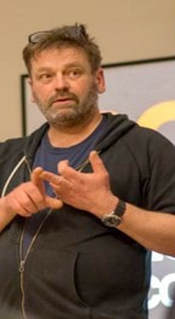 evin Healey hears more voices than you can shake a stick at, so many that even his voices hear voices, and has done so for longer than either he – or they -care to remember.
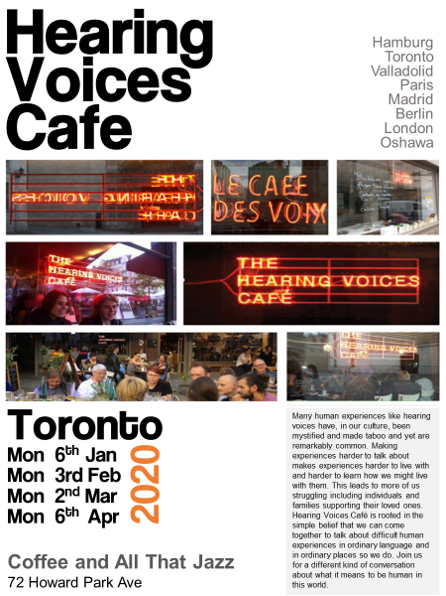
Founder and coordinator of www.recoverynet.ca, Toronto Hearing Voices group, Anglophone Canada’s longest running, and of the Hearing Voices Café.
Creates and delivers innovative, taboo-busting talks, trainings and workshops that enable people to find new language, and simpler ways to understand surprisingly common human experiences that we’ve made fearful and taboo, so making life even harder both for those who struggle and also for the rest of us to understand.
Shows how we can make simple sense of trauma, pain, psychosis, taboo, and butt-hurt voices, and how they interweave and interconnect our inner-struggle with living in an outer-world that is fast becoming unfit for humans who built it and in which we keep creating results that nobody wants. After you’ve heard him talk you may join those who say they don’t hear voices but now wish they could.
Also Coordinator for the Toronto branch of ISPS-US International Society for Social Psychological Approaches to Psychosis.
 Dave Umbongo
For many years Dave would only say only one word, now he authors articles at http://www.recoverynet.ca and moderates online support groups for voices to talk directly with each other round the world, and he coaches and co-presents in workshops for approaches like voice dialogue.
Enjoys creating memes: out of things voices say, about living in a universe that mostly comprises what he refers to as The Weird, and his own wry observations on the human obsession with calling each other horrible names, categorizing and crushing each other into boxes that don’t fit.
Voices have stories too: His favourite pastime is pretending to be a jelly bean, second is remarking upon how “voices” and “humans” behave in ways that are often very much the-one-is–like-the-other. Dave doesn’t really have a bio – like other superheroes he has an “Origins Story”, and like “The Truth…”, at least some of it, “is Out there…”
 Mark Roininen
Mark has many years experience as “worker” with a major social services agency, and has worked with many who struggle with the kind of experiences that get called “psychosis”.
He shares his personal perspective of how being confronted with his own dark side enabled him to relate more simply and authentically with difficult experiences of the people he works with, in-process, freeing himself from merely following “the script” and playing “invisible worker” so that he can be both more professional and more human.
His ability to share stories of his own experience of learning how to do this work offers others hope that they can too.
About Hearing Voices
- Hearing voices is intentional, ordinary language descriptive of a range of human experiences that in Western cultures has been mystified and made taboo, and that we have been taught to fear – and yet which are also remarkably common, likely much more common than you think.
- Hearing Voices as Approach also refers to broadly emancipatory ideas and ways of working that accepts such experiences as very real and meaningful- if sometimes difficult to live with, and that seeks to share ways we can learn to live with such difficult experiences and support and connect with each other.
This approach also includes many other similar experiences that can be hard to live with and harder to talk about and make sense of.
When we learn to put aside our fear of both ourselves and each other we generate possibilities, to create new roles, to connect with each other, and to find richer experiences of being human and co-create a world that’s easier to live in for all of us.






































 agnotarte
 dave umbongo
 drkenplacebo
 highfellow
 recoverynetwork:Toronto


 recovery network: Toronto
You must be logged in to post a comment.