I still hear his voice – Joe Biden


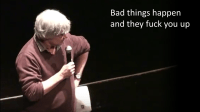
Vice President Jo Biden talking with Stephen Colbert about the loss of his son, the grief, he experiences and how as part of that he still hears the voice of his son, and talks with him…

In western culture we teach ourselves and each other to fear eacj other and to fear such  experiences, to call it “mental illness” and to seek “help”, to get treatment and to take the drugs. Especially if it lasts for more than two weeks.

And all of that is all just so much bollocks.

[Note- see Dr Arseblog’s irrefutable law of interminable bollocks for the evidence.]

Plainly, this culture is fucked [and in many more way than merely this] and is itself dying.

Meanwhile, many, many  cultures round the world have more grown up ways of understanding such human experiences

Most 0- three in four- of us will have at least one period in our lives when we hear a voice that no on eelse hears, often around key life events like the loss of a loved one.

And most people, when they do,  find it meaningful, even if, when they come to talk with others about it they, like Biden say it seems kinda odd to do so.

Well fuck that, eh?

Hearing voices is not an illness
it is a human experience.

Biden:     “I do what I think works…”

“Bo is still with me…”
“I  hear his voice”
“It’s a constant reassurance”
“and its a constant… push”

Colbert:  “And Do you talk back to him?”

Biden:     “I do, actually”
“I know it sounds….

[at about 19:00 mins]

t

Posted in hearing voices, human diversity, Ideas | Tagged , | Comments Off on I still hear his voice – Joe Biden

Dear Doctor – MC Fubb


Posted in Uncategorized | 2 Comments

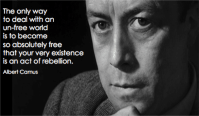
The sun was beginning to bear down on the earth… Albert Camus


Heat makes life even more difficult for those who have been estranged from our society- made ousiders by politics, economics and more than a smidgeon of good old not giving a fuck about those we see as not like us.

Seems we don’t just blame folks who find themselves struggling, we punish them.

TVO on how response from Cities across Ontario is just inadequate.

How Soaring Temperatures Are Affecting Ontario’s Homeless

“Inhuman and oppressive.”
Albert Camus


it was hot2

The sky was already
filled with light.

The sun was beginning
to bear down on the earth.

And it was getting hotter
by the minute.

It was Hot.

But today
with the sun bearing down
making the whole landscape
shimmer with heat
it was inhuman
and oppressive.

Albert Camus
L’Etranger

Posted in Uncategorized | Tagged , , | Comments Off on The sun was beginning to bear down on the earth… Albert Camus

Trauma is the effect left within us by our experience….


Dr Robert Scaer…

“In Western medicine we incorrectly categorize trauma by the events that happen
when, in fact, it is the effect left within us by our experience. “

As he introduces himself here, “humble country traumatologist from Colorado” who, growing increasingly frustrated that the ten thousand or so patients for whom all his knowledge and skills didn’t “work” – people who had been in low speed car collisions, struggling with what he came to name “whiplash syndrome” –   started to look beyond his medical training and elsewhere – to the work of Peter Levine.

The he began to understand…

His book “The Trauma Spectrum” is one of a handful that I could feel myself healing as I read it.

This is a pretty good intro….


Posted in Uncategorized | Tagged , , | Comments Off on Trauma is the effect left within us by our experience….

I’ve learned we are never too small to make a difference – Greta Thunberg


My name is Greta Thunberg.

I am 15 years old. I am from Sweden.

I speak on behalf of Climate Justice Now.

Many people say that Sweden is just a small country and it doesn’t matter what we do.

But I’ve learned you are never too small to make a difference.

And if a few children can get headlines all over the world just by not going to school, then imagine what we could all do together if we really wanted to.

But to do that, we have to speak clearly, no matter how uncomfortable that may be.

You only speak of green eternal economic growth because you are too scared of being unpopular.

You only talk about moving forward with the same bad ideas that got us into this mess, even when the only sensible thing to do is pull the emergency brake.

You are not mature enough to tell it like is.

Even that burden you leave to us children.

But I don’t care about being popular.

I care about climate justice and the living planet.

Our civilization is being sacrificed for the opportunity of a very small number of people to continue making enormous amounts of money.

Our biosphere is being sacrificed so that rich people in countries like mine can live in luxury.

It is the sufferings of the many which pay for the luxuries of the few.

The year 2078, I will celebrate my 75th birthday.

If I have children maybe they will spend that day with me.

Maybe they will ask me about you.

Maybe they will ask why you didn’t do anything while there still was time to act.

You say you love your children above all else, and yet you are stealing their future in front of their very eyes.

Until you start focusing on what needs to be done rather than what is politically possible, there is no hope.

We cannot solve a crisis without treating it as a crisis.

We need to keep the fossil fuels in the ground, and we need to focus on equity.

And if solutions within the system are so impossible to find, maybe we should change the system itself.

We have not come here to beg world leaders to care.

You have ignored us in the past and you will ignore us again. We have run out of excuses and we are running out of time.

We have come here to let you know that change is coming, whether you like it or not.

The real power belongs to the people.

Thank you.

#SchoolStrike4Climate #ClimateStrike #Youth4Climate #YouthUnstoppable #


Posted in Adversity, Crazy World, Do Something, Ideas | Tagged | Comments Off on I’ve learned we are never too small to make a difference – Greta Thunberg

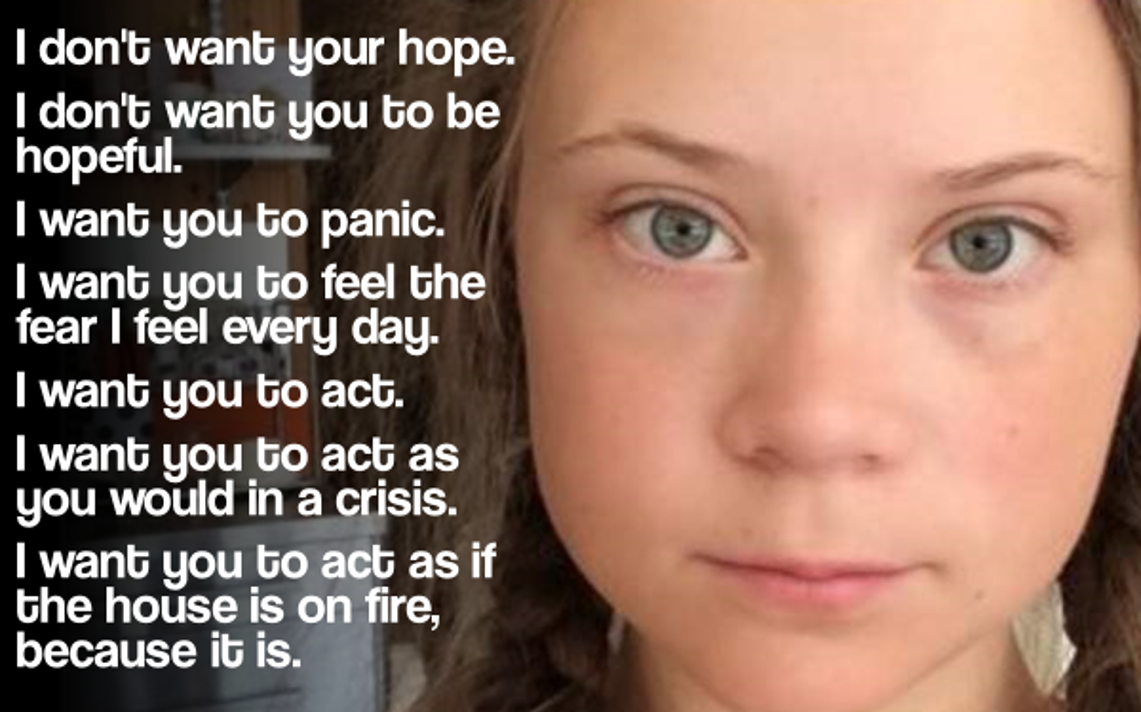
I want you to act


I don’t want your hope.
I don’t want you to be hopeful.
I want you to panic.
I want you to feel the fear I feel every day.
I want you to act.
I want you to act as you would in a crisis.
I want you to act as if the house is on fire,
because it is.

Geta Thunberg

Posted in change, Ideas | Tagged , , | Comments Off on I want you to act

Illness? or Dangerous Gifts? Sascha Altman DeBrul


To label a state of being as “extreme” is  to pass judgement and to seek to box the unboxable, impose some prefered state order upon necessary chaos ?

So who gets to judge if what you experience is “extreme” ?
Who gets to name it?

What does it mean?
Not much really.
A diagnosis like any other ? Just more [subtly] imposed bollox” ? yet more of the latest “right thing to say”?

One person’s “extreme” is anothers’ mundane, ordinary, every day.
Extreme is relative to the observers limit of ability to accept chaos- especilly chaos in another.
Extreme is as much socially determined as any other categorical limit.

Extreme i simply what we have yet learned to accept occurs and accept that we can learn to be ok with.
Extreme today, difficult , useful or even tedious tomorrow.

Does “extreme” exerience it arise by itself or as response, in relation with extreme environment? threat to life? self  existence? being?

“Extreme states” certainly do exist – not so much in individual humans as in groups, societies, countries and run by extreme, hate filled politicians.
And they do seem to be on the rise right now.

Difficult experiences are part of life, what if we can learn to be ok midst even the most difficult?

What can we learn with and from each other about many ways we might do that ?

How do we create supports that enable learning, and sharing what we learned?

Who gets to choose how we do that and who gets to choose what we put in our bodies as part of how we do that?

Sascha Altman de Brul in Manchester as part of his punk world tour of UK, here shares and reflects from a different perspective – “illness” or “dangerous gifts”?

What’s more useful  as way of framing undestanding and living a life:
for you?

Vid by Andew Baxter…


<p><a href=”https://vimeo.com/346446218″>Extreme Experiences: Personal &amp; Collective Visions of Transformation</a> from <a href=”https://vimeo.com/idha”>IDHA-NYC</a&gt; on <a href=”https://vimeo.com”>Vimeo</a&gt;.</p>

Posted in Adversity, bollocks, Crazy World, Ideas | Comments Off on Illness? or Dangerous Gifts? Sascha Altman DeBrul

Scorchio!!! Make Your Own $20 AC Unit


Toronto’s Public Health decided they can no longer be arsed to issue hot weather Alerts, so here’s one:

ITS GONNA BE  FUCKING HOT OUT THERE !!!

And, since Tronto Public Health also decided it cant be arsed to offer cooling centres for those most vulnerable, including the 120 people who die each year in Toronto from extreme heat and instead only offer what they call a “superior model” a website:

The NETWORK of NOTHING….
Stay cool with a spanky website that is basically a bunch of places open anyhoo and from which many folks will be turned away by City staff and Police and told: “go to the lake”.

So while Mayor John Tory is telling you to go there then when you do city staff tell you where to go..

Here’s another option…

Make your own AC unit.

Note: prices are from 2017 and likely in USD so …
Get together with your freinds and chip in…

Five [short] videos, five ways…


Posted in Adversity, bollocks, Crazy World, Scorchio!!, sh!t is f#cked, shit is f#cked | Comments Off on Scorchio!!! Make Your Own $20 AC Unit

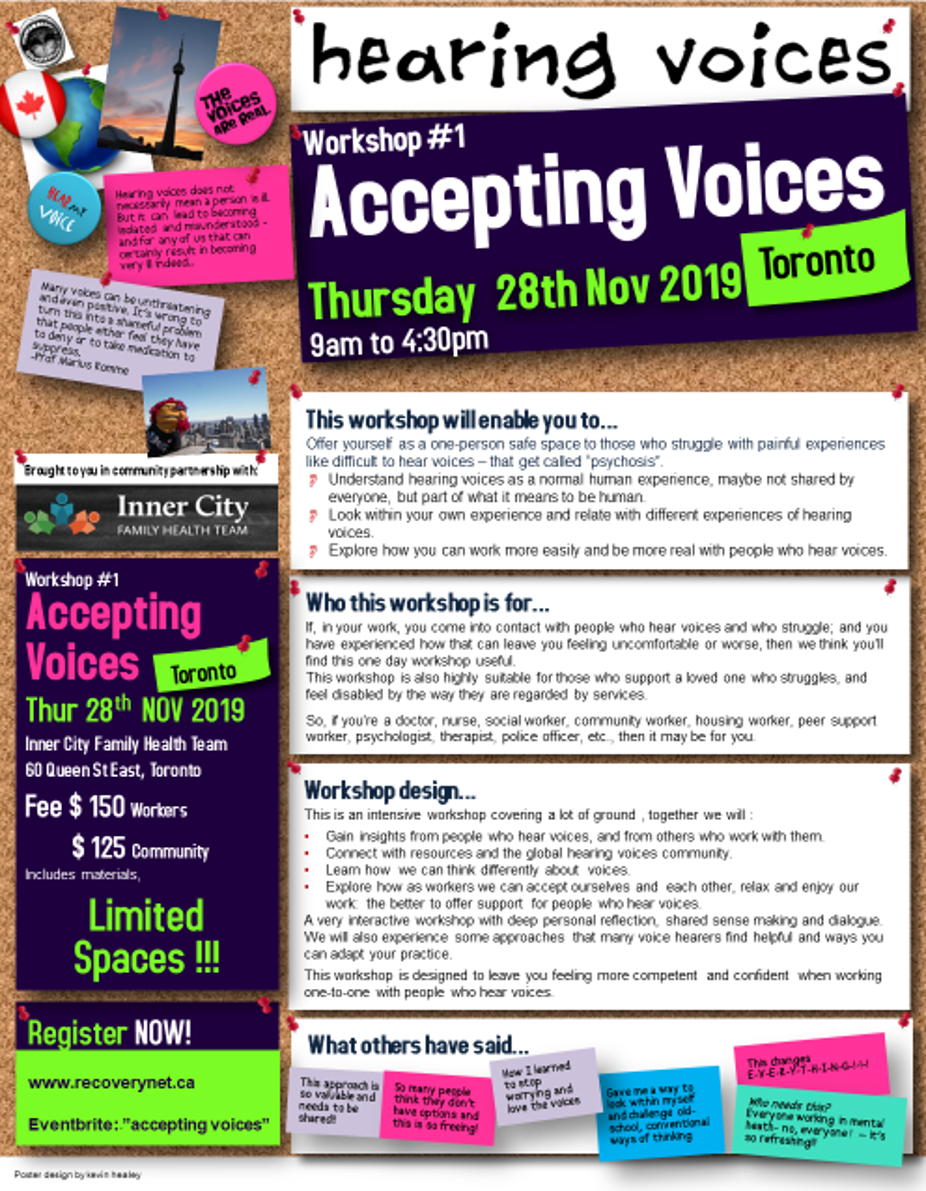
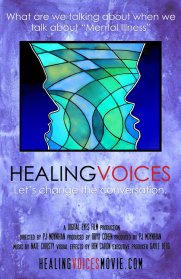
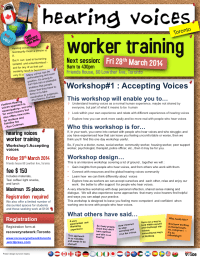
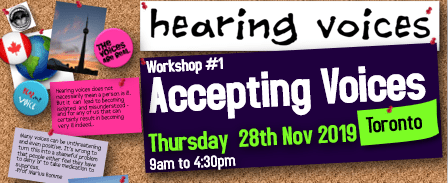
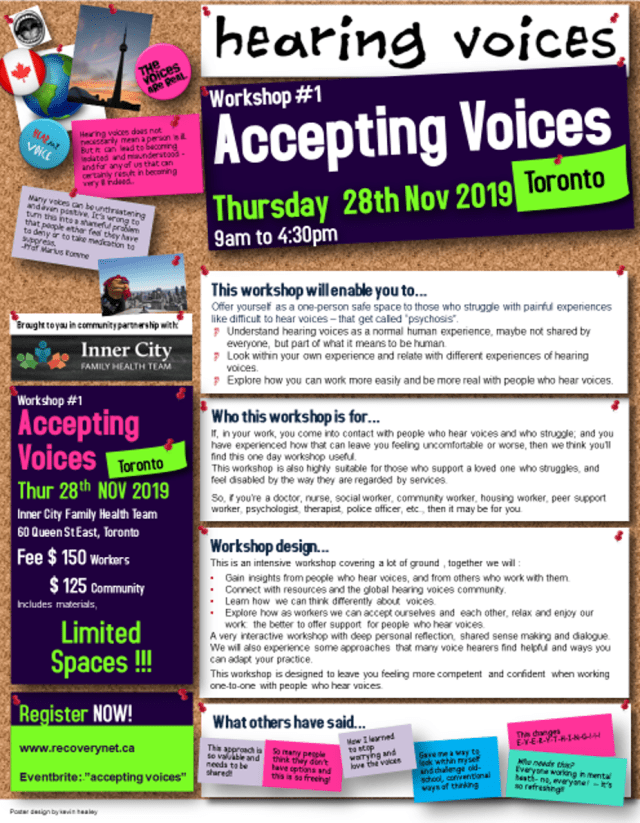
Hearing Voices Workshop #1 Accepting Voices – Thu 28th November 2019


This introductory and foundational workshop will open doors of understanding, in non-dignostic non-categorising ways, a  range of experiences that get called “psychosis” like difficult to hear voices.

Ihis workshop isdesigned especially for those who work in health and social services but open to all. Indeed it creates a richer experience when we can come together and learn with and from each other.

The world, societ, culture we have created for ourselves and each other is not fit for humans. Join us, be part of creating one that is.
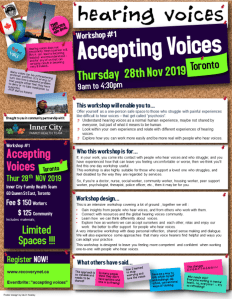
Hearing Voices Workshop #1″
Accepting Voices

Thursday 29th Nov, 2019
9:30am to 4:30pm

@ Inner City FHT
69 Queen St E
Toronto

Spaces are limited.
Register Online now at Eventbrite.

Full description below…

Limited Spaces Available.

Tilt your universe blow your mind and / or gain a whole new perspective on experiences that we’re taught to fear and to believe that we can’t possibly understand. THis workshop will show you tat you can understand, and in  simple, human terms.

We’ll be joined by some cool folks working at the intersections of trauma, psychosis, homelessness and in a system that many can see is overwhelmed and creaking at the seams.

No amount of more of the same will ever be enough so how do we do different?

You can start here.


“You gave me a whole new way of thinking about voices”

“I’m not quite sure what I learned nut I feel like my whol Universe has ben tilted”

“Eye opening, Stunned”

Who needs to atend this workshop?

“Everyone working in mental health.  Scatch that:  EVERYONE!!!”

This workshop offers a beginning, an introduction to a non-diagnostic, non-medical,  human experience perspective understanding of the kinds of experiences – like difficult-to-hear voices- that are often categorised as “psychosis”.

A key part is making connections between pain, trauma psychosis powerlessness and disconnectedness we can experience when we find ourselves feared and discarded by society.

Hearing Voices Workshop#1

Accepting Voice
Thursday  24th Oct  2019

9.30am to 430pm
4th Floor, 69 Queen St East
Toronto
[Queen n Church]

Spaces are limited
and registration is required.

Fee
Worker          $150
Community  $125

Register Now

Online at Eventbrite:

Click on the BIG RED BUTTON  or the link below to go to register now.

https://www.eventbrite.com/e/hearing-voices-workshop-1-accepting-voices-tickets-65027467907


Full description below. There’s also a [pdf] printer friendly version.
Poster Only:             HV Wrkshp#1-Accepting Voices-Poster-29NOV2019


Full Workshop Description

Do you…?

  • Work with people who hear voices and who struggle with their experience of that?
  • Have someone in your life who hears voices and struggles with difficult experiences that get called “psychosis
  • Feel limited in your ability to understand and support them?
  • Feel frustrated at how the story that voices must mean illness limits us – not only the lives of people who hear voices, but all of us?
  • Feel weary of the notion that we must fear ourselves and fear each other?
  • Want to understand connections between adverse events, trauma , injury woundedness, pain and diffcult-to-hear voices.
  • Want to minimise the trauma you deepen or generate in your work with those who face being rendered powerlessness and disconected from society?
  • Feel ready to learn more, ask yourself “what else can I do?”.
  • Want to know more about how you can be part of the future, join us in enacting a world that understands ?

Are Ready to “tilt your universe”?

If so, then this workshop might help you tilt your universe and emancipate yourself with very simple and very human ways to understand and begin to act to support a person who struggles with difficult experiences that get called names like “psychosis”.

Our aim is that you can feel more confident in your ability to offer yourself as a one-person safe space to people who hear voices and struggle.

Note: If you’re looking for a workshop on how to diagnose and categorise your friends, family and colleagues and what dehumanizing names to call yourself and them, then know that this is not that workshop.

Our aim is that you can feel more confident in your ability to offer yourself as a one-person safe space to people who live with experiences that get called names like “psychosis” and that can be difficult to live with and more difficult to talk about.

Join us in enacting a world that understands voice hearing, supports the needs of people who hear voices and regards them as full citizens.


Note

This Workshop is part of a structured and modular approach to learning, and is a  first step that is designed to offer a basic grounding but also foundation for further, deeper learning and practice in supporting people who struggle with experiences like difficult-to-hear voices that get called “psychosis”.
Participation in this workshop is prerequisite to other more advanced and learning opportunities, eg…

  • Working With Voices
  • Starting and Sustaining Hearing Voices Groups In Your Community
  • Carnival des Voix [running your own]
  • Working with Maastricht Interview
  • Facilitating Voice Dialogue

Note: If you prefer a print version of this description, try the pdf version:


Full Workshop Description

Workshop #1 Accepting Voices

This unique and innovative workshop offers you a non-diagnostic understanding of the kinds of experience like hearing voices that are that are sometimes called “psychosis”.

We offer you simple,  everyday language to show you how you can understand such experiences not as “disconnected from” but intimately connected with reality and in ways that can be overwhelming, painful, frustrating, sometimes terrifying response to the reality we share,

It also offers a framework you can use to connect and draw from your own experiences to help you truly empathize and understand how better to support people who might be undergoing such difficult experiences.

You’ll leave feeling more at ease with both yourself and your ability to offer yourself as a one-person safe-space to people who struggle.

Join us in enacting a society that understands voice hearing, supports individuals who hear voices and views them as full citizens…

What you can expect and connect yourself with a community of people doing just that.

This workshop will enable you better to …

  • Understand hearing voices [and other experiences] as a normal human experience, that can become problematic when a person is left to struggle without support.
  • Share simple data and stories about just how common it is to hear voices- how it is not in itself a problem and many people do – some cultures regard it as bringing great benefit.
  • Peer through and beyond diagnostic frameworks – resist the urge to catalogue and categorize everything you witness as “symptom”.and instead.
  • take an interest in the person struggling with their experience of voices and other experiences called “psychosis” as a human being having a hard time.
  • Begin to accept even the most difficult of human experiences as something that can be understood, explored and even valued.
  • Look within your own experience and relate with different experiences like hearing voices, visions, unshared beliefs.
  • Explore how you can be at ease in your role and be more real with people who have difficult experiences.
  • Offer yourself as a one-person safe-space to people who struggle with experiences like hearing voices.

Who this workshop is designed for…

We believe the hearing voices approach is emancipatory for all.

Workers
If, in your work, you work with you come into contact with people who hear voices and who struggle with that; and you have experienced how that can leave you feeling uncomfortable or worse, then we think you’ll find this one day workshop useful.

So, if you’re a doctor, nurse, social worker, community worker, housing worker, peer support worker, psychologist, therapist, police officer, etc. then it may be for you.

Families, carers, everyone. 
The workshop is also highly suitable for you if you love, live with, care for people in your life who hear voices and struggle with that – and you have come to realise the limitations of an approach that limits understanding to illness-brain chemicals and you are curious about how else you may understand, and what else you can do…

Workshop design…

This is an intensive workshop covering a lot of ground, together we will :

  • Gain insights from people who hear voices, and from others who work with people who hear voices.
  • Learn how we can think differently about voices and other experiences that are sometimes called “psychosis”.
  • Explore how, as workers, we can accept ourselves and each other, relax and enjoy our work: the better to offer support for people who hear voices.
  • Interact – with deep personal reflection,  shared sense-making and dialogue.
  • We will also share some simple, practical approaches that you can use in your practice on return to work.
  • Connect with resources and both local network and the global hearing voices community.

This workshop is designed to leave you feeling more competent and confident in your own ability to offer yourself as a one-person safe space for people who hear voices.

You will not become an expert in one day but you’ll have a good basis for starting and feeling more comfortable – and more human – as you do.

Poster

Please feel free to help us let people know about this workshop by printing, posting, distributing, however you can with your networks…

Or, hand to your worker, colleague, or boss, and ask…

“Q. When are you going to do this training?”


Printer-friendly poster [pdf]


About the Presenters, Facilitators, Designers

Kkevin-healey-action figureevin Healey hears more voices than you can shake a stick at, so many that even his voices hear voices, and has done so for longer than either he – or they -care to remember.
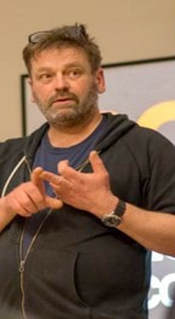
Founder and coordinator of www.recoverynet.ca, Toronto Hearing Voices group, Anglophone Canada’s longest running, and of the Hearing Voices Café.

Creates and delivers innovative, taboo-busting talks, trainings and workshops that enable people to find new language, and simpler ways to understand surprisingly common human experiences that we’ve made fearful and taboo, so making life even harder both for those who struggle and also for the rest of us to understand.

Shows how we can make simple sense of trauma, pain, psychosis, taboo, and butt-hurt voices, and how they interweave and interconnect our inner-struggle with living in an outer-world that is fast becoming unfit for humans who built it and in which we keep creating results that nobody wants. 

After you’ve heard him talk you may join those who say they don’t hear voices but now wish they could.

Also Coordinator for the Toronto branch of ISPS-US International Society for Social Psychological Approaches to Psychosis.

Picture1Dave Umbongo
For many years Dave would only say only one word, now he authors articles at http://www.recoverynet.ca and moderates online support groups for voices to talk directly with each other round the world, and he coaches and co-presents in workshops for approaches like voice dialogue.

Enjoys creating memes: out of things voices say, about living in a universe that mostly comprises what he refers to as The Weird, and his own wry observations on the human obsession with calling each other horrible names, categorizing and crushing each other into boxes that don’t fit.

Voices have stories too: His favourite pastime is pretending to be a jelly bean, second is remarking upon how “voices” and “humans” behave in ways that are often very much the-one-is–like-the-other. Dave doesn’t really have a bio – like other superheroes he has an “Origins Story”, and like “The Truth…”, at least some of it, “is Out there…”
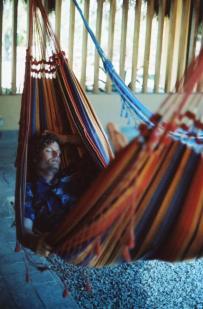

Mark Roininen
Mark has many years experience as “worker” with a major social services agency, and has worked with many who struggle with the kind of experiences that get called “psychosis”.
He shares his personal perspective of how being confronted with his own dark side enabled him to relate more simply and authentically with difficult experiences of the people he works with, in-process, freeing himself from merely following “the script” and playing “invisible worker” so that he can be both more professional and more human.
His ability to share stories of his own experience of learning how to do this work offers others hope that they can too.

About Hearing Voices

  • Hearing voices is intentional, ordinary language descriptive of a range of human experiences that in Western cultures has been mystified and made taboo, and that we have been taught to fear – and yet which are also remarkably common, likely much more common than you think.
  • Hearing Voices as Approach also refers to broadly emancipatory ideas and ways of working that accepts such experiences as very real and meaningful- if sometimes difficult to live with, and that seeks to share ways we can learn to live with such difficult experiences and support and connect with each other.
    This approach also includes many other similar experiences that can be hard to live with and harder to talk about and make sense of.

When we learn to put aside our fear of both ourselves and each other we generate possibilities, to create new roles, to connect with each other, and to find richer experiences of being human and co-create a world that’s easier to live in for all of us.



Posted in Event, hearing voices, Trauma, workshop | Comments Off on Hearing Voices Workshop #1 Accepting Voices – Thu 28th November 2019

Resistance is Resilience: Resilience is Resistance


Article I first drafted two years ago now, published today in Canadian Journal of Disabilities Studies,
Vol 8, Iss 4, Survivals, Ruptures, Resiliences.

This is my first artile published in a peer reviewed journal, so:
Whoohoo!

Big up from my voices and and big thanks from me to Katie Albrecht on the editorial team who offered me much patience supporing me in cutting through the crap and “gettin’ me ‘ead round” what I needed to do, and to J, Jeigh, Jay who prodded and poked me to do it in the first place, when could make neither ” ‘ead-nor-tail” of what the call for submissions actually said and dismissed it as just yet another load of ol’ academical masturbatory intellectual wankfest bollocky bollocks.

Whoohoo!

You can read it here:

Along with the contributions of many  others here:
https://cjds.uwaterloo.ca/index.php


Vol 8 No 4 (2018): Survivals, Ruptures, Resiliences

This special issue of the Canadian Journal of Disability Studies (CJDS) includes 18 original works that critically examine survival and resilience as socio-political phenomena. The volume of contributions in this issue suggest the complexities of survival and resilience are important current considerations for critical disability studies scholarship and praxis. Drawing on interdisciplinary disability and mad studies perspectives, and a wide range of methodologies, including autoethnography, poetry, photography, art, commentary, as well more traditional academic methods for sociological and social-geographical, genealogical, and geopolitical analysis, these works expose, resist and rupture unexamined relations to difference and adversity.

Published: 2019-07-01

https://cjds.uwaterloo.ca/index.php/cjds/issue/view/28?fbclid=IwAR2V1jxyXWlsYhh3CpNZqH8OpBzYm1TMwsFzPQL9BqQTioYx13BH0bFRnuo

Thanks as always to Reviews Editor Tobin Haley, to our accessibility partner AbleDocs (www.abledocs.com), and to Gerard Salisi, Graham Faulkner and Jordan Hale at the University of Waterloo.

This issue, themed around Survival and Resilience, was co-edited by Dr. Katie Aubrecht and Dr. Nancy La Monica.

From the Foreword:

“This special issue includes 18 original works that critically examine survival and resilience as socio-political phenomena. The volume of contributions in this issue suggest the complexities of survival and resilience are important current considerations for critical disability studies scholarship and praxis. Drawing on interdisciplinary disability and mad studies perspectives, and a wide range of methodologies, including autoethnography, poetry, photography, art, commentary, as well more traditional academic methods for sociological and social-geographical, genealogical, and geopolitical analysis, these works expose, resist and rupture unexamined relations to difference and adversity.”

FOREWORD

Complexities of Survival and Resilience
Katie Aubrecht, Nancy La Monica

CREATIVE WORKS

Do You Know Why You’re Here?
nancy viva davis halifax

Caterpillar; Autumn Leaves; Daffodils; Last Day
Andrea Nicki

ARTICLES

Storytelling Beyond the Psychiatric Gaze-Resisting resilience and recovery narratives
Jijian Voronka

Including Our Self In Struggle Challenging the neo-liberal psycho-system’s subversion of us, our ideas and action
Peter Beresford

Brain Injury Survivors: Impairment, Identity and Neoliberalism
Mark Sherry

Resistance is Resilience
Kevin Healey

Resilience Governance a good place for disabled people to shape and resist problematic resilience discourses?
Gregor Wolbring, Nicole Mfoafo-M’Carthy

Living with Herbert: Mediating Survival and Resilience
Samira Rajabi

Diaspora: Dislocation and its Resentment, or, the Impossible Dialogue of “Safe Space”
Essya M. Nabbali

“Like Bananas with Brown Spots” Epilepsy, Embodiment, Vulnerability and Resilience in South Asia
Aparna Nair     

Whose Disability (Studies)?
Defetishizing Disablement of the Iranian Survivors of the Iran-Iraq War by (Re)Telling their Resilient Narratives of Survival
Sona Kazemi Hill

Absence and Epidemic
Autism and fetal alcohol spectrum disorder in Indigenous populations in Canada
Caleigh Estelle Inman

On Survival and Education: An Academic’s Perspective on Disability
Shad Alshammari

The ‘Nothing But’
University Student Mental Health and the Hidden Curriculum of Academic Success
Katie Aubrecht

Designing Access Together: Surviving the Demand for Resilience
Esther Ignagni, Eliza Chandler, Kim Collins, Andy Darby, Kirsty Liddiard

Navigating the Terrain of Dis/Ability
An Autoethnographic Cartography
Susan Docherty-Skippen

ART

Bride Stripped Bare by her Bachelors; Balancing the World; Underwater Wheeling; Dream of Life; Water of the World
Elaine Stewart

REVIEW ARTICLES

Reimagined Story
Kelly O’Neil

REVIEWS

Review of Jameel Hampton (2016), “Disability and the Welfare State in Britain: Changes in Perception and Policy 1948-79”
Fallon Burns

Review of Bonnie Burstow (2017), “The Other Mrs. Smith”
Sona Kazemi Hill

Posted in Uncategorized | Comments Off on Resistance is Resilience: Resilience is Resistance