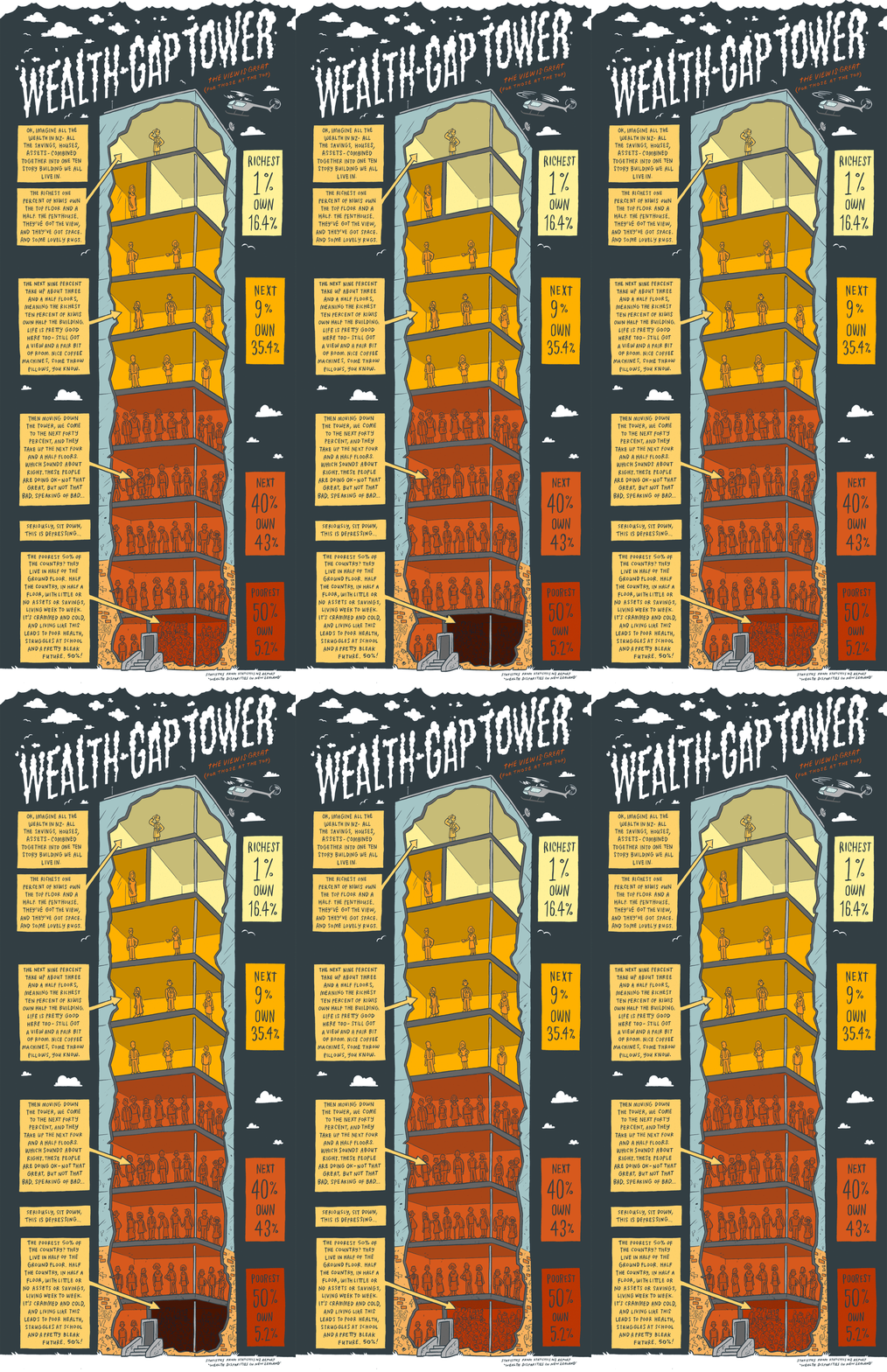
Wealth-Gap Tower – Toby Morris


Toby Morris’ illustration of how inequality would look if we all live in the same building.
Statistics are for Aotearoa/ New Zealand, his home country.
You can adjust/ re draw it according to how  the stats breakdown for your own.

wealth-gap-tower-02v3

More Toby Morris

Posted in bollocks, Crazy World, inequality | Tagged , | Comments Off on Wealth-Gap Tower – Toby Morris

The Pathology of Privilege – Tim Wise


Tim Wise talk on The Pathology of Privilege.


Posted in Crazy World, Difference and Diversity, Emancipate yourself..., inequality | Tagged , , , | Comments Off on The Pathology of Privilege – Tim Wise

How privilege works…


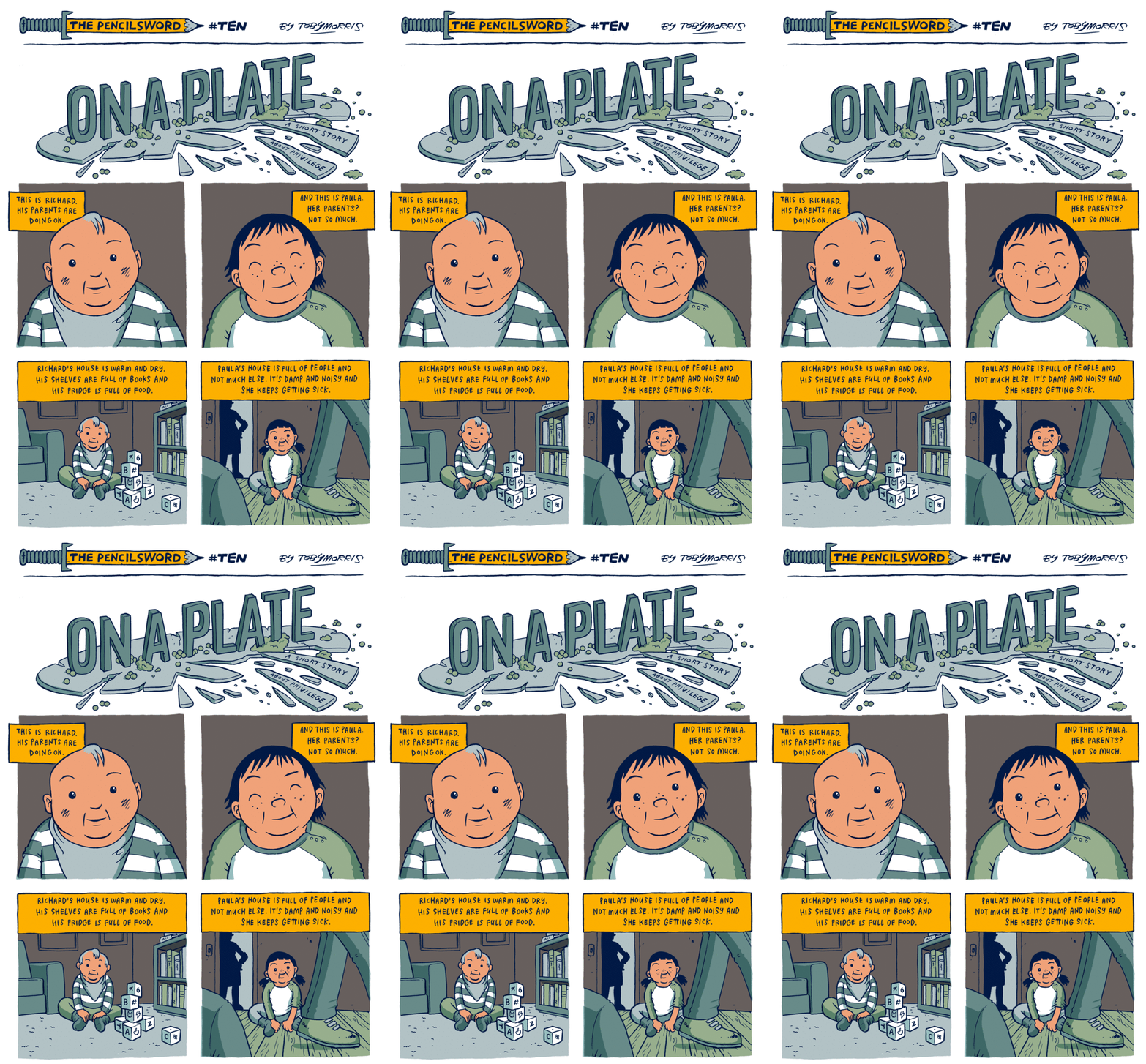
Toby Morris’ excellent Pensilsword comic strip on a plate telling parallel  stories of two lives to illustrate how privilege works…

on-a-plate-1

pencilsword on a plate eight_col_02


on-a-plate-03

on-a-plate-04


More on Toby Morris: http://thewireless.co.nz/articles/the-pencilsword-on-a-plate

Posted in Crazy World, Ideas, inequality | Comments Off on How privilege works…

WTF ?


The day I woke up to find someone was tweeting weird shit about me.

“So on April 24th, 2013 at 11am, someone comes into my office…”

John Stewart sharing his dialogue from  Twitter with the man who would be [come] President.

Posted in Uncategorized | Tagged , , | Comments Off on WTF ?

CALM technique – Jennifer Kholari


I was in the audience when this was recorded, about fifteen feet in front of this camera.

Jennifer Kolari shares her CALM technique as a parent can connect with their child when emotions are running away with the moment.

Her book Connected Parenting is great – it starts with ways to to repair your relationship with your child- because you will do things that  damage it,  and working to repair the relationship is part of the work.

And because showing our kids and -each other – that relationships will get damaged from time to time, and that they can be repaired is the work.

Posted in Uncategorized | Tagged , , , | 1 Comment

William Blake


William Blake, poet artist, visionary,  as considered eccentric, mad by contemporaries saw angels, conversed with spirits, saw visions as real as if you were stood in front of him.

william-blake“His was a world in which all of life: imagination, reason, concrete and spiritual worlds were connected – a view completely at odds with the science of the day but which now chimes with some of the thinking emerging with the new milenium” [2000].

His ideas about the interconnectedness of everything mirrors the way science has come round to – there is an inherent mystery and magicality beneath what science can reveal and describe.

This episode of LWTV’s weekly arts magazine The South Bank Show  

BOOM !

Posted in Ideas | Tagged , , | 2 Comments

HUAD – Attwenger


attwenger2Betcha never knew there was a song for it
Well, neither did I till yesterday…

Austrian Drum-n-Accordion at its best..


More on HUAD


Posted in Uncategorized | Tagged , , , , | Comments Off on HUAD – Attwenger

Love on a real train


Posted in Uncategorized | Tagged , , | Comments Off on Love on a real train

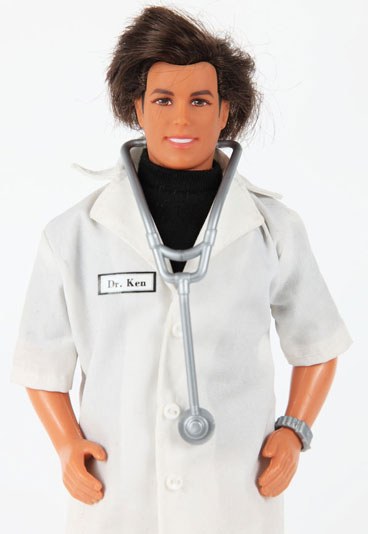
An end to ‘doctor knows best’


From the UK – in 2009, the NHS [National Health Service] released a legally binding charter setting out rights and responsibilities for those who use and work in the system.

Seven years later – just last week the Royal College of Surgeons set out guidelines for doctors that they must no longer tell patient what treament they need, but instead inform them of options and let the patient choose.

Doctors will no longer be able to decide for patients what treatment  is best, or what information to withold and what to share about treatment options. Patients will have legal right to all information to make their choice.

Interestingly this has not been about as a way to improve patients ability to make informed choice – but spurred into action by a court case to prevent hospitals getting sued when doctors get it wrong.

Still. It’s way past time doctors stopped thinking its their job to decide for us.

Of course, many clinicians  complained, still are complaining and data from trials showed that such consultations do take longer , d’oh!  Of course, explaining options and risks takes time, sometimes twice as long  [which is a big part in why so many don’t do it already]. But trials data also showed that times for post-op consultations for surgery for instance were reduced – because patients understand better what’s happening an dwhat to expect because they had it explained to them before they made their choice. 

bugs-bunny

Er… about time, Doc ??.

Daily Telegraph 27Oct 2016

The end of doctor knows best as medics are told to let patients make their own decision about treatment

Doctor
New guidelines have been set out by the Royal College of Surgeons CREDIT: 

Doctors should no longer tell  patients which medical treatments they need to have and must instead set out the options and let people decide for themselves, according to guidelines published today.

In an attempt to avoid hospitals being sued, doctors are being told to stop treating patients with a “paternalistic” attitude and to let them make their own decisions about treatments.

In a shift away from the “doctor knows best” culture, the Royal College of Surgeons (RCS) has released new guidelines which say that clinicians should take patients through every possible option – even if they believe some will have disadvantages.

It comes after a Supreme Court judgment awarded a diabetic mother £5 million after her baby was born with disabilities because, she claimed, medics failed to advise her of the risks of natural birth over a caesarean.

We can no longer be the judge of what we tell patientsLeslie Hamilton, RCS

Announcing new guidance, the RCS said that, as a result of the court ruling, doctors “can no longer be the judge of what we tell patients”.

Patient safety groups welcomed the move as a “step towards modernity”. The changes, however, threaten a major organisational challenge for the NHS after doctors already adhering to the new procedures reported their consultation times had doubled.

NHS practice has previously been to give doctors wide discretion in what information they provide to patients,with typical custom being only to mention risks that are particularly serious or which have a more than 1 per cent statistical likelihood of occurring.

Leslie Hamilton, the RCS council member who drew up the new guidance, said the surgical profession needed a “culture change”.

He said: “We can no longer be the judge of what we tell patients. We feel that the NHS and doctors in general haven’t really woken up to this yet, which is why we are bringing out this guidance now.”

Pregnant woman 
It comes after a case in which a woman’s baby was born with disabilities after, she claimed, doctors failed to advise her of the risks of natural birth over a caesarean

Previous rules meant consent could be taken by someone technically trained to conduct the procedure being discussed, although Mr Hamilton said in practice legal written approval was often taken amid a “flurry of activity” on the day of the operation.

Since 2008, General Medical Council rules have stated that doctors should not make assumptions about the information a patient might need, but Mr Hamilton said many surgeons adhered to the traditional method.

The NHS is under huge pressure and seeing more patients than ever,” he said. “It’s not hard to see how in many hospitals gaining a patient’s consent has become a tick-box exercise.”

The new guidance means a senior surgeon with experience of a range of procedures on offer must find the time to talk through the options in detail.

Shafi Ahmed, a cancer specialist and RCS council member, said adopting the new approach had lengthened his typical consultation from 20 minutes to nearer 40.

He added, however, that the rate of follow-up consultations had fallen significantly and trusts could adapt to the new rules if they were “smart”.

Some doctors haven’t moved with the times and there is a culture issue that needs to be addressed. This is a welcome step in the right directionPeter Walsh, Action Against Medical Accidents

NHS trusts in England paid out more than £1.4 billion during 2015-16, according to the NHS Litigation Authority.

The RCS guidance states that written information on diagnosis and available treatments should be provided to patients, and they should be given enough time to make an informed decision, wherever possible, and when it is not adverse to their health.

Surgeons must also keep a “written decision-making record that contains a contemporaneous documentation of the key points of the consent discussion”.

“For the NHS generally, we’re going to have to change the way we do the clinics,” said Mr Hamilton.

“It will be difficult for surgeons who have to think ‘I need more time or I need to see fewer patients’.”

Surgeons
Surgeons say the impact could be that they have less time to see patients  CREDIT: CHRISTOPHER FURLONG /GETTY

Peter Walsh, chief executive of the patient safety charity Action Against Medical Accidents, said the consent process currently could be “very cursory”.

“Patients are far too often having consent forms thrust in their face at the last minute,” he said.

“Some doctors haven’t moved with the times and there is a culture issue that needs to be addressed. This is a welcome step in the right direction.”

The announcement came as it was revealed that Britain has proportionately fewer than half the doctors of some other EU countries, according to a report which says hospitals are struggling to cope amid “dangerous levels of alienation” felt by staff.

The General Medical Council said medics felt under growing pressure, with falling numbers amid an ageing workforce and rising numbers of part-time workers.

The watchdog’s annual report expresses concern that “anger and frustration” among junior doctors, following a year of industrial action, could add to the problems of a service under severe strain. It added the signs of distress were now “unmistakable” and threatened patient care.

Its report shows that Britain has fewer doctors per head of population than almost every other European country, with half the number of medics as Spain, and far fewer medics than Lithuania, Latvia and Estonia. Britain now has 2.7 doctors per 1,000 people, compared with 4.1 in Portugal and Lithuania, 4.2 in Norway and 4.9 in Spain, the statistics disclose.

Original at: http://www.telegraph.co.uk/news/2016/10/26/the-end-of-doctor-knows-best-as-medics-are-told-to-let-patients/

See also…

Guardian, Sep 2009

NHS constitution ends era of ‘doctor knows best’

A legally binding NHS [National Health Service] constitution that is designed to end the era of “doctor knows best” will be unveiled today by Alan Johnson, the health secretary.

In a Guardian interview, he said patients will gain a new legal right to information about the options available for free treatment on the NHS in England.

It will no longer be enough for a doctor to recommend painkillers for chronic backache without informing the patient of the benefits and risks of physiotherapy or surgery, if these are medically appropriate alternatives.

The constitution will for the first time set out the rights and responsibilities of patients, NHS staff and the organisations that deliver services, including private hospitals and voluntary bodies that provide care for NHS patients.

A draft version, published for consultation last year, said patients should have the right to make choices about the type of treatment that may be appropriate. Johnson said the public thought the right to choose was meaningless if it was not accompanied by a right to information about the choices available.

The constitution will say: “You have the right to choice about your NHS care and to information to support these choices. The options available to you will develop over time and depend on your needs.”

A senior Department of Health source said: “Gone will be the paternalistic days of being told by the doctor that you can’t have physiotherapy for your back pain, or referral to an orthopaedic consultant. If you have prostate cancer, you will get the information you need to choose whether to go for an operation or opt for a period of watchful waiting. If you need a hysterectomy, you will be told about the benefits and risks of minimally invasive surgery.”

The constitution will give patients limited rights to be treated in other EU countries. Other rights include:

  • Choice of GP practice and preference for using a particular doctor;
  • Access to drugs and treatments that have been recommended by the National Institute for Health and Clinical Excellence (Nice);
  • Access to vaccinations that have been recommended by the Joint Committee on Vaccination and Immunisation;
  • Privacy, confidentiality and an expectation that the NHS will keep confidential information secure;

Patients will have a responsibility to:

  • Register with a GP practice;
  • Treat NHS staff and other patients with respect;
  • Follow the agreed course of treatment and talk to the clinician if this is difficult;
  • Keep appointments or cancel within reasonable time.

The document says people failing to keep appointments may no longer be entitled to be treated within the maximum waiting times. But there will be no financial penalties on patients who fail to meet their responsibilities. Ministers have ruled out withdrawal of treatment from people who smoke, drink excessive amount of alcohol or are obese.

Johnson said: “Since the NHS was founded in 1948, the public has never had such a clear, concise definition of their rights and responsibilities brought together in one place … I would be most surprised if this constitution does not become something people refer to over and over again.

“Some people have said this is Tory-proofing the NHS [making it harder for a future government to take away services or require people to pay for them.] The only way to Tory-proof the NHS is by electing Labour governments. But much of this constitution would make it more difficult to change the NHS.

“It says NHS services should be free of charge, except in limited circumstances sanctioned by parliament. It says the right of access to NHS services should not be refused on unreasonable grounds. It should be a comprehensive service available to all, with a duty to each and every individual it serves.”

Original here: https://www.theguardian.com/society/2009/jan/21/nhs-constitution-rights-treatment

Posted in Ideas | Tagged , , | 1 Comment

Unmasking Masculinity – Ryan McKelley


Ryan Mc Kelley talking about mens health and connectedness and how we can help men be more connected.

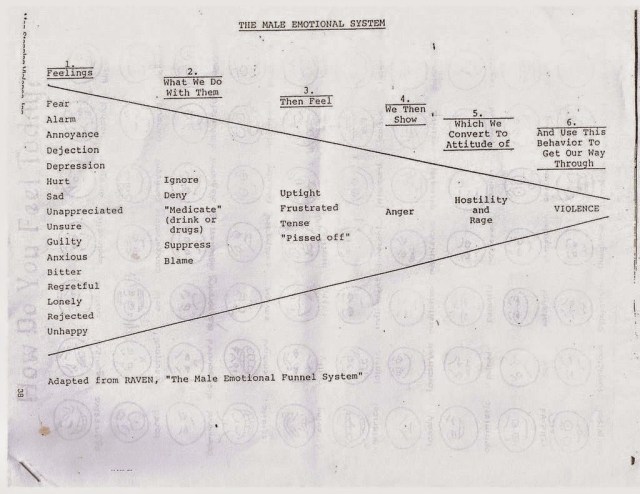
He starts by talking about how we historically socialise boys and men to mask their emotions. He mentions “the male emotional funnel system”, see below.

Male Emotional Funnel System 

the-male-emotional-funnel-system

Posted in Uncategorized | Tagged , , , , | Comments Off on Unmasking Masculinity – Ryan McKelley