
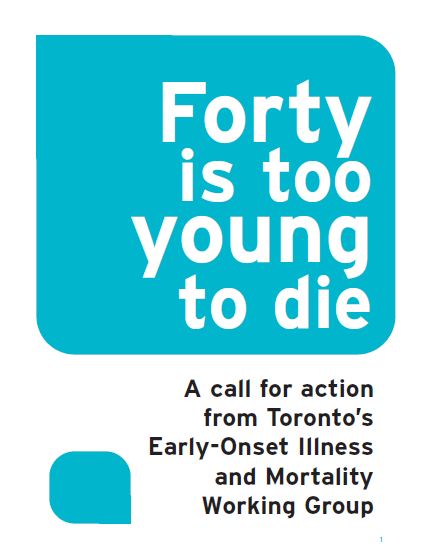
 A call for action from Toronto’s
Early-Onset Illness and Mortality Working Group
extract…
Introduction
“What use is funding for seniors when our tenants die before their 65th birthday?”
– Housing Support Worker
For Mainstay Housing, the “ah-ha” moment came when it received an RFP for The Toronto Central Local Health Integration Network’s (LHIN) 2008- 2009 Aging at Home Strategy. Tenants in seven properties fit all the criteria: they all had chronic illnesses, suffered the same symptoms as the program’s target clients, and lived in priority neighbourhoods. But they did not qualify for services. They had not reached their 65th birthday.
For Houselink Community Homes, the “ah-ha” moment came when 12 people died in 2010 from natural causes. None of them was a senior. These “ah-ha” moments led Mainstay Housing to invite leaders from a cross-section of organizations – supportive and transitional housing; providers of seniors’, addictions and community services; a community health centre; and two university professors – to join a working group. We realized we needed to collaborate with others who had their own “ah-ha” moments to understand and find solutions to the issues we all saw. In the process we found many others who, though not part of the working group, will share in the results.
The Early Onset Illness and Mortality Working Group met monthly from October 2010 till September 2011.
During that time we:
• solicited the experiences of 60 direct-service staff, tenants and clients through three focus groups, 13 face-to-face or phone interviews, and a survey.
• gathered expert opinion through interviews;
• enlisted the help of Ryerson Sociology students to analyze the statistical relationships between personal habits, socio-economic status, aging, chronic health and mental health;
• conducted, with the help of a York University Social Work student, a brief review of the considerable literature that confirms our experience is not an isolated one.
This report reflects our findings.
The Early Onset Illness and Mortality Working Group
Mainstay Housing
Houselink Community Homes
WoodGreen Community Services
Community Outreach Programs in Addictions
Margaret Frazer House
Dixon Hall
South Riverdale Community Health Centre
St. Stephen’s Community House
Street Health
Accommodation Information and Support
Dr. Reena Tandon, Ryerson University Faculty of Arts
Dr. Atsuko Matsuoka, York University Faculty of Social Work







































 agnotarte
 dave umbongo
 drkenplacebo
 highfellow
 recoverynetwork:Toronto


 recovery network: Toronto
“12 people died in 2010 from natural causes” – before reaching 65, I think ‘natural causes’ is a misnomer, a lazy, convenient label hospital emergency rooms put on a deceased body. It’s denial. It helps society block on the realities of their neighbours’ lives. In my ‘ideal community’, residents would be communicating/dialoguing with and about their vulnerable neighbours and with each other, trying to understand their neighbours’ needs, and attempting creative support, political action, whatever is needed of caring people that ensures all members of the community are as nourished as possible. ‘Nourished’ is another concept that needs more thought too…. I hope this report has a real impact. Maybe there should be a small group of volunteers following up…..
LikeLike