
Still “gett’n me-yed” round this….
The “Only” in the title does smack a bit of “all or nothing” and the “environmental failure-Oppression” does seems like trying-too-hard to coin a TLO [three letter acronym] . But still, David H Jacobs in this paper from 1994 is on to something…
Now I’m just a muppety-muppet thing from muppetville and didn’t get to flounce around for a zillion years in college learning fancy academia-speak so this goes way over my noggin most o’ the time. But here’s what I reckon it says…
Basically seems that David H Jacobs is sold on selling us the idea that “psychopathology” is always caused by failure in the environment . That is failure of/in the environment to provide optimal conditions for the well being, especially the psychological well-being, of the human organism [that’s you, and by inference, me].
And, that qualifies as an oppressively oppressive oppression since the culture/society systematically and intentionally creates such an environment that leads to humans becoming unwell – pretty much as a cost of doing business.
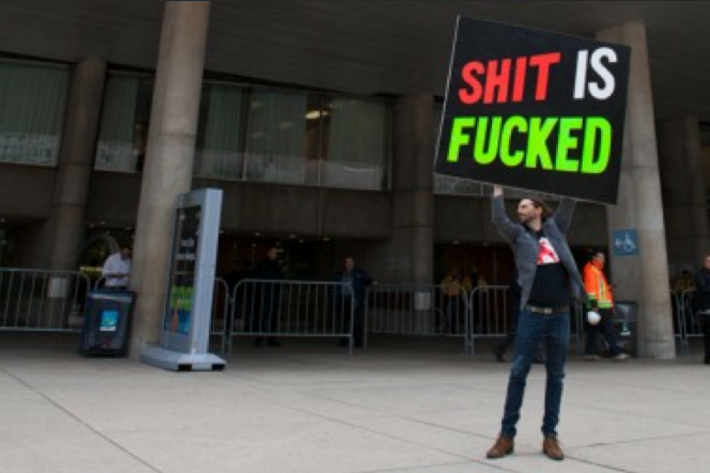 For the short version, go with this guy…
Shit IS fucked!
and so will you be.
Put it that way, its like…
D’oh!
It is a nice turn-around from the standard bollocks that that “psychopathology” / “mental illness” is a failure of biology-character within inept individuals who refuse/fail to buck-the-fuck-up and cant adapt to being capitalism-fodder in a world of mcjobs, crushing debt, alienation, living in a rat-infested swamp-tip in a world run by pigmounting, dickhead, would-be oligarchs who run the whole kaboodle for their own benefit, extracting the maximum capital from society so they and their buddies can filch it off to some offshore tax haven – and a big “fuck you, buddy” to the rest of yer..
Humans are weird, why would you even think its a good idea to build a society that makes so many of you ill?
Guess you’d have to aspire to be a dickhead, pigmounting, would-be oligarch, eh?
Peace
Umbongo out.
Continue reading for David H Jacobs _______________________________________
Environmental Failure-Oppression is the Only Cause of Psychopathology
David H. Jacobs
National University
The Journal of Mind and Behaviour Winter and Spring 1994, Volume 15, Numbers 1 and 2 Pages 1-18
http://www.brown.uk.com/brownlibrary/DJH.htm
Abstract
The present paper intends to clear the way to considering all psychopathology as responses to failures in the human environment by examining three common sources of error in scientific reasoning about psychopathology: (i) the false identification of “biological considerations” with the sub-interest of organic pathology, (ii) the idea that a person could be genetically predisposed or vulnerable to psychopathology, (iii) the failure to distinguish between causal forms of explanation and explanation based upon connections of meaning and significance. For convenience, the omnibus term “environmental failure-Oppression” (EFO) is introduced to refer to the totality of possible failures in the human environment.
Introduction
In this paper I discuss three common sources of error in scientific reasoning about psychopathology. Taken together they operate to block advances in thought about how psychopathology originates and develops. The intended thrust of my overall argument is to clear the way to consider all psychopathology (l) as resulting from failures in the specifically human environment, that is, the endless varieties of trauma, abuse, neglect, imposed suffering, exploitation, victimisation, misuse, maltreatment, inadequacy, and so on. For convenience, I refer to the totality of pathogenic influences in the human environment by an omnibus term: Environmental Failure-Oppression (EFO).
Biological reasoning about our species and its bearing on psychopathology. The understandable focus of medicine on organic pathology may have eliminated a broader biological view of our species in conventional scientific discourse concerning psychopathology. This is astonishing in light of the enormous influence within psychology of researchers like Harry Harlow and Jean Piaget. Perhaps it is even more difficult to grasp the indifference (seen in retrospect) to Harlow’s work, since it possesses all the appeal that genuine experimental design combined with spectacularly obvious results can offer to scientific research (for example, see Harlow, 1960j Harlow and Harlow, 1962). Harlow’s subjects were non-human primates, but it is still hard to miss the point that profound disruptions in the species’ “normal expected” nurturant social environment produces equally profound disruptions in normal species emotionality, mood, sexuality, and social behavior. It also seems hard to miss the point, as I will discuss, that people would be even more vulnerable than non-human primates to serious disturbances in the nurturant social environment during the course of biological immaturity or childhood.
For example, Kroll ( 1988) equates biological theories of psychopathology with the realm of organic pathology, and contrasts these theories with psychological theories where the primary causal factors lie in the social realm. Both the dichotomy between biological and social-psychological considerations and the identification of biology with the sub-interest of organic pathology are seriously misleading. In addition, distinguishing ( wrongly) between biological considerations and social-psychological considerations allows for the false conclusion that the realm of organic pathology is a more pertinent and fundamental level of reality than the social-psychological level. A presumption that organic pathology is the pertinent focus of attention easily creates an intellectual framework in which the social-cultural-interpersonal aspects of life appear off the topic, rather like asking whether a patient with Alzheimer’s is a banker or a baker.
However, it ought to be evident (from a combined evolutionary-zoological-ethological perspective) that the degree to which social-psychological considerations enter into a comprehensive grasp of a species’ way of life varies enormously across living species, culminating in its unprecedented importance in our own life as a species. I have already mentioned the most dramatic sort of evidence in the case of non-human primates which reveals a complete dependence upon the normal species nurturant social environment for normal social-behavioural development. It is only in the context of a deliberately contrived (human) experimental setting that it is possible for an asocial infant monkey to exist at all, so it is otherwise idle to speak of its biological life apart from the normal species social environment. This fundamental point – that for some species, especially our own – there is no biological existence apart from the normal species social environment – deserves a great deal of emphasis.
A useful concept to bring into focus the unprecedented degree of our species-specific dependence on the social environment is the idea of a dimension of “world openness.” This idea is borrowed from the generally overlooked developmental masterpiece of E.G. Schachtel (1959), although the concept itself originated in the context of German comparative biological thought prior to World War II. The term refers to the degree to which a species depends upon learning, and thus exhibits a range of behavioural flexibility, as a routine part of the normal species way of life in its normal ecological niche. Dependence on learning and the range of behavioural flexibility are inversely related to innate and inflexible species-specific patterns of behaviour. The harder it is to observe, think of, or contrive situations in which learning and behavioural flexibility playa significant role for a given species, the more the species can be regarded as “world-closed.” This perspective does not produce an ordering of species into higher and lower; it is useful for understanding the normal species way of life and evolutionarily-produced adaptation to its specific ecological niche (for further important elaborations on this point, see Gould, 1977,1981,1989).
The enormous historical and anthropological literature which documents our own species’ flexibility even with regard to the most fundamental matters of sexuality, reproduction, parenting arrangements and kin relations (important sources here are Aries, 1962; Money and Ehrhardt, 1972; Sahlins, 1976) reveals that our own species represents the pinnacle of world-openness. In our case, biological immaturity is most prolonged as a percentage of the total life span (Gould, 1977) – with correspondingly unprecedented demands in terms of nurturance, protection, social learning, security, and attachment. Since human intelligence and cultural life introduce entirely new and unique ontogenetic considerations (personal identity, including gender-identity, internal representations of self-worth, self-esteem, the possibilities of guilt, shame, self-disparagement, self-loathing, self-hatred), and since the ontogenetic aim of the individual is adult status in a complex cultural life which likewise imposes biologically unique demands, it should be apparent that our species-specific biological heritage imparts an unprecedented vulnerability to inadequacies in the nurturant-developmental social environment.
I am calling attention to the strong tendency – based upon the convention that all circumstances occurring outside of the interior of the body are “non-biological” – to regard severe psychopathology as indicative of organic pathology. This convention regards even severe sexual or physical abuse during childhood as non-biological, except of course if internal organic damage is sustained. A few examples from the clinical research literature will illustrate the degree to which this tendency dominates the scientific study of psychopathology:
(i) In preparation for discussing their own research concerning the frequency with which traumatic stressors appear in the life histories of borderline patients, Herman and van der Kolk (1987) show that the relevant clinical research literature rarely considers traumatic stressors as an aetiological-explanatory possibility. The intellectual framework for research and theoretical formulation is essentially exhausted by attempts to establish borderline personality disorder as a variety of affective disorder, which itself assumes a primarily organic disorder, perhaps of genetic origin, or a psychodynamic model of developmental arrest, which often postulates constitutional defects as a central aetiological principle. With regard to the latter, I would add that the extent to which psychoanalytic formulations take for granted and rely upon the (hypothetical) role of constitutional defects in the development of psychopathology is not widely appreciated – or I should say not widely enough appreciated (see Kohut, 1977, for a discussion of this point with regard to Oedipal conflicts; in his final – posthumous – 1984 publication, he makes a decisive break with the entire tradition of assuming constitutional defects in the development of psychopathology).
(ii) Goodwin, Cheeves, and Connell (1990) report that each of the first 20 women who volunteered for an outpatient group for adult incest victims, and who had sustained at least one psychiatric hospitalisation: revealed a personal history of “multiple and severe child abuse” (p. 29). Although the authors are clearly tempted to accept the straightforward hypothesis (buttressed by a great deal of collateral clinical research which they review) that “multiple and severe symptoms. ..result from multiple and severe child abuse” (p. 31), the fact that the very same multiple and severe symptoms fulfil the DSM-III-R criteria for borderline personality disorder, affective disorder, and other psychiatric diagnoses raises the possibility that the multiple severe symptoms may in fact be produced by the “underlying diagnostic profile” – meaning DSM-III-R disorders understood as distinct disease entities. Groping for a formulation which does not directly challenge either the idea of distinct psychiatric disorders or the assumed pertinence of organic pathology, the authors finally hypothesise that the presence of multiple severe symptoms in their patient group could represent the combined action of post-traumatic and affective disorders, the latter disorders having been “kindled” after trauma in children with “genetic vulnerability.” There can be little doubt that this concluding formulation was constructed out of pre-established lines of reasoning considered obligatory regardless of the actual data. Specifically, the authors do not examine the reasoning ( which they nevertheless wind up endorsing) that would lead to the conclusion that bone fractures reveal a genetic vulnerability to mechanical pressure because individual differences exist in the amount of direct pressure on a bone required for fracture. This mode of thinking could be extended to conclude that battered children suffer from a genetic vulnerability which is “kindled” by being physically struck. Secondly, they do not examine the reasoning involved in proposing that labelling a symptom cluster in a certain way (e.g., “borderline personality disorder”) at a later date allows researchers to conclude that the symptoms are caused by the label. There are a number of missing steps here, as in the fatigue of anaemia is caused by deformed haemoglobin, etc. It is not sufficient to call fatigue, lethargy, lassitude, etc. (symptoms) by a name and then declare that the symptoms are caused by the name. The name (label) is in the nature of a promissory note which must be redeemed by discovering causal mechanisms or processes which produce the symptoms. Nevertheless, the authors do not question the propriety of supposing that affective symptoms are caused by an “affective disorder,” by “borderline personality disorder,” etc. (I am for the moment overlooking the often arbitrary manner in which the above “disorders” are defined and classified).
(iii) The NIMH sponsored Finnish study of adopted children of schizophrenic mothers (Tienari et al., 1987) evidently was determined to find a “genetic contribution” to “schizophrenia,” despite its own blatantly disconfirming data. The data which the investigators laboriously collected on the “index” children (the adopted children of schizophrenic mothers) and the adopted families in which they were raised shows clearly (Table 4, p. 483) that a schizophrenic outcome occurred only in adoptive families assessed as severely disturbed; for adoptive families assessed as healthy or only mildly disturbed, there were zero cases of the adopted child of a schizophrenic mother turning out to be schizophrenic. Despite these absolutely straightforward findings, the authors conclude that genetically transmitted vulnerability “appears to be” (where ?) a necessary precondition for schizophrenia, but that a disturbing rearing environment may also be necessary (italics added) to “transform that vulnerability into clinically overt schizophrenia” (p. 483 ). In a final attempt to save the original conviction that schizophrenia is after all a genetically transmitted disease, the authors speculate that perhaps the adoptive families evaluated as severely disturbed had actually been wrecked by the index child who eventually manifested clinically overt schizophrenia – notwithstanding the fact that there were many more adoptive families assessed as severely disturbed (43) than there were index children assessed as psychotic (7), and also notwithstanding the chronic nature of what was being assessed so as to place the adoptive family in the severely disturbed categories, compared to the admittedly late appearance in life of clinically overt schizophrenia (no case assessed before age 21, Table 2, p. 481).
It would seem that the organicity assumption is based upon a taken-for-granted, essentially unexamined view that freedom from severe symptoms is “natural,” that is, simply part of what it is to be free of serious organic pathology, so that the presence of blatant deviations from normalcy must be a sign of organic illness. I believe this view also contains the collateral tacit conviction that there are intrinsic limits (self-regulating organic mechanisms?) as to how disturbed, especially in the long run, an individual who is not organically ill or impaired can become. (2) Such a view does not take our situation as a species very seriously, and so it winds up being a biologically naive view.
It will be interesting to follow what effects the growing contemporary interest in Multiple Personality Disorder – which no one appears to dispute, directly implicates severe mistreatment – will have not only on the general idea that severe symptoms require organic pathology, but also on the sanctity of “schizophrenia” as a distinct psychiatric disease that is predominantly “biological” (i.e., produced by organic pathology). For example, Kluft’s (1985) clinical research indicates that it is easy (partly because patients often deliberately disguise or deny subjective phenomena that psychiatric thought now refers to as Multiple Personality Disorder) to view Multiple Personality Disorder-symptoms as first-rank or primary symptoms of “schizophrenia” (thoughts ascribed to others, reports of being made to do things or made to have certain impulses by mysterious influences, etc.; Table 1, p. 209).
Genetic predisposition or vulnerability to a psychological characteristic; the related idea of organic interaction with the social environment. It does not seem to be a promising move to propose that a person could be genetically predisposed, or be the victim of a heightened genetic vulnerability to, what we might refer to as unflattering and distressing self-regarding sentiments: self-contempt, self-loathing, a pervasive background feeling that one is unentitled to the good things potentially available in life, etc. Such distressing sentiments and others along these general lines are commonplace in clinical practice, but it does not seem attractive to postulate non-social origins for such sentiments (an outstanding exception is classical psychoanalytic drive-instinct-Oedipal theory, which proposes that powerful conflicts are produced endogenously, and that being overcome by endogenously generated conflicts can also be attributed to exclusively endogenous factors; see Kohut, 1977 and 1984, for relevant discussion, among many other sources). I imagine the main difficulty here lies in construing how organic processes themselves could contribute to the manifestly evaluative, even intellectual, aspects of negative self-regarding attitudes.
A more promising move might be to fix upon aspects of psychological life that do not themselves depend so obviously upon evaluation, thought, and social experience, as in profoundly dysphoric mood or extreme mood swings, or impairments in thought itself, with the implication that it is the equipment with which thought is conducted that is damaged. Thus Goodwin et al. (1990) propose that being abused in childhood could “kindle” affective disorder in children who are “genetically predisposed” to affective disorder; Tienari et al. ( 1987) propose that a disturbing rearing environment may be necessary to transform genetic vulnerability to schizophrenia into clinically overt schizophrenia; and Crowe ( 1990) proposes that panic disorder could be either dependent on a genetic vulnerability or actually produced by a single disease gene.
What appears to block the assertion that affective disorder, panic disorder, schizophrenia, etc. are actually organic disorders – thus eliminating the conceptual and evidentiary complexities of a “potential” disorder that requires a contribution from the social environment – is simply the absence of evidence that patients diagnosed with such disorders are organically ill – or even present discernible “biological markers,” as Kendell ( 1991) somewhat reluctantly admits in the larger context of expressing faith that such markers exist and will eventually be discovered. The problem with the genetic predisposition approach is that there do not actually appear to be any established disorders which fall into the proposed class, that is, there do not appear to be any genetic disorders which require a contribution from the social environment in order to become “clinically overt.” In fact, just the opposite appears to be the case. No contribution from the social environment seems to make any difference to the development and overt clinical appearance of a genetic disorder (unless the “social environment” is taken to encompass the results of scientific investigation and specific medical interventions, as in low phenylalanine diets for infants who test positive for phenylketonuria. But of course this is not ordinarily what is meant by the “social environment” in discourse about either organic illness or psychopathology. For discussion of phenylketonuria as a genetic disease, see Sarbin and Mancuso, 1980). This suggests that the idea of genetic predisposition to psychological disturbance is not simply an extension of medical genetics, but is rather de novo, and thus carries with it conceptual-evidentiary issues that have not already been worked out in medical genetics or in genetic thought more broadly considered,
At this juncture it might be proposed that the empirical facts themselves require the idea of a genetic contribution to psychopathology, whatever the conceptual difficulties involved in grasping just how organic realities come directly into contact with social circumstances and subjective experience. Thus organic-social interaction refers (it could be said) only to statistical discourse, leaving for future scientific-philosophical work the job of constructing concepts which will render comprehensible the a-theoretical statistical realities’. For example, just like the statistical interaction of soil sample and amount of sunlight in accounting for variations in plant growth, genetic contributions and social contributions interact statistically so as to account for variations in phenotypic outcome, This might be a defensible position except for the inconvenient fact that it cannot be supported empirically. Studies do not show an a-theoretical, merely statistical interaction between genetic contributions and social contributions. I have reviewed above the NIMH-sponsored Finnish adoptive family study which shows in the clearest possible manner – in contradiction to the authors’ own commentary, and also despite additional sleight-of-hand which I have not mentioned (e.g. some index children lived with their schizophrenic mothers until they were five years old) – that the actual data do not require an interaction interpretation at all. Precisely the same pattern of (negative) results, including the sleight-of-hand, but going even further into outright fraud (e.g. claiming subjects were interviewed who were not), is found in the series of reports concerning the Danish-American adoption studies (see the remarkable review of these studies by Lewontin, Rose, and Kamin, 1984), In the previous section I discussed the manner in which Goodwin et al, (1990) constructed a “genetic contribution” with respect to adult patients who presented with “severe and multiple symptoms” out of whole cloth, with no point of contact at all to their actual findings, Crowe ( 1990) utterly disregards his own observation that panic disorder probands develop in disturbed families – he might as well propose that wealth is a genetically transmitted organic condition, since it runs in families.
It is not easy – on scientific grounds – to understand the appeal either of the notion that psychopathology is a genetic disorder or that genetic predisposition or vulnerability plays a substantial role in its development. First, actual genetic disorders are very uncommon, but psychopathology is widespread. For example, Goodwin et al. (1990) propose that being abused in childhood may “kindle” an affective disorder in genetically predisposed children. Since their subjects were all women, it is relevant to note that the estimated lifetime prevalence rate of affective disorder for American women is about 16% (based upon St. Louis ECA data, reported in Pribor and Dinwiddie, 1992). By comparison, American Blacks are known to be unusually susceptible to sickle cell anaemia, which is produced by a single recessive gene. The estimated prevalence for sickle cell anaemia in American Blacks is about one fourth of one percent (Duster, 1984). Most authors simply do not discuss how such a prevalence rate (or that of many other disorders) impacts the plausibility of psychopathology being understood in genetic terms. Secondly, the idea that panic or depression are disorders in which genetic factors render people prone or vulnerable requires that a substantial proportion of a genetic population is predisposed to develop behavioural abnormalities in the context of the normal species environment. This can only be characterised as a gross misunderstanding of evolutionary-genetic thought. We look in vain across living species for signs that behavioural maladaptation to the species-specific natural environment is widely prevalent, whether due to genetic propensities or any other reason or combination of reasons. What is observed is that all living species display a marvellous adaptation to their natural environment (Ayala, 1970; Gould, 1989; Lewontin, 1978; Piaget, 1978; Wilson, 1975). In the human case, what stands out is enormous flexibility in social arrangements and cultural life, even over the course of a short period of historical time (for example, from the end of World War II to the present, which has witnessed monumental upheavals in social-cultural life, especially in the direction of what Durkheim referred to as “social disintegration”) (3) so it would seem natural and obvious to examine changes in the social-cultural environment, and not our relatively unchanging and permanent genetic heritage, for clues regarding widespread psychopathology.
Research findings in the area of gender identity development could be useful to address the precise form of the relation between organic processes and the individual’s ontogenetic construction of a complex psychological and social life. On the face of it, it is hard to think of a more likely case of genetic predisposition to a psychological characteristic than the possibility that a genetic male or female will develop a corresponding masculine or feminine gender identity during the course of childhood -especially if prenatal and perinatal biological development is normal in all respects. Nevertheless, one of the many cases upon which Money and Ehrhardt (1972) based their overall conclusions as to the sequential role of chromosomes, hormones, physiology, morphology, and “social biography” in the development of gender identity offered a flat contradiction. between normal biological development up to the moment of circumcision and subsequent – due to a tragic accident – surgical and social reassignment to a female social identity. In this case, the complete contradiction between internal morphology and physiology did not interfere with the generally untroubled development of a female gender identity.
It is crucial to be as linguistically precise as possible in this area of perennial ambiguity and, if I may put it in this manner, political/Ideological opportunity. Thus Money and Ehrhardt introduce their work by explaining that it is outmoded to juxtapose the genetic vs. the environment; instead, the “basic proposition should not be a dichotomisation of genetics and environment, but their interaction” (p. 1). This would appear to be the received modern view, but it turns out that they do not actually see the development of gender identity (people’s internal self-representation of their own gender commitment, their erotic impulses and so on, and their gender sexuality relevant social presentation of self) in such a manner. Instead, they regard the postnatal development of psychosexual differentiation to be a function of “biographical history, especially social biography” (p. 2). In short, from birth onward the relevant circumstances and processes are social-psychological, not organic, and the idea of genetic-environment interaction has to be dramatically revised so that it now becomes necessary to depict a relay race as the model of interaction, such that organic developments pass the baton to social contingencies after birth, and organic processes have no important role left to play in the development of a complex psychological construction of self-identity, erotic longings, etc. This model is clearly not what is ordinarily meant by genetic-environment interaction. In other words, in shifting from a physical consideration like adult height (in which it is necessary to think of a genetic-environment interaction producing a specific phenotype) to a social-‘psychological consideration like gender identity, the distinction between organic-physical and social-psychological requires a corresponding shift from interaction throughout the course of development to the model of a relay race. To put this another way, although it appears necessary in the organic realm to think of a genetic norm of reaction (the genotype) which can be expressed in varied ways due to the precise configuration of environmental circumstances (the phenotype), it does not seem useful to think in this manner when what is under consideration is some aspect of our unprecedented “world-openness” as a species. In the latter case (e.g., variations on a specific culture’s norms and mores pertaining to social presentation of self as masculine or feminine at a given moment in cultural-historical time) it appears to lose any specific or concrete meaning to speak of a genetic norm of reaction which operates to establish limits (as in adult height, no matter how adequate nutrition or other “environmental” conditions might be). Indeed, our cultural life as a whole reveals many illustrations of the complete irrelevance of pre-established genetic reaction norms or limits in the realm of cultural life and cultural evolution (e.g., developments in science and technology). The point here is that the individual genetic program in our species must be “open” to the evolving intellectual-cultural demands and opportunities of the larger society in which the individual is embedded. Of course, in making this point I return to an earlier theme, namely that the separation of cultural life from “biological” thought as applied to our species necessarily produces a grossly distorted and inadequate vision of our situation as a biological species. (I should add that research developments since the 1972 publication of Money and Ehrhardt’s book have not altered the basic picture, as described in Money, 1987).
There is an obvious consideration regarding the idea of a predisposition to psychopathology that is rarely made explicit (overlooking entirely now the actual findings of the Danish-American and Finnish adoption studies, which seem as conclusive as research in this area is likely to be, given the enormous practical difficulties involved in un-mixing genetic heritage and “biographical experience”). For example, in the course of proposing that patients who presented with “multiple and severe symptoms” could have been genetically vulnerable to affective disorder, the latter having been “kindled” by the actual experience of “severe and multiple child abuse,” Goodwin et al. ( 1990) do not discuss what they think the psychological fate is of children subject to “multiple and severe child abuse” who are not genetically predisposed to affective disorder, anxiety disorder, “schizophrenic spectrum” disorders, dissociative disorder, etc. The logic of the argument requires the existence of real people who, although comparably subjected to severe and multiple child abuse, exhibit their constitutional robustness by enjoying relatively good psychological health during adulthood. There is a remarkable silence on this matter in the literature as a whole. Are there such people ?
Such robust people might exist, indeed must exist if the idea of genetic predisposition or constitutional defect is to have any meaning, but where to look for them? Obviously, they do not present themselves for treatment. One source of relevant information lies in the biographies of people who have achieved enough worldly fame or prominence that their lives become the subject of scrutiny. The results here, considering a wide spectrum of artists, writers, composers, and public figures show that the achievement of worldly fame as an adult is by no means incompatible with serious psychological distress/disturbance, and the latter appears connected to a personal history of loss, abuse, trauma, or neglect that clinical work has prepared us to expect (Aberbach, 1989; Miller, 1984; Terr, 1989). A second source of data derives from certain longitudinal studies. In this case, too, results do not appear promising. A good example is George Vaillant’s (1977) Grant Study, which began following the lives of a group of male Harvard undergraduates prior to World War II, and which can now meaningfully speak of “outcome” since the men are in their fifties. Vaillant concludes that “the thirty Worst Outcomes were three times as likely [compared to the thirty Best Outcomes] to have experienced childhoods that blind raters saw as uncongenial to developing the basic trust, autonomy, and initiative that Erikson suggests are the most important tasks of childhood” (p. 349). I should add that assessments of the childhood environments of these men were made during an era in which the possibilities of serious mistreatment were entirely overlooked, and also that Vaillant’s own commitment to a self-contained, ego-development model of the life course causes him to consistently downplay the long-range consequences of pre-adult family history revealed by his own data.
Ontology and explanation with respect to psychopathology. It is enlightening to speculate on why the DSM-III-R assigns bereavement to a non-mental disorder “V” code, while Post Traumatic Stress Disorder and Multiple Personality Disorder are regarded as part of the corpus of mental disorders. Inspecting the description provided for “uncomplicated bereavement” (pp. 361-362), it would be easy to translate this text into the same list-of-symptoms, x number must be present to qualify-format used to delineate “mental disorders” proper. What blocks such a move? The answer is not, as DSM-III-R’s description clearly shows, that bereavement is necessarily any less severe, disturbing, incapacitating, debilitating, long-lasting or chronic than any actual “mental disorder.” The answer is also not that bereavement is known to be a psychological-emotional response to a severely disturbing event in the individual’s relation to a subjectively very significant other, since a literal reading of the DSM-III-R reveals that this is often the case for Post Traumatic Stress Disorder and apparently always the case for Multiple Personality Disorder. Why then is bereavement not officially considered a mental disorder if the latter two are mental disorders? 1 can only conclude that forcing bereavement into the mental disorder category (and thus into the same medical-organic pathology format) would constitute – even for the authors of the DSM-III-R – an offence to sensibility. Bereavement is best understood as a response to profound loss, to a permanent change for the worse in the bereaved’s personal world, sense of well-being, vision of the future, etc. In other words, bereavement is meaningful, and it would therefore be an offence to sensibility to force it into the same ontological-explanatory format with measles, Alzheimer’s, etc., which do not mean anything in themselves, although they can be causally explained. The foregoing may be stated as an explicit principle: things that can be causally explained do not mean anything in themselves; their only meaning or significance is in terms of human interests (i.e., a hurricane slamming into Southern Florida, an organic entity and organic process that attracts human interest in terms of “disease,” the chemical composition of matter and its reaction possibilities as organised into the scientific discipline of “chemistry,” and so on). Thus a person suffering from measles and a person suffering from bereavement are only alike insofar as they are suffering. What they are suffering from is radically different, and the explanation of this difference requires two distinct ontological-explanatory frameworks.
The same line of reasoning can be applied to Post Traumatic Stress Disorder and Multiple Personality Disorder, which are included in the vast section on “mental disorders” proper. Neither the trauma of, for example, being battered by a parent, nor its emotional-attitudinal-intellectual aftermath seems to have any point of contact -save suffering – with the ontological-explanatory framework within which measles, etc. can be adequately grasped. Once again the central issue is one of human meaning, as in interpersonal events which transform attachment objects into Jekyll-and-Hyde figures and the lived-world into a nightmare. Thus it is not the severity of symptoms, the degree of distress, or the extent of disability by themselves which determine what kind of ontological-explanatory framework is appropriate for manifest suffering and/or disorder, it is rather whether the originating circumstances belong to the realm of human meaning and feeling, or whether to that of causal events and processes.
In declining to relegate bereavement to the realm of “mental disorder,” the DSM-III-R tacitly acknowledges that the connection between loss of a loved one and consequent intense emotional reaction is not a cause-effect connection between events that can be independently described. The “symptoms” of bereavement themselves (sleeping and eating problems, reduction in energy, etc.), considered independently, do not somehow add up to or indicate “bereavement” – it is only by allowing connections of subjective meaning and significance on the part of the bereaved that it is possible to join two events: (i) person A dying, and (ii) person B being bereaved. However, just this necessary sort of connection of meaning, feeling, and significance is precisely what prohibits designating the connection as a cause-effect sequence, since the designated cause cannot be described in a manner that is independent of the designated effect (people are dying every minute, but I am not therefore bereaved). Naturally, it is possible to say that A would not be bereaved if B had not died, and this sort of formulation does resemble the statement that a certain disease would not be present if the patient had not been exposed to a certain pathogen, but it remains the case that the pathogen can be described independently of the disease, whereas if the deceased person is described in a manner that is independent of the bereaved, we are no longer in a position to recognise bereavement. Events that are connected on the basis of meaning are not cause-effect sequences.
Thus, the decision to designate something as a “syndrome” in the overall medical framework of thought is by no means a neutral or a-theoretical move to simply describe the way symptoms “present themselves” in the world and how they “cluster together” ( which is not even the case as far as that goes, see Mirowsky, 1990, on this score). Rather, designating something as a “syndrome” involves very definite ontological-explanatory commitments. Thus Kendell (1991) justifies the category (syndrome) organization of the DSM-III-R (and DSM-IV to come) precisely on the grounds of confidence that neurochemical, neurophysiological, etc. “markers” will be discovered which will refine current clinical descriptions of (psycho)pathology in the accustomed manner when the actual organic causes of a disease are finally identified. In other words, he takes it for granted that physical abnormalities will be discovered that can be described independently of the psychopathological conditions which they are said to produce. This kind of reasoning highlights a source of resistance to regard events in the patient’s social environment as productive of psychopathology. In the case of Post Traumatic Stress Disorder and Multiple Personality Disorder, for example, the connection between being beaten by a parent and intensified startle response, fearfulness, intrusive memories, etc., is one of meaning, significance, and feeling, and not an impersonal cause-effect sequence at all. But this means that the category or syndrome or disease entity or disorder (or an)’ standard medical) framework of discourse is as irrelevant and obfuscating as insisting that because people suffer from measles and from bereavement, both are therefore medical conditions.
The distinction between, on the one hand, connections of meaning and significance and, on the other, connections of cause-effect, can also be usefully applied to the issue of whether it is sensible to insist upon reliable and distinct empirical “syndromes” in the realm of psychopathology. Beginning again with the case of bereavement, I would make the Wittgensteinian point (e.g., 1958) that if our language and culture did not contain “paradigmatic” illustrations of bereavement we could not use the term to recognise or designate anything. However, it does not follow that everyone who suffers a significant or even profound loss will exhibit the classical or paradigmatic signs of bereavement. Being bereaved does not depend upon the sort of inevitability, reliability, predictability or invariance that is required of medical syndromes, and more generally of identification of cause-effect sequences. Variations in personality and in circumstances will produce corresponding variations in the precise form that bereavement takes, both in the short and long term (Aberbach, 1989). This is one of several ways of discrediting the idea that crisp psychiatric syndromes actually exist (see also Mirowsky, 1990). In the overall context of complaining that ideological, economic, and other non-scientific considerations have wreaked havoc with the clinical description of the “borderline personality disorder” category in the DSM-III-R, Kroll (1988) points out that the present “polythetic” system permits 56 different combinations of criteria which may qualify a person as “borderline.” However, Kroll questions the category system itself with respect to “personality disorders” only, but in general looks with favour upon the neo-Kraepelinian program of clarity and reliability of diagnosis as a necessary preamble to identifying “the causes of psychiatric illnesses,” that is, “increasingly robust genetic and biochemical studies pointing to a primarily organic etiology” (p. 18). Of course, such faith in non-arbitrary refinements in diagnosis rests upon the conviction that in the realm of psychopathology, as well as of organic pathology, what the patient suffers from is independent of variations in social history, personality, and present social circumstances. But if the medical frame of reference is not considered obligatory, there is little reason to expect that psychological distress, disturbance, defect, or impairment will be less variable than personality itself ( which Kroll admits cannot realistically be forced into a category system).
I return to Goodwin et al.’s (1990) paper to illustrate how even sensitive and well-intentioned research can be utterly confounded by the conviction that the standard medical ontological-explanatory framework must not be directly challenged. This paper, to recall, reports on the symptoms and personal histories of the second half of an original pool of 20 consecutive women who volunteered for an outpatient incest survivors therapy group, and who had also sustained at least one psychiatric hospitalisation. Since virtually no differences were found between the first and second group of ten, I will refer to the entire group of 20 as a whole. As the authors report, all of the women suffered at least seven of 11 severe problems: borderline personality disorder, affective disorder, dissociative symptoms, eating disorders, antisocial actions (loss of child custody or arrests), alcohol or substance abuse, rape victimisation (multiple), battering by a sexual partner, multiple suicide attempts, multiple psychiatric hospitalisations (three or more), and somatic symptoms. All the women also had symptoms of Post Traumatic Stress Disorder, including anxiety, sexual dysfunction, hostility, waking flashbacks to the sexual abuse (including hearing the abuser’s voice), nightmares, and depression.
Turning now to the patients’ developmental histories, all the women had been multiply sexually abused in childhood by more than one perpetrator, all had been severely physically abused and witnessed severe violence, all had been severely emotionally abused. Most of the women had at least one alcoholic parent, and some had one or both parents who had been hospitalised for a psychiatric disorder.
It might seem that the plausibility and usefulness of maintaining the system of distinct diagnostic categories is challenged by these live patients whose actual symptoms criss-cross and overlap in such a blatant manner. Could this presentation of simultaneous DSM-III-R categories be a deliberate farce designed to show that the system of distinct categories makes a mockery of live patients? This turns out not to be the case. The authors begin and end their paper by stating their inability to distinguish between “extenuation of post-traumatic and dissociative responses to childhood trauma” (p. 23) and the “underlying diagnostic profile” (p. 23), meaning the rest of the DSM-III-R diagnoses conceived of not as complex developmental responses to severe failures of the social-developmental environment, but as literal disease entities, independent of social history (as in “genetic vulnerability to affective disorder”). In short, no amount, severity, and chronicity of EFO is regarded as a compelling alternative to postulating non-social disease entities.
Turning now to explanatory options, Goodwin et al. introduce their paper by stating their perplexity as to how they might connect their patients’ histories of severe abuse to their adult symptoms: “. ..we are many steps away from knowing whether or how child abuse might relate causally to the severe symptoms” (p. 23). They conclude their paper with a restatement of their perplexity. I can only conclude that their problem about “causality” is based upon their commitment to a view of causality as an unbroken chain of physical events and processes. With this template in mind, the authors are – quite rightly – baffled as to how they could causally connect (say) being sexually abused by a parent as a child with self-mutilation as an adult. The possibility that the ontological-explanatory framework of organic pathology may not be applicable to psychopathology is not considered.
Concluding Remark
Kroll (1988) suggests that psychiatry has grown disenchanted with “psychological explanations” (he means pathogenic social influences) of mental illness because one formulation after another has been discredited (he mentions the “schizophrenogenic mother” and the “double-binding family”), and because of the impact of “increasingly robust genetic and biochemical studies pointing to a primarily organic etiology” (p. 18). I will add nothing further regarding the proposal that “robust” evidence exists that any form of psychopathology is actually a product of organic disease or abnormality; suffice to say it is a fiction. As to the failure of “psychological” forms of explanation to provide adequate accounts of pathogenesis, this failure must be recast in the form of a probing question: Why has what is most striking about patients who present with severe pathology – namely the history of imposed suffering to which they have been subjected for substantial periods of their formative years – been so consistently and thoroughly overlooked or minimised in clinical research up to the recent past? Further, now that clinical research has finally begun to reveal the routine nature of imposed suffering in the histories of patient populations, why has this had so little effect upon the ascendancy of “biological” formulations in the present, and upon the unabashedly medical-syndrome organization of the current Diagnostic and Statistical Manual of the American Psychiatric Association?
The answer to this (multifaceted) question will not be found by accepting the common ideas that scientific research inexorably advances knowledge over time and is self-corrective over time, both due to an intrinsic internal dynamic based upon the social organization of the scientific discipline itself. The entire topic of non-scientific influences on scientific formulations is systematically elided in journals which define their subject matter such that complex social thought appears clearly off the topic -taking into account the occasional deviation, this is a good description of psychiatric journals.
References
Aberbach, D. ( 1989). Surviving trauma. New Haven, Connecticut: Yale University Press.
American Psychiatric Association. (1987). Diagnostic and statistical manual of mental disorders (third edition, revised). Washington, D.C.: American Psychiatric Association.
Andreasen, N.D. (1985). Post-traumatic stress disorder. In H.I. Kaplan and B.J. Sadock (Eds.), Comprehensive textbook psychiatry (fourth edition) [pp. 918-924]. Baltimore: Williams and Wilkins.
Archibald, H.C. (1965). Persistent stress reaction after combat: A 20-year follow-up. Archives of General Psychiatry, 12, 475-481.
Aries, P. (1962). Centuries of childhood. New York: Vintage Books.
Ayala, F. (1970). Teleological explanations in evolutionary biology. Philosophy of Science. 37. 1-15.
Cherlin, A.J. (1981). Marriage, divorce. remarriage. Cambridge, Massachusetts: Harvard University Press.
Crowe, R.R. (1990). Panic disorder: Genetic considerations. Journal of Psychiatric Research, 24, 129-134.
Davidson, J.R.T., and Foa, E.B. (1991). Diagnostic issues in post-traumatic stress disorder: Considerations for the DSM-IV. Journal of Abnormal Psychology. 100, 346-355.
Duster, T. (1984). A social frame for biological knowledge. In T. Duster and K. Garrett (Eds.), Cultural perspectives on biological knowledge (pp. 1-40). Norwood, New Jersey: Ablex Publishing Company.
Gerson, K. (1985). Hard choices. Berkeley, California: The University of California Press. Goodwin. J.M., Cheeves, K., and Connell, V. (1990). Borderline and other severe symptoms in adult survivors in incestuous abuse. Psychiatric Annals, 20, 22-32.
Gould, S.J. (1977). Ontogeny and phylogeny. Cambridge: Harvard University Press.
Gould, S.J. (1981). The mismeasure of man. New York: W.W. Norton.
Gould, S.J. (1989). Wonderful life: The Burgess Shale and the nature of history. New York: W.W. Norton.
Harlow, H.F. (1960). Primary affectional patterns in primates. American Journal of Orthopsychiatry, 30, 676-684.
Harlow, H.F., and Harlow, M. (1962). The effect of rearing conditions on behavior. Bulletin of the Menninger Clinic, 26, 213-224.
Herman, J.L., and van der Kolk, B.A. (1987). Traumatic antecedents of borderline personality disorder. In B.A. van der Kolk (Ed.), Psychological trauma (pp. 111-126). Washington, D.C.: American Psychiatric Press, Inc.
Hordern, A. (1968). Psychopharmacology: Some historical considerations. In C.R.B. Joyce (Ed.), Psychopharmacology: Dimensions and perspectives (pp. 95-148). London: Tavistock Publications.
Kendell, R.E. (1991). Relationship between the DSM-IV and the lCD-10. Journal of Abnonnal Psychology, 100, 277-301.
Kluft, R.P. (1985). The natural history of multiple personality disorder. In R.P. Kluft (Ed. ), Childhood antecedents of multiple personality disorder (pp. 197-238). Washington: American Psychiatric Press, Inc.
Kohen, J., Brown, C.A., and Feldberg, R. (1981). Divorced mothers: The costs and benefits of female family control. In P.J. Stein (Ed.), Single life (pp. 288-305). New York: St. Martin’s Press.
Kohut, H. (1977). The restoration of the self. New York: International Universities Press, Inc. Kohut, H. (1984). How does analysis cure? Chicago: University of Chicago Press.
Kroll, J. (1988). The challenge of the borderline patient. New York: W.W. Norton and Company.
Lewontin, R.C. (1978). Adaptation. Scientific American, 239, 212-220.
Lewontin, R.C., Rose, S., and Kamin, L.J. ( 1984 ). Not in our genes. New York: Pantheon Books.
Masson, J.M. (1984). The assault on truth: Freud’s suppression of the seduction theory. New York: Penguin Books.
McCann, I.L., Sakheim, D.K., and Abrahamson, D.J. (1988). Trauma and victimisation: A model of psychological adaptation. The Counseling Psychologist, 16, 531-594.
Miller, A. (1984). Thou shalt not be aware. New York: New American Library.
Mirowsky, J. (1990). Subjective boundaries and combinations in psychiatric diagnoses. The Journal of Mind and Behavior, 11, 407-424.
Money, J. (1987). Sin, sickness, or status. Homosexual gender identity and psychoneuroendocrinology. American Psychologist, 42, 385-399.
Money, J., and Ehrhardt, A. (1972). Man and woman, boy and girl. Baltimore: The Johns Hopkins University Press.
Pearce, D., and McAdoo, H. (1984). Women and children: Alone and in poverty. In R.G. Genovese (Ed.), Families and change (pp. 144-161). Westport, Connecticut: Greenwood Publishing Group.
Piaget, J. (1978). Behavior and evolution. New York: Pantheon Books.
Pribor, E.F., and Dinwiddie, S.H. (1992). Psychiatric correlates of incest in childhood. American Journal of Psychiatry, 149, 52-56.
Sahlins, M. (1976). The use and abuse of biology. Ann Arbor: The University of Michigan Press.
Sarbin, T.R., and Mancuso, J.C. (1980). Schizophrenia: Medical diagnosis or moral verdict? New York: Pergamon Press.
Schachtel, E.G. (1959). Metamorphosis: On the development of affect, perception, attention, and memory. New York: Basic Books.
Terr, L. (1989). Terror writing by the formerly terrified. Psychoanalytic Study of the Child, 44, 369-390.
Tiernari, P., Sorri, A., Lahti, 1., Mikko, N., Wahlberg, K., Moring, J., Pohjola, J., and Wynne, L.C. (1987). Genetic and psychosocial factors in schizophrenia: The Finnish adoptive family study. Schizophrenia Bulletin, 13, 477-484.
Vaillant, G. (1977). Adaptation to life. Boston: Little, Brown and Company.
Wilson, E.O. (1975). Sociobiology: The new synthesis. Cambridge: Belknap Press of Harvard University Press.
Wittgenstein, L. (1958). Philosophical investigarions (third edition), [G.E.M. Anscombe, Trans.]. New York: Macmillan Publishing Co., Inc.
Requests for reprints should be sent to David H. Jacobs, Ph.D., Psychology Department, National University, 4075 Camino del Rio South, San Diego, California 92109.
1, ‘The terms “psychopathology” and “mental illness,” as well as “mental disorder” (from the title of the DSM-III-R), are in common usage, but as they are commonly used do little to clarify – and much to obscure – just what is and is not being referred to by the terms themselves. Since Kraepelin constructed the syndrome of “dementia praecox” self-consciously along the lines of “dementia paralytica” (or general paresis of the insane, or parenchymatous neurosyphilis), the conviction that mental illness is in fact a consequence of somatic disease has never been far from the forefront of psychiatric belief and research (for a discussion of Kraepelin’s training and psychiatric investigations in the context of an early summary of somatic treatments in psychiatry, see Hordern, 1968). Obviously I am concerned to divorce the realm of specifically psychological difficulties from terms which even tacitly invoke illusions of somatic disease. The situation would not be so bad if it was commonly understood that “psychopathology,” etc. were terms meant only to suggest a limited analogy with somatic disease (e.g., as in genuine somatic disease, the depressed person, the obsessive person, the phobic person, and so on cannot simply “make an effort of will” as an effective route to recovery), but that is not the case. What I actually have in mind in a positive sense, of course, is age-related defects in personality development, with the understanding that such defects have their origins in conditions of environmental failure-oppression.
2, Up until the 1980 DSM-III, the American Psychiatric Association’s official position was that even the most severe forms of psychic trauma could produce only short-term distress/disturbance in an individual who was not already impaired by psychopathology. This position was held despite psychiatric experience with two world wars, the Korean conflict, and the Vietnam War, and despite psychiatric research concerning the long-term consequences of severe trauma, such as Archibald’s 1965 report on World War II combat veterans twenty years after. Further discussions on this paint can be found in Andreason, 1985; Davidson and Foa, 1991; McCann, Sakheim, and Abrahamson, 1988. The DSM-III-R does not unambiguously attribute any symptoms, syndromes, or conditions to trauma, abuse or mistreatment, no matter how severe, in the entire section entitled “Disorders First Evident in Infancy, Childhood, or Adolescence.”
3, I think that the idea of progressive social disintegration is the core concept for grasping American social evolution since World War II. It is only in an advanced stage of social disintegration, for example, that social commitments, social bonds, and embeddedness in a stable network of enduring social relationships are all so weak that divorced fathers routinely fail to provide support for their own children (Kohen, Brown. and Feldberg, 1981; Pearce and McAdoo, 1984). Or that half of all marriages end in divorce in the first place (Cherlin, 1981; Gerson, 1985). From a combined political-economic-cultural perspective, it could be said that all social developments which weaken social bonds, community, and solidarity, and which enhance anonymity and individualism. strengthen the advanced corporate-political social order.












































 agnotarte
 dave umbongo
 drkenplacebo
 highfellow
 recoverynetwork:Toronto



 recovery network: Toronto
You must be logged in to post a comment.